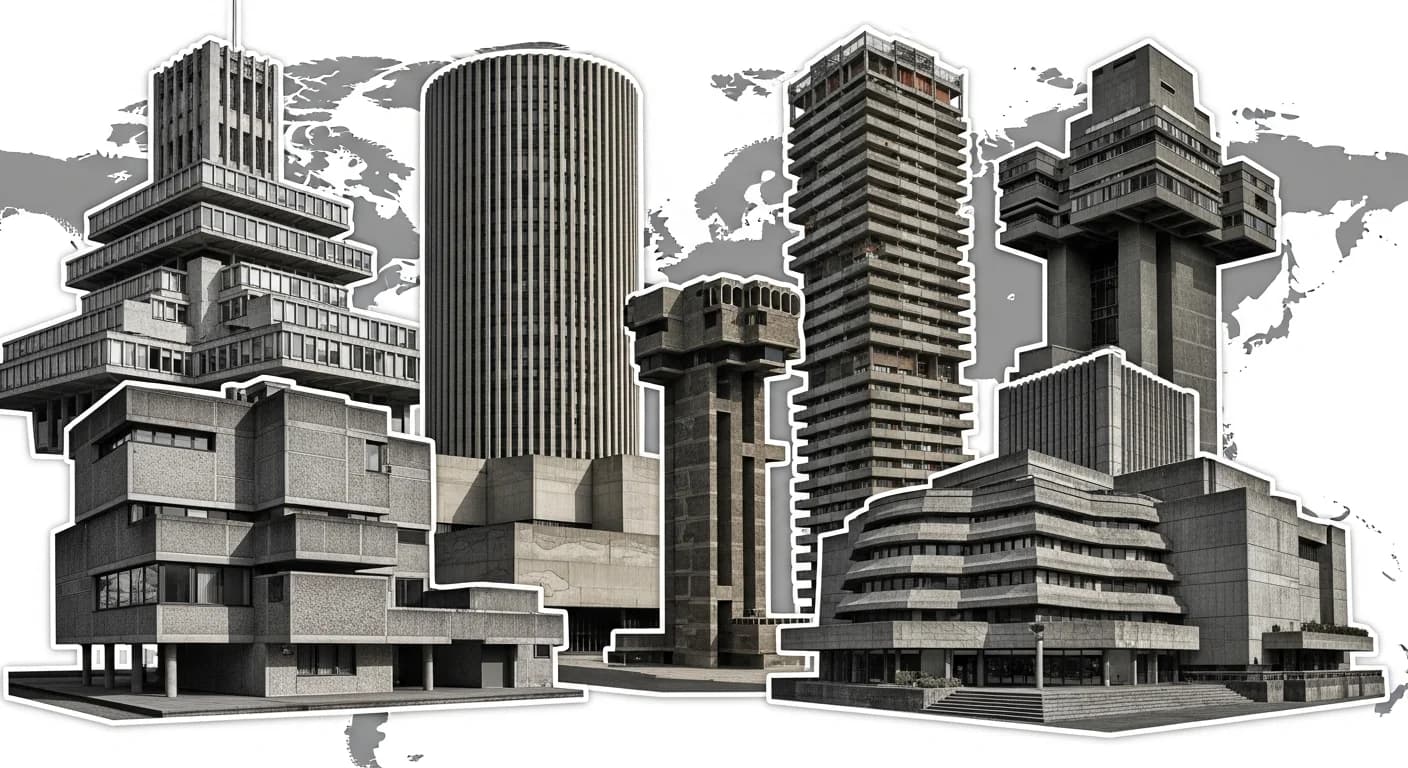
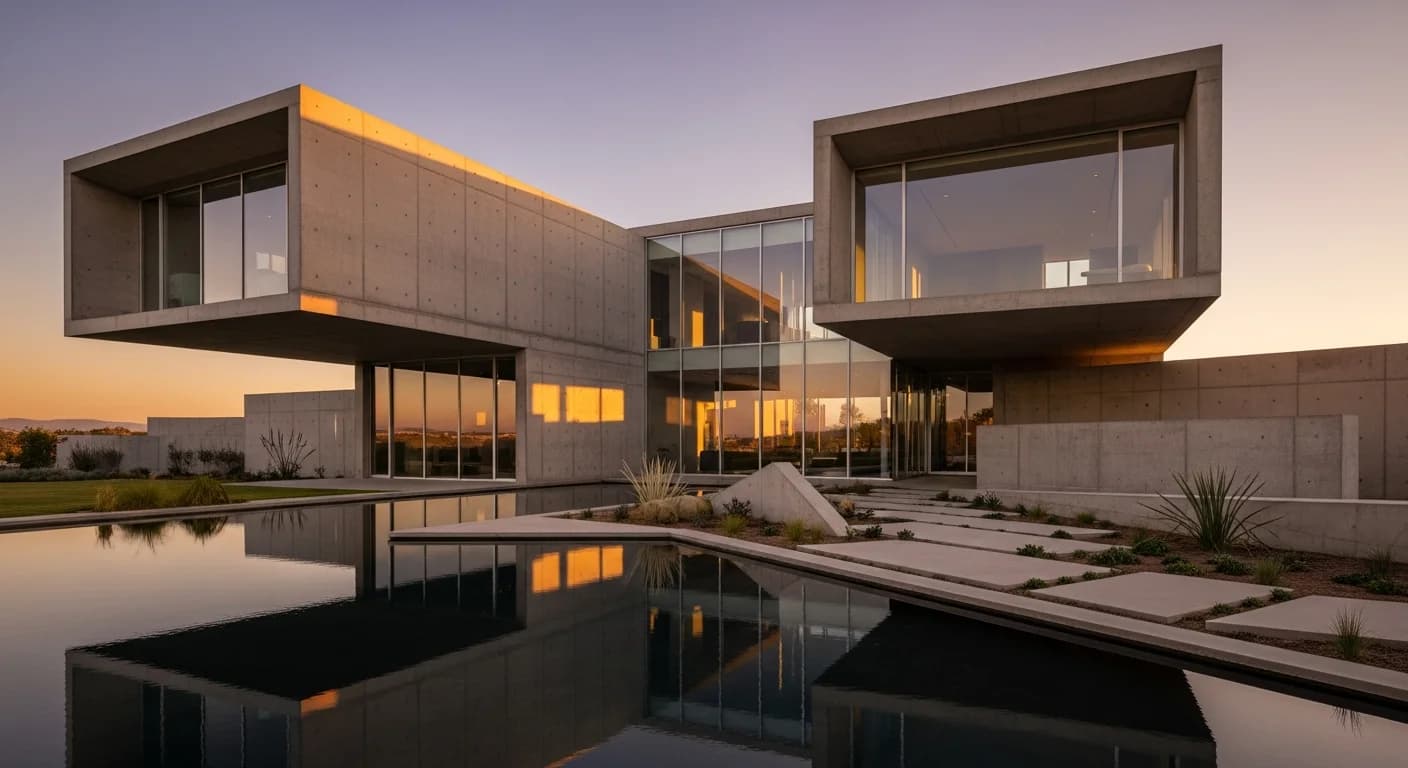
Brutalist Architecture: The Complete Guide to History, Characteristics & Modern Revival
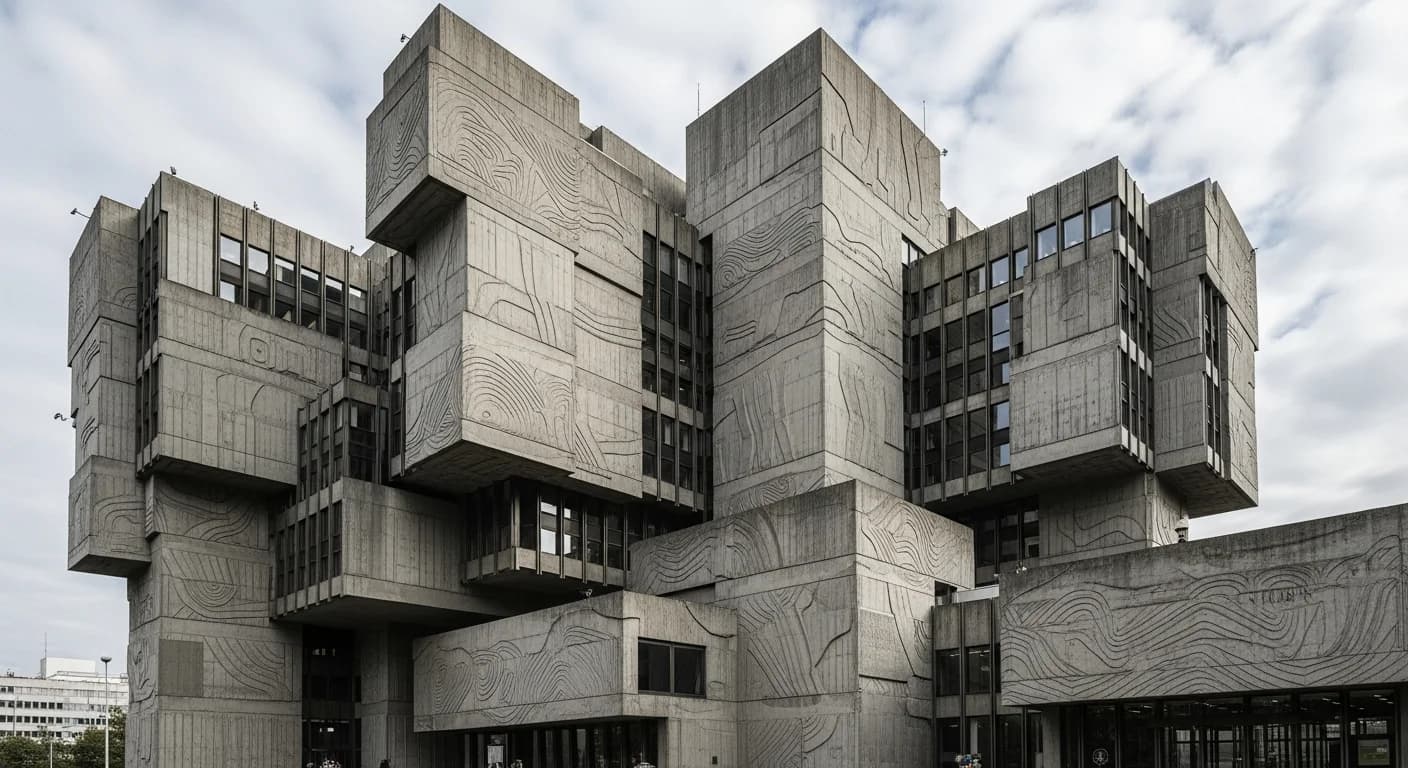
Few architectural styles inspire such passionate debate as brutalist architecture. From President Trump's 2020 executive order banning brutalist designs in federal buildings to the renewed cultural fascination sparked by the Oscar-nominated film The Brutalist, this polarizing style continues to captivate and divide audiences worldwide.
Whether you love the raw honesty of exposed concrete or find these monumental structures cold and imposing, understanding brutalism helps you appreciate one of the 20th century's most influential—and controversial—architectural movements.
This comprehensive guide explores everything from brutalism's post-war origins to its surprising revival in contemporary design, including how you can incorporate brutalist elements into your own home.
What Is Brutalist Architecture?
Brutalist architecture is an architectural style that emerged in the 1950s, characterized by massive geometric forms, raw concrete surfaces, and an uncompromising emphasis on functionality over ornamentation. The style represents a radical branch of modernism that prioritizes honesty in materials and construction.
As architect Geddes Ulinskas explains: "If modernism is about architecture being honest, Brutalist design is about architecture being brutally honest. Forms are as they seem—unadorned and raw."
Quick Identifier: Is It Brutalist?
Look for these defining characteristics:
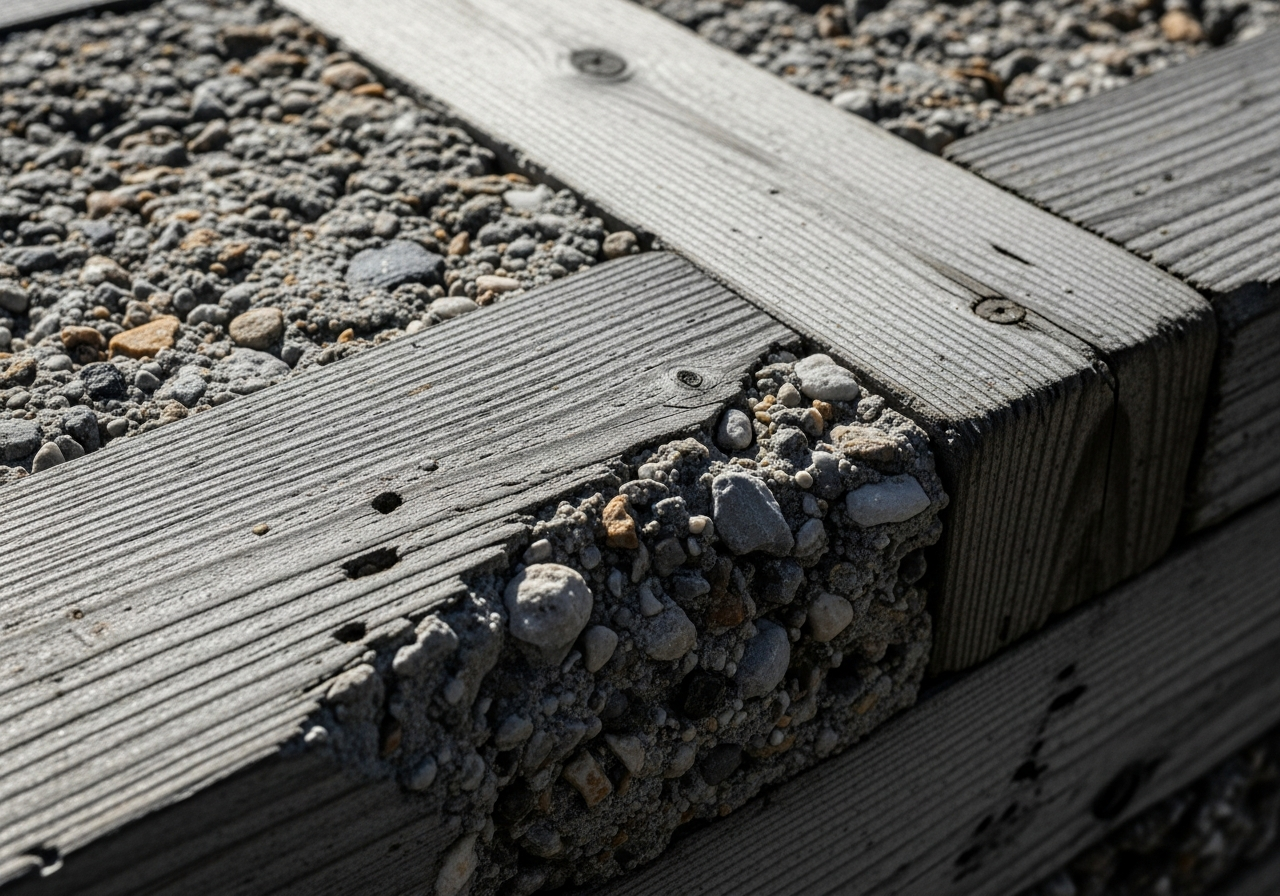
- Raw concrete (béton brut) with visible formwork patterns
- Massive, blocky geometric forms that create visual weight
- Exposed structural elements and building systems
- Modular, repetitive patterns in windows and balconies
- Monochromatic color palettes dominated by grays
- Bold, sculptural silhouettes often defying traditional proportions
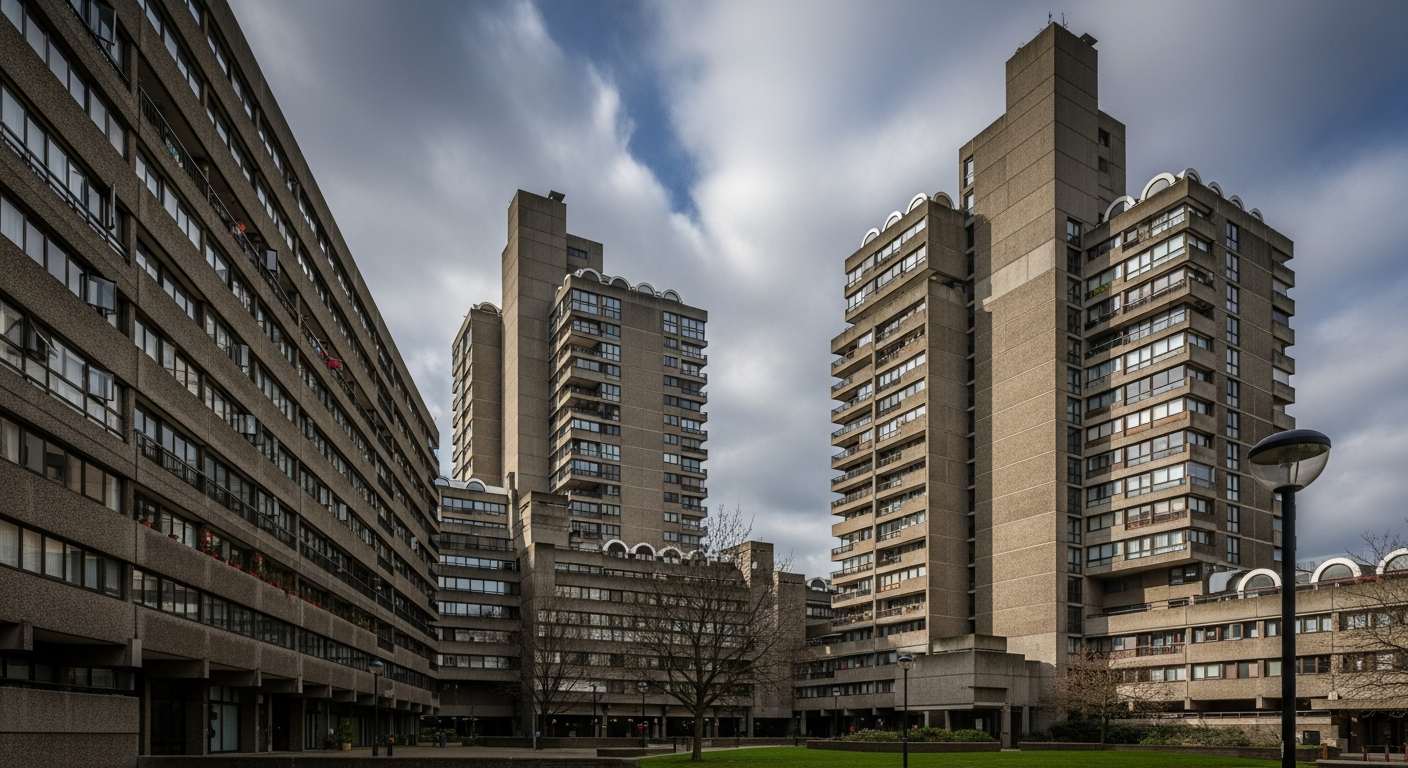
The Etymology: Why Is It Called Brutalism?
Contrary to popular belief, "brutalism" doesn't refer to buildings being "brutal" in the aggressive sense. The term derives from the French phrase béton brut, meaning "raw concrete"—a reference to the unfinished concrete surfaces that define the style.
Swedish architect Hans Asplund first coined the term "nybrutalism" (new brutalism) in 1949 when describing Villa Göth, a modernist brick house in Uppsala, Sweden. The term gained international recognition when British architectural critic Reyner Banham published his influential 1955 essay "The New Brutalism" in Architectural Review.
Banham identified brutalism as both an ethical approach and aesthetic style, praising buildings that hid nothing from viewers: "Whatever has been said about honest use of materials, most modern buildings appear to be made of whitewash or patent glazing, even when they are made of concrete or steel." Brutalist buildings, by contrast, boldly displayed their true construction.
History and Origins of Brutalist Architecture
Brutalism emerged from the post-World War II reconstruction era when architects faced unprecedented challenges: devastated cities, limited resources, and urgent housing needs for displaced populations.
Le Corbusier's Revolutionary Vision (1952)
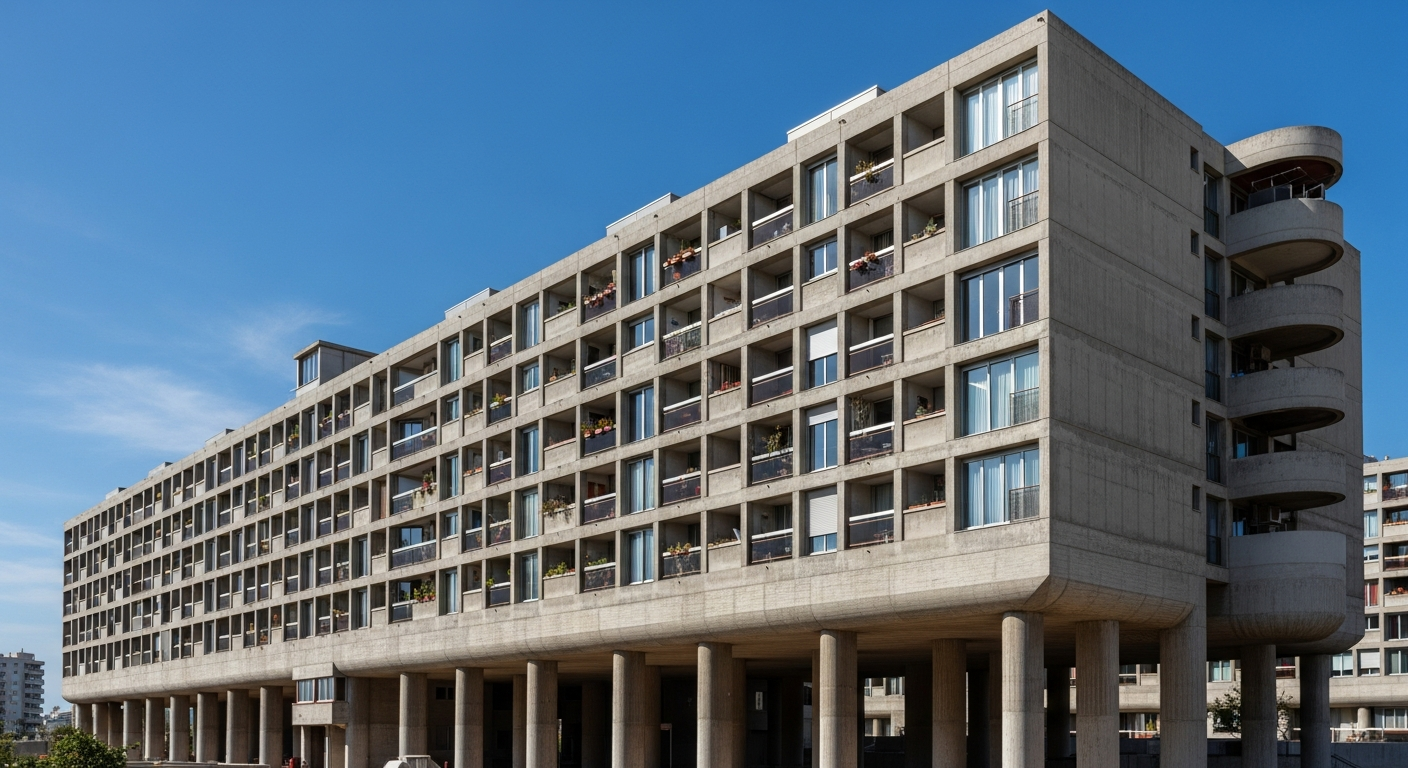
Swiss-French architect Le Corbusier is widely credited with sparking the brutalist movement. His Unité d'Habitation in Marseille, France (1952) became the prototype for brutalist social housing worldwide.
This massive concrete structure housed 1,600 residents in 337 apartments, complete with internal shopping streets and rooftop amenities. Le Corbusier described the building's exposed concrete as "béton brut," inadvertently naming the movement that would follow.
British Pioneers: Alison and Peter Smithson
The movement crystallized in Britain through architects Alison and Peter Smithson, who championed brutalism's ethical dimensions. Their Hunstanton Secondary Modern School (1954) in Norfolk became the first building officially described as "New Brutalist."
The Smithsons saw brutalism as inherently connected to socialist ideals—an architecture that served the working class without pretension. Their later work, Robin Hood Gardens (1972) in East London, became both a celebrated brutalist icon and a cautionary tale about the style's social housing applications.
Global Spread (1960s-1970s)
Brutalism rapidly spread worldwide during the 1960s and 1970s, appealing to governments and institutions seeking to project modernity, power, and democratic accessibility. The style became particularly popular for:
- Universities (Yale, Boston University, SUNY campuses)
- Government buildings (Boston City Hall, FBI Headquarters)
- Cultural institutions (National Theatre London, Barbican Centre)
- Social housing (Trellick Tower, Habitat 67)
Key Characteristics of Brutalist Architecture
Understanding brutalism's defining features helps you identify and appreciate these distinctive buildings.
1. Raw Concrete (Béton Brut)
The signature material of brutalism is exposed reinforced concrete, often showing the texture patterns left by wooden formwork (called "boardmarking"). This deliberate imperfection celebrates the construction process rather than hiding it.
The concrete was sometimes bush-hammered or pick-hammered to reveal the aggregate beneath, creating varied surface textures. These techniques are prominently displayed in London's Barbican Estate and National Theatre.
2. Massive Geometric Forms
Brutalist buildings emphasize weight, scale, and sculptural presence. Unlike the light, glass-heavy structures of International Style modernism, brutalist architecture celebrates mass and solidity.
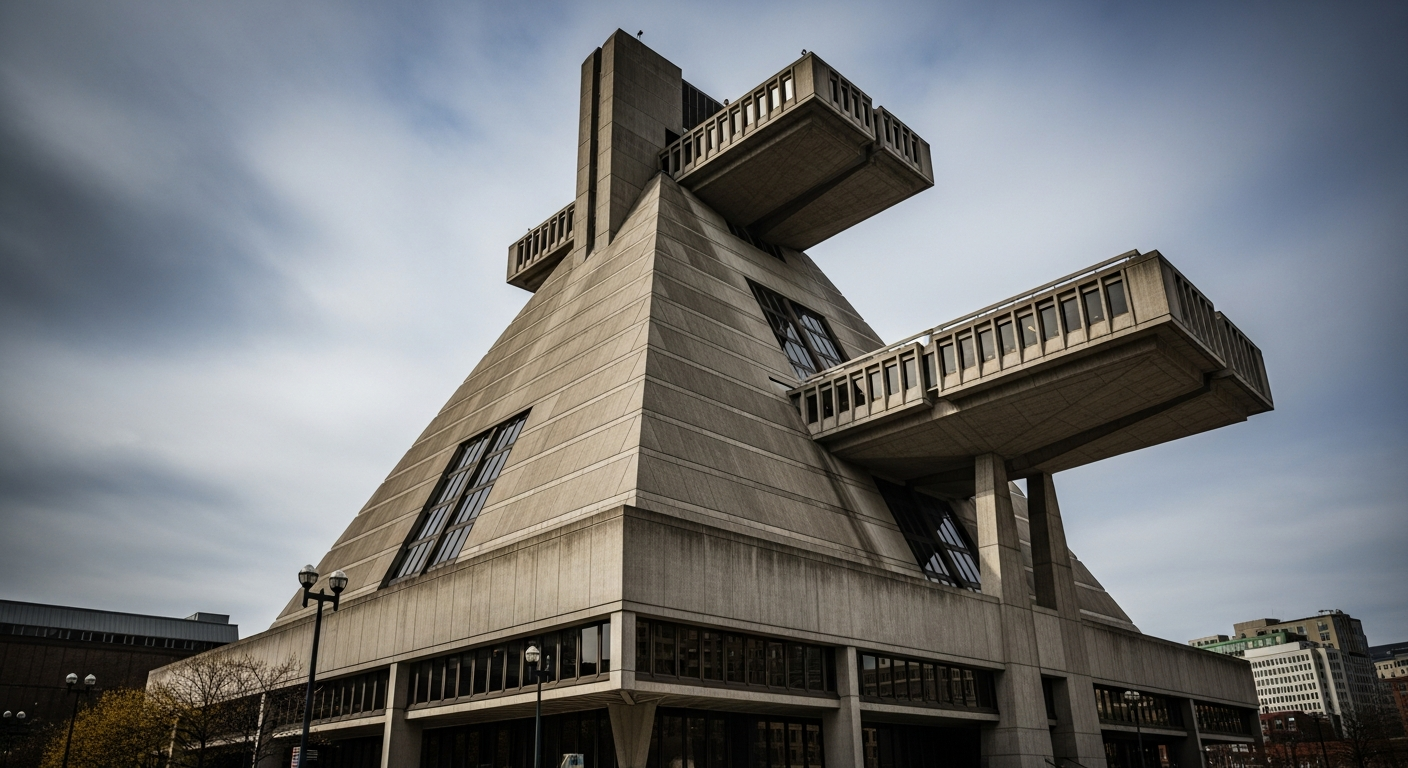
Forms often appear top-heavy, cantilevered, or impossibly balanced—creating visual tension that draws the eye and commands attention. Boston's City Hall exemplifies this approach with its dramatically projecting upper floors.
3. Functional Honesty
Brutalism makes the building's purpose visible from outside. Different functions receive distinct architectural expression: in Boston City Hall, the mayor's office and council chambers project outward, signaling their special civic importance.
This "legibility" was central to Reyner Banham's definition of brutalism: buildings should clearly communicate their internal organization and purpose.
4. Modular Repetition
Many brutalist buildings feature repeating modular elements—identical apartment units, window bays, or structural components. This reflects both industrial construction methods and the socialist ideals of equality that informed many brutalist projects.
Habitat 67 in Montreal takes modularity to an extreme: 354 identical prefabricated concrete boxes stacked to create 158 unique apartments, each with its own roof garden.
5. Exposed Building Systems
Unlike buildings that conceal mechanical systems within walls and ceilings, brutalist structures often celebrate service ducts, ventilation towers, and structural elements as design features.
Iconic Brutalist Buildings Around the World
These landmark structures demonstrate brutalism's global reach and remarkable diversity.
Unité d'Habitation (1952) - Marseille, France
Architect: Le Corbusier
The building that launched brutalism. This "vertical village" pioneered concepts including internal streets, mixed-use programming, and rooftop community amenities that influenced housing design for decades.
Barbican Estate (1965-1976) - London, UK
Architects: Chamberlin, Powell and Bon
Built on a site destroyed during the Blitz, the Barbican is Europe's largest brutalist complex. Its 2,000+ apartments, arts center, schools, and restaurants create a self-contained urban community that has become one of London's most desirable addresses.
Boston City Hall (1968) - Boston, USA
Architects: Kallmann McKinnell & Knowles
Perhaps America's most controversial brutalist building. The massive inverted pyramid has faced multiple demolition threats, yet architectural historians consistently rank it among the nation's most significant modern buildings.
Habitat 67 (1967) - Montreal, Canada
Architect: Moshe Safdie
Originally Safdie's McGill University thesis project, this prefabricated housing experiment for Expo 67 proved that high-density living needn't sacrifice privacy or outdoor space. Its dramatic silhouette remains Montreal's most recognizable architectural landmark.
National Theatre (1976) - London, UK
Architect: Denys Lasdun
Prince Charles famously called it "a clever way of building a nuclear power station in the middle of London." Yet this South Bank landmark has become beloved for its dramatic terraces, theatrical interiors, and commanding Thames-side presence.
Trellick Tower (1972) - London, UK
Architect: Ernő Goldfinger
This 31-story residential tower, once nicknamed the "Tower of Terror" due to crime and neglect, has transformed into one of London's most sought-after brutalist addresses following renovation and improved security.
Geisel Library (1970) - San Diego, USA
Architect: William Pereira
UC San Diego's iconic library appears like a spacecraft landed on the campus. Pereira described the design as "hands holding up a stack of books"—a poetic interpretation of brutalism's functional principles.
Soviet Brutalist Architecture
Soviet brutalist architecture represents a distinct regional variation that merged brutalism's concrete aesthetic with communist ideology and Eastern European building traditions. From the 1960s through the 1980s, the Soviet bloc produced thousands of brutalist structures that remain among the most dramatic examples of the style.
Political Context
For Soviet leaders, brutalism offered an ideal architectural expression of socialist values: collective over individual, function over luxury, the workers' state over bourgeois pretension. The style's monumental scale also served propaganda purposes, projecting state power and modernity.
Unlike Western brutalism's association with democratic institutions, Soviet brutalism became intertwined with authoritarian governance—a connection that later contributed to the style's global decline.
Notable Soviet Brutalist Examples
- Western City Gate (1979) - Belgrade, Serbia: Twin 28-story towers connected by a two-story bridge, dominating the entrance to the Yugoslav capital
- Telecommunications Centre (1989) - Skopje, North Macedonia: A massive complex combining brutalist forms with distinctive regional character
- Polytechnic Institute (1970s) - Minsk, Belarus: A sprawling campus demonstrating Soviet educational architecture
- Spomeniks - Various locations: Abstract memorial monuments scattered across former Yugoslavia, combining brutalist concrete with sculptural expressionism
What Makes Soviet Brutalism Different?
Soviet brutalist buildings often feature:
- Even larger scale than Western counterparts
- Symbolic sculptural elements celebrating socialist themes
- Prefabricated panel construction for rapid mass production
- Integration with urban planning on a city-wide scale
- Less refined detailing due to construction constraints

Brutalist Architecture Interiors
Brutalist architecture interior design translates the movement's raw exterior aesthetic into livable spaces. While brutalist buildings were often criticized for cold public spaces, their residential interiors can be surprisingly warm and inviting.
Key Interior Elements
Exposed Concrete: Interior walls often feature the same raw concrete as exteriors, sometimes with softer textures or painted surfaces to add warmth.
Open Floor Plans: Brutalist interiors typically emphasize spatial flow and volume rather than traditional room divisions.
Industrial Fixtures: Lighting, hardware, and fittings celebrate function with minimal ornamentation—exposed bulbs, metal conduit, and simple geometric forms.
Natural Light: Despite heavy concrete exteriors, brutalist buildings often feature carefully designed fenestration that floods interiors with natural light.
Living in Brutalist Spaces
Residents of Barbican Estate apartments and other brutalist residences often describe unexpected coziness. The key is balancing concrete's coldness with:
- Warm textiles: Area rugs, curtains, and upholstered furniture soften hard surfaces
- Wood accents: Natural wood furniture and flooring provide warmth and texture contrast
- Plants: Greenery brings life and color to monochromatic spaces
- Layered lighting: Multiple light sources at different heights create intimacy
- Bold art: Large-scale artwork complements brutalism's dramatic proportions
Incorporating Brutalist Design at Home
You don't need to live in a brutalist building to embrace the aesthetic. Consider these approaches:
- Concrete accent walls: Poured concrete or concrete-look panels create focal points
- Geometric furniture: Chunky, angular pieces echo brutalist forms
- Industrial fixtures: Exposed bulbs, metal finishes, and minimal ornament
- Monochromatic palette: Grays, charcoals, and earth tones with strategic color accents
- Textured surfaces: Board-formed concrete, rough stone, or textured plaster
Want to visualize brutalist-inspired design in your space? HanoDecor's AI tools can transform your room photos to show how these elements might look in your home.

Modern Brutalism and Neo-Brutalism
After decades of neglect, brutalism has experienced a remarkable revival. Modern brutalist architecture and neo-brutalism are thriving in contemporary design, driven by renewed appreciation for the style's honest materiality and photogenic qualities.
The Instagram Effect
Social media has played a surprising role in brutalism's comeback. The hashtag #brutalism has accumulated over 500,000 Instagram posts, with photographers and architecture enthusiasts sharing dramatic images of concrete structures. The style's strong geometric forms and textured surfaces prove remarkably photogenic.
Conservation Movements
Preservation groups worldwide now fight to protect brutalist buildings from demolition. Organizations like the Twentieth Century Society (UK) and Docomomo International have successfully campaigned for landmark status for threatened brutalist structures.
New Brutalist Buildings
Contemporary architects are designing new buildings that reference brutalist principles while incorporating modern sustainability standards and construction techniques. Neo-brutalism adapts the aesthetic for 21st-century needs:
- Sustainable concrete: Low-carbon concrete mixtures reduce environmental impact
- Improved insulation: Modern thermal performance without sacrificing aesthetic
- Mixed materials: Concrete combined with wood, glass, and metal for variety
- Refined detailing: Higher construction quality than historical examples
Why Is Brutalism Making a Comeback?
Theories about brutalism's revival include:
- Authenticity seeking: In an era of disposable design, brutalism's permanence appeals
- Anti-minimalism: A reaction against bland contemporary architecture
- Historical distance: Enough time has passed to view brutalism without Cold War associations
- Design influence: Brutalist aesthetics have spread to furniture, fashion, and product design
The Controversy: Why People Love and Hate Brutalism
No architectural style generates such polarized reactions. Understanding both perspectives helps explain brutalism's enduring fascination.
The Case Against Brutalism
- "Cold" and "inhuman": Critics find concrete structures alienating and unwelcoming
- Authoritarian associations: Connection to Soviet and institutional power
- Poor aging: Concrete stains, cracks, and decays without careful maintenance
- Social housing failures: Many brutalist housing projects became crime-ridden and neglected
- Scale and context: Massive buildings often clash with surrounding architecture
The Case For Brutalism
- Honest materials: No pretense or false surfaces—what you see is what you get
- Democratic access: Buildings designed for public use, not private wealth
- Sculptural beauty: Dramatic forms and textures create visual interest
- Durability: Properly maintained concrete structures last indefinitely
- Historical significance: Important chapter in architectural evolution
Frequently Asked Questions
Why is it called brutalism?
The term comes from the French "béton brut" meaning "raw concrete," not from the English word "brutal." Swiss architect Hans Asplund first used "nybrutalism" in 1949, and British critic Reyner Banham popularized the term in 1955.
Is brutalism the same as minimalism?
No. While both styles reject ornamentation, brutalism emphasizes mass, weight, and texture, while minimalism emphasizes lightness and absence. Brutalist buildings feel heavy and substantial; minimalist buildings feel spare and ethereal.
What's the difference between brutalism and modernism?
Brutalism is a specific branch of modernism. While modernist architecture emphasizes function, brutalism adds emphasis on raw materials, exposed construction, and monumental scale. All brutalist buildings are modern, but not all modern buildings are brutalist.
Is brutalist architecture making a comeback?
Yes. Since approximately 2015, brutalism has experienced significant revival through social media appreciation, conservation movements, and new buildings designed in neo-brutalist styles. The architectural press now regularly features brutalist structures, and preservation efforts have protected many threatened buildings.
What are the main characteristics of brutalist buildings?
Key characteristics include: raw exposed concrete (béton brut), massive geometric forms, modular repetitive elements, exposed structural and mechanical systems, monochromatic color palettes, and functional honesty where internal uses are expressed externally.
Where can I see brutalist architecture?
Notable examples exist worldwide: London (Barbican, National Theatre, Trellick Tower), Boston (City Hall), Montreal (Habitat 67), Marseille (Unité d'Habitation), and throughout Eastern Europe. Many universities built brutalist campus buildings in the 1960s-70s.
The Enduring Legacy of Raw Concrete
Love it or hate it, brutalist architecture has earned its place in architectural history. These buildings represent a bold experiment in honest, functional design that shaped cities worldwide and continues to influence contemporary architecture.
As we reconsider brutalism with fresh eyes—unburdened by Cold War politics and aided by social media's visual appreciation—many find beauty in what earlier generations dismissed. The style's emphasis on materials, craftsmanship, and social purpose resonates with contemporary concerns about authenticity and sustainability.
Whether you're exploring brutalist landmarks, appreciating #brutalism photography, or considering brutalist elements for your own home, understanding this controversial movement enriches your appreciation of the built environment.
Curious how brutalist design elements might look in your space? Try HanoDecor's AI visualization tools to experiment with concrete textures, industrial fixtures, and geometric forms in your own rooms.
Brutalist Architecture FAQs
Written by
James Park
Architectural Design Advisor specializing in exterior remodeling, siding systems, and structural home improvements. Licensed architect with 18 years of residential project experience.