Soviet Brutalist Architecture: Concrete Monuments of a Fallen Empire

Quick Overview
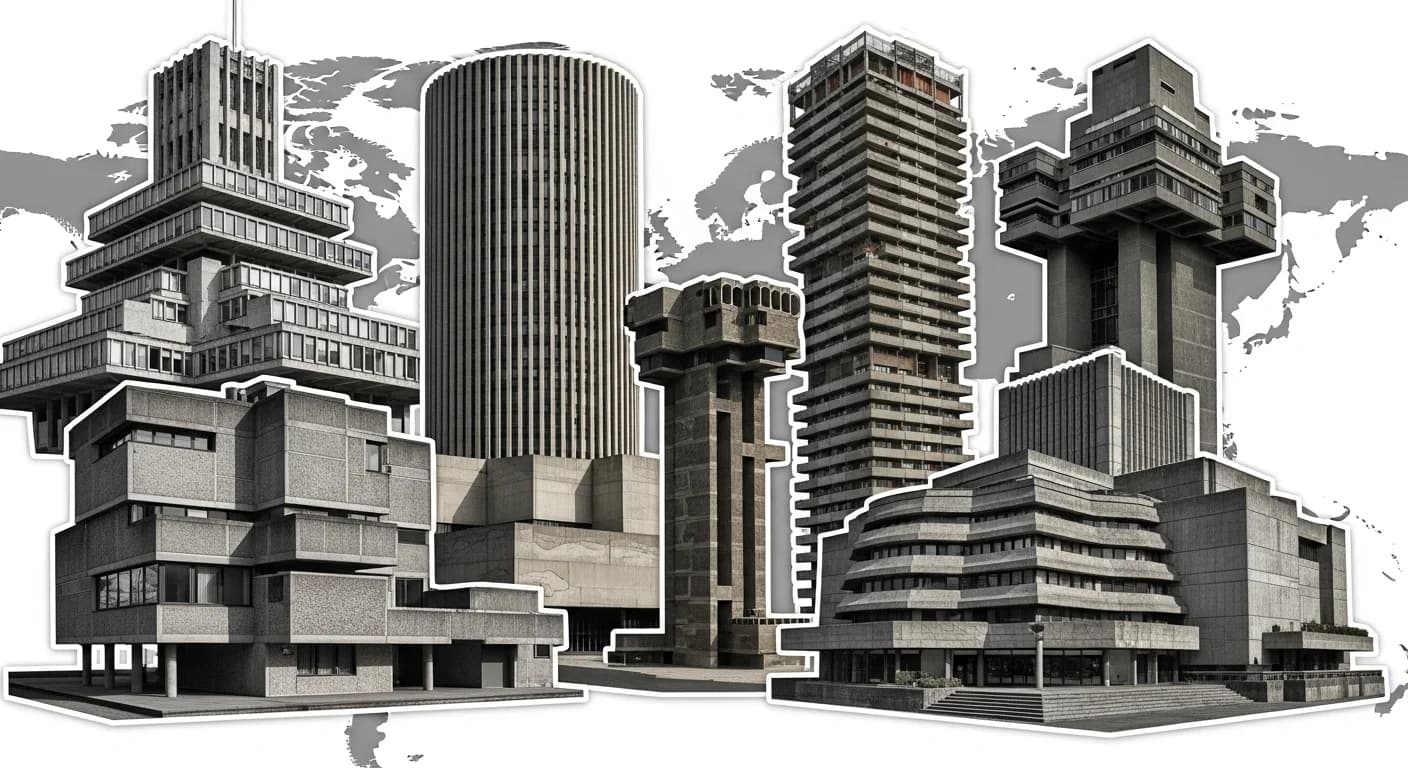
Soviet brutalist architecture stands as one of the most powerful and polarizing architectural legacies of the twentieth century. Born from the intersection of communist ideology, postwar reconstruction, and raw concrete ambition, these structures stretch across a vast geographic expanse from Kaliningrad on the Baltic Sea to Tbilisi in the Caucasus Mountains, from the wide boulevards of Moscow to the memorial landscapes of the former Yugoslavia.
What makes Soviet brutalism distinct from its Western counterpart is its fundamental purpose. While Western brutalism emerged from individual architects expressing social ideals through bold form, Soviet brutalism was state-commissioned architecture on an unprecedented scale. These buildings were instruments of ideology, designed to project the power, permanence, and egalitarian promise of the socialist state. Every monumental civic center, every housing block, every memorial sculpture carried the weight of political meaning embedded in poured concrete.
Today, these concrete monuments face an uncertain future. Some have been demolished as symbols of oppression. Others have been recognized as masterworks of twentieth-century architecture and gained heritage protection. The tension between these impulses, between erasure and preservation, defines the ongoing story of Soviet brutalist architecture and why it continues to captivate architects, photographers, and cultural tourists decades after the empire that built it collapsed.
For a broader context on brutalism's global history, characteristics, and modern revival, see our complete guide to brutalist architecture.
Brutalism as Political Expression
The Soviet Union adopted brutalism not merely as an architectural style but as a political language. After Stalin's death in 1953 and Khrushchev's subsequent denunciation of the excessive ornamentation of Stalinist architecture, the USSR pivoted dramatically toward modernist construction methods. Concrete became the material of socialist progress: honest, strong, egalitarian, and infinitely reproducible.
This shift was codified in the 1955 Soviet decree "On the Elimination of Excesses in Design and Construction," which effectively banned the wedding-cake towers and ornamental facades of the Stalinist era. In their place rose buildings of raw concrete and repetitive geometric form that prioritized function and ideological symbolism over decorative excess.
The distinction between Soviet and Western brutalism runs deeper than patronage. Western brutalist architects like the Smithsons in Britain worked within democratic societies, proposing brutalism as a form of social architecture that served communities. Soviet brutalism served the state first. Buildings were designed to impress upon citizens the scale and permanence of the socialist project, to make individuals feel simultaneously protected and subordinate to something vastly larger than themselves.
This dual quality of shelter and intimidation gives Soviet brutalist architecture its distinctive emotional register. These buildings can feel simultaneously utopian and dystopian, protective and oppressive, awe-inspiring and deeply unsettling. It is precisely this emotional complexity that draws millions of visitors, photographers, and architecture enthusiasts to Soviet brutalist sites each year.
Russia: The Motherland of Soviet Concrete
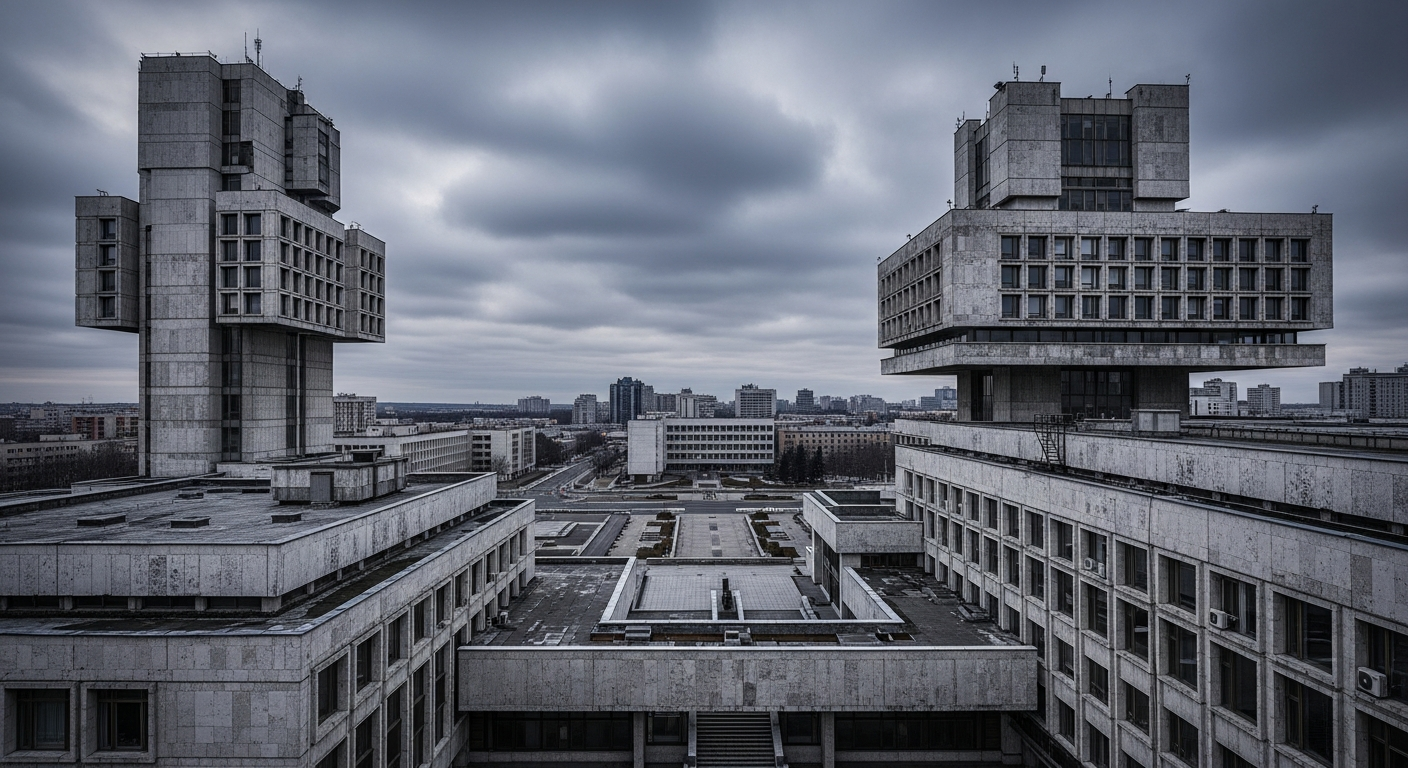
Moscow and Saint Petersburg contain the densest concentration of Soviet brutalist architecture, reflecting the capital's role as the ideological center of the communist project. The cityscape of Moscow is dominated by structures that embody the raw power aesthetic of state brutalism.
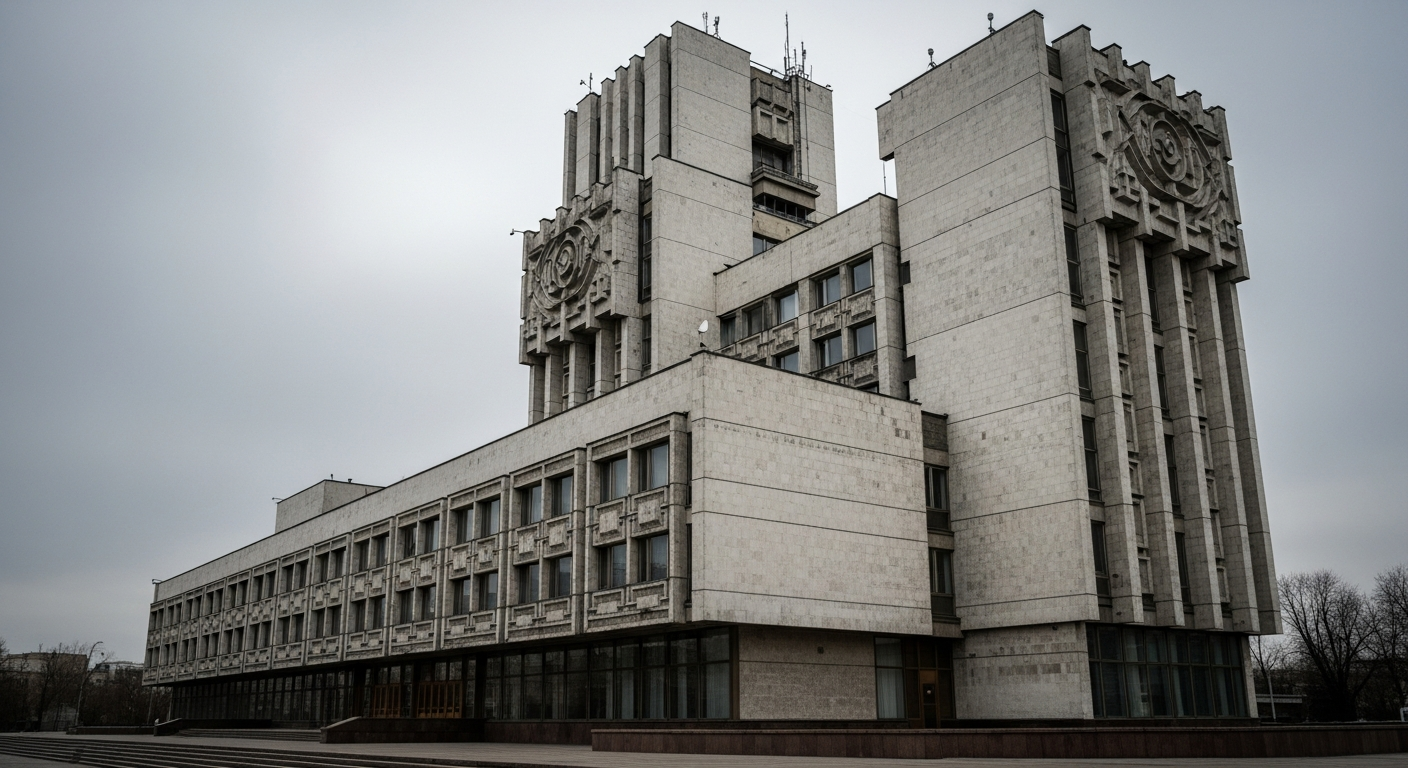
The House of Soviets in Kaliningrad stands as perhaps the most infamous example of Russian brutalism. Built on the ruins of the Prussian Konigsberg Castle, this massive concrete administrative building was never completed and has stood as a haunting concrete skeleton since the 1980s. Its incomplete state has made it both a symbol of Soviet ambition and Soviet decay, a monument to plans that outlived the state that conceived them.
The Presidium of the Russian Academy of Sciences, known colloquially as the "Golden Brains" building for its distinctive gilded crown structure, rises above Moscow's skyline as a striking example of late Soviet brutalism. Completed in 1990, just one year before the USSR dissolved, it represents the final flowering of Soviet monumental architecture.
In Saint Petersburg, the brutalist legacy manifests in civic buildings and research institutions that contrast dramatically with the city's famous baroque and neoclassical architecture. The Leningrad Television Tower and surrounding technical buildings showcase the utilitarian precision of Soviet engineering translated into architectural form.
Beyond the major cities, Russian brutalism extends to scientific research centers like Akademgorodok in Siberia and industrial cities across the Urals, where entire communities were built in prefabricated concrete panels according to standardized plans distributed from Moscow.
Yugoslav Brutalism and the Spomenik Monuments
Yugoslavia occupies a unique position in the story of Soviet-sphere brutalism. Tito's break with Stalin in 1948 meant that Yugoslav architecture developed along a distinctly independent path, producing some of the most extraordinary brutalist structures anywhere in the world. The spomenik monuments, memorial sculptures commemorating World War II and the Partisan resistance, represent an artistic achievement that transcends the category of architecture entirely.
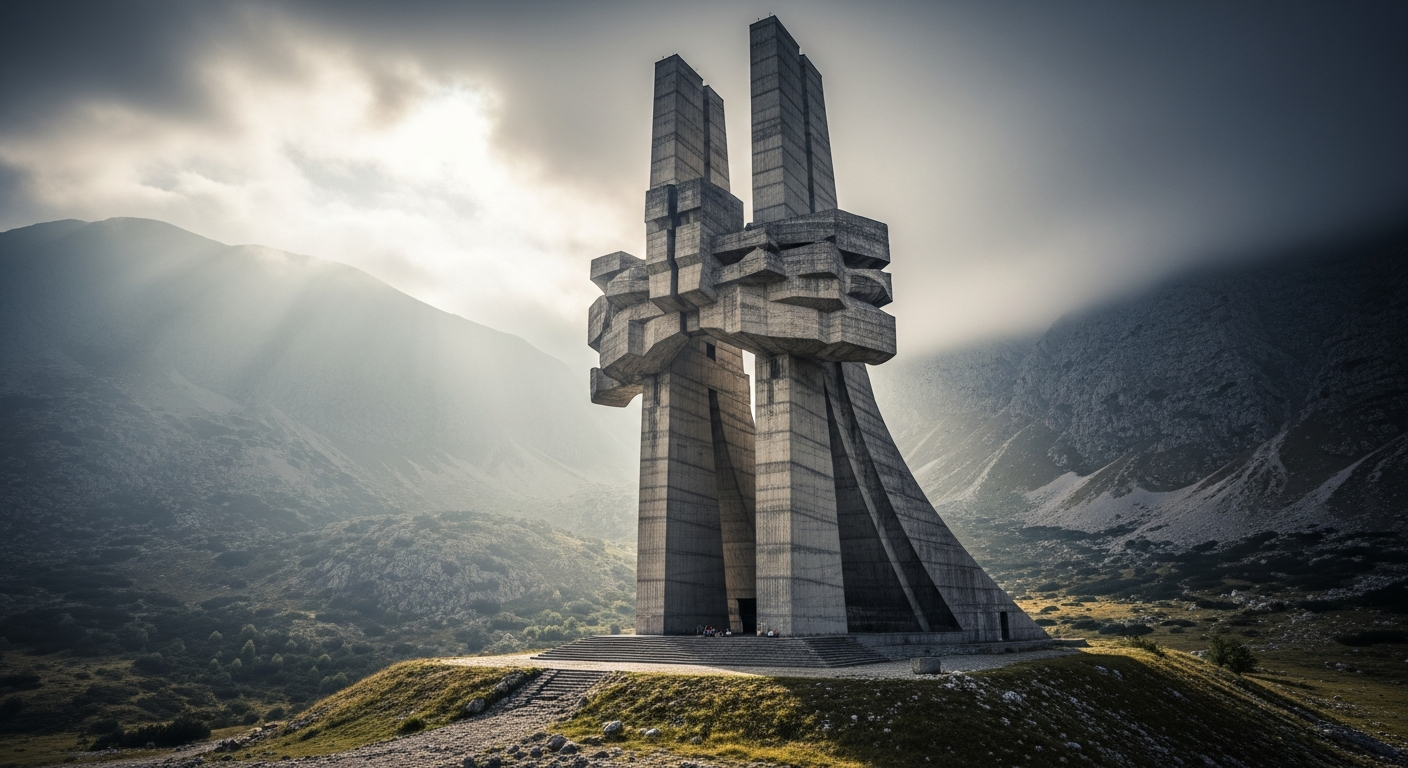
These monuments, scattered across the landscapes of present-day Croatia, Serbia, Bosnia and Herzegovina, North Macedonia, Montenegro, and Slovenia, are abstract concrete and steel sculptures of staggering scale and ambition. The Tjentiste War Memorial in Bosnia, designed by Miodrag Zivkovic, features massive wing-like concrete forms that split open to frame mountain views. The Kosmaj Monument near Belgrade rises like an alien star from a hilltop. The Ilinden Monument in Krusevo, North Macedonia, resembles a futuristic dome emerging from the earth.
What distinguishes the spomenik monuments from conventional Soviet war memorials is their radical abstraction. While Soviet memorials typically featured realistic sculpture of soldiers and workers, Yugoslav architects were given artistic freedom to create abstract forms that expressed grief, defiance, and hope through pure geometry and material presence. The result is a body of work that belongs as much to the history of sculpture as to architecture.
In Skopje, the city center rebuilt after the devastating 1963 earthquake by Kenzo Tange offers another dimension of Yugoslav brutalism. Tange's masterplan, commissioned by the UN, brought Japanese Metabolist ideas into the Balkan context, producing a unique hybrid of Eastern and Far Eastern brutalist thinking.
Georgian and Caucasus Brutalism
Georgia produced some of the most imaginative and structurally daring brutalist architecture in the entire Soviet sphere. The relative autonomy that Georgian architects enjoyed within the Soviet system allowed for creative expression that pushed the boundaries of what concrete could do.

The Ministry of Highways in Tbilisi, designed by George Chakhava and completed in 1975, is arguably the single most iconic piece of Soviet brutalist architecture. Its interlocking horizontal blocks, stacked in a zigzag pattern and cantilevered over the road below, create a building that appears to defy gravity. The structure has been called the most futuristic building of the Soviet era and continues to function as a government office building today.
Tbilisi's Palace of Ceremonies, designed by Victor Jorbenadze in 1984, is a sweeping concrete structure that appears to grow organically from its hillside site. Its flowing forms, unusual for brutalist architecture, demonstrate how Georgian architects stretched the vocabulary of concrete beyond the rectilinear rigidity typical of Soviet construction.
The Technical Library of Tbilisi, the ceremonial halls of Chiatura, and various resort buildings along the Black Sea coast further illustrate the remarkable creativity of Georgian brutalism. These buildings demonstrate that within the constraints of Soviet state architecture, individual artistic vision could produce structures of genuine originality and beauty.
Mass Housing: The Khrushchyovka and Panelak
No discussion of Soviet brutalist architecture is complete without addressing mass housing, the most visible and controversial legacy of Soviet construction. The khrushchyovka apartment blocks, named after Nikita Khrushchev who initiated their construction in the late 1950s, represent the largest housing program in human history.

These five-story prefabricated concrete buildings were designed for speed and economy above all else. Standardized floor plans, produced in factories and assembled on-site, allowed the Soviet Union to house millions of people who had been living in communal apartments, basements, and barracks since the postwar period. Between 1959 and 1985, the USSR built approximately 290 million square meters of khrushchyovka housing, providing homes for roughly 127 million people.
The Czech and Slovak panelak, the East German Plattenbau, and the Hungarian panel buildings followed similar principles adapted to local conditions. In East Germany alone, the Plattenbau program produced housing for approximately one-third of the population. The Halle-Neustadt development, built as a model socialist city in the 1960s, housed 90,000 residents in a landscape of prefabricated concrete blocks arranged according to modernist urban planning principles.
The micro-district or mikrorayon planning model organized these housing blocks into self-contained neighborhoods with schools, clinics, shops, and recreational facilities within walking distance. This planning approach, whatever its aesthetic limitations, represented a genuine attempt to provide equitable access to services and amenities for all residents regardless of social position.
Today, these housing blocks face divergent fates across the former Eastern Bloc. In Moscow, the renovation program has demolished thousands of khrushchyovkas and replaced them with modern high-rises. In the Baltic states, many panel buildings have been renovated with insulation, colorful facades, and modern windows. In parts of Ukraine and rural Russia, deteriorating panel housing remains the primary shelter for millions of people, a utilitarian legacy that outlives the ideology that created it.
The Baltic States and Ukraine
The Baltic republics of Estonia, Latvia, and Lithuania developed their own variations of Soviet brutalism, inflected by their distinct cultural identities and their pre-Soviet architectural traditions. Riga's Latvian Academy of Sciences, though constructed in Stalinist style, sits alongside later brutalist additions that reflect the transition to concrete modernism. Tallinn's Linnahall, a massive waterfront concert hall and leisure complex completed in 1980 for the Moscow Olympics sailing events, is a horizontal concrete landscape that merges architecture with topography.
In Ukraine, the brutalist legacy is concentrated in Kyiv and Kharkiv, where ambitious civic buildings and housing developments demonstrate the scale of Soviet construction. The Kyiv Crematorium, a remarkable piece of ceremonial architecture with its dramatic concrete canopy, and the Salut Hotel with its distinctive cylindrical form represent the diversity of Ukrainian brutalist design. The ongoing conflict has added tragic urgency to questions of architectural preservation, as buildings face destruction from warfare rather than deliberate demolition or neglect.
Dystopian Aesthetics and Cultural Impact
Soviet brutalist architecture has become deeply embedded in contemporary popular culture, particularly through its association with dystopian aesthetics. Films, video games, music videos, and fashion photography frequently use Soviet brutalist buildings as backdrops to evoke feelings of alienation, totalitarian control, and post-apocalyptic desolation.
This cultural appropriation raises important questions about how architecture is perceived across time and cultural context. Buildings designed as expressions of socialist optimism and collective progress are now widely read as symbols of oppression and conformity. The very qualities that made them powerful as political architecture, their scale, repetition, and raw material honesty, now register as threatening rather than protective.
Social media has amplified this aesthetic fascination. Instagram accounts dedicated to Soviet architecture attract millions of followers. The hashtag #sovietbrutalism generates continuous content from travelers and photographers exploring these structures. This digital attention has contributed directly to preservation efforts, as public awareness of architectural significance grows through viral photography and documentary filmmaking.
The 2024 film "The Brutalist," while focused on a fictional Hungarian architect in postwar America, brought renewed mainstream attention to brutalist architecture and its emotional power. The film's critical acclaim and awards recognition further cemented public interest in the movement and its practitioners.
Preservation vs. Demolition
The fate of Soviet brutalist architecture is actively contested across every country where it stands. Three competing impulses drive the debate: preservation as cultural heritage, demolition as symbolic rejection of the Soviet past, and pragmatic renovation to meet contemporary needs.
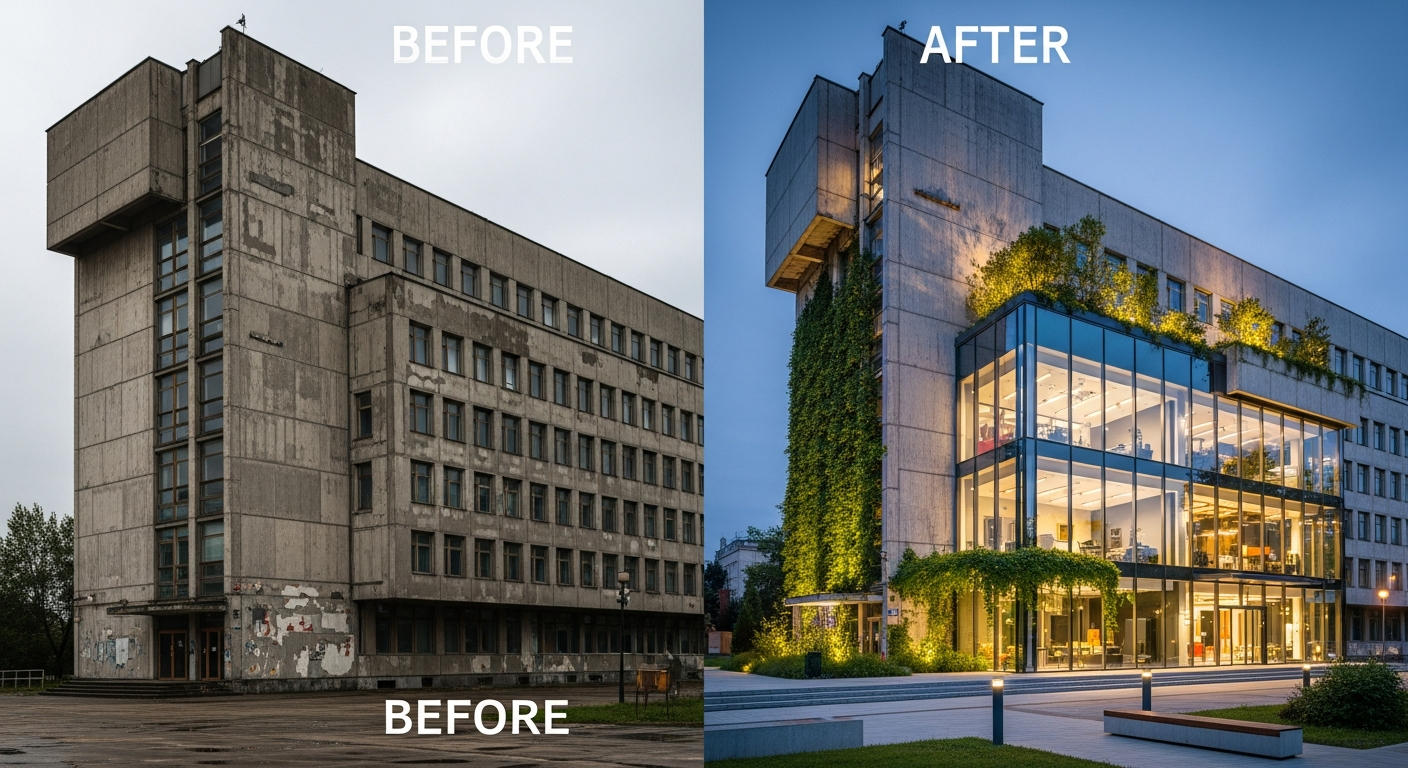
In Georgia, the Ministry of Highways has been recognized as a masterwork and continues to serve its original function. In contrast, Moscow's ongoing renovation program has demolished hundreds of khrushchyovka blocks without architectural assessment, erasing entire neighborhoods of postwar concrete. The demolition of Tokyo's Nakagin Capsule Tower in 2022, while not Soviet, demonstrated how quickly brutalist landmarks can disappear when economic pressures override heritage values.
Organizations like the Modernist Society, Docomomo International, and local preservation groups across Eastern Europe advocate for the recognition and protection of significant Soviet brutalist structures. Their work involves documenting buildings, nominating them for heritage lists, proposing adaptive reuse strategies, and raising public awareness of their architectural value.
Adaptive reuse offers perhaps the most promising path forward. Converting Soviet brutalist buildings to cultural centers, creative workspaces, galleries, and community facilities preserves their architectural significance while giving them contemporary relevance. The successful conversion of several Soviet-era buildings into hotels, restaurants, and cultural venues across the Baltic states and Georgia demonstrates that these structures can serve new purposes while retaining their monumental character.
For more on how brutalist architecture is being reimagined for contemporary use, see our guide to modern and neo-brutalist architecture.
Frequently Asked Questions
Why does Soviet architecture look so imposing?
Soviet architecture was designed to project state power and the permanence of the socialist system. Scale, repetition, and raw concrete were used deliberately to create an emotional response of awe and subordination. The buildings were political statements as much as functional structures.
Is Soviet brutalist architecture the same as Stalinist architecture?
No. Stalinist architecture, dominant from the 1930s to 1955, featured ornamental neoclassical styles with columns, spires, and decorative details. Soviet brutalism emerged after 1955 when Khrushchev banned architectural excess and promoted modernist construction methods. The two styles are dramatically different in appearance and philosophy.
Can you visit Soviet brutalist buildings?
Yes. Most Soviet brutalist buildings in major cities are accessible. Many civic buildings, cultural centers, and housing complexes are in active use. Cities like Tbilisi, Belgrade, and Tallinn have organized brutalist architecture walking tours. Our famous brutalist buildings city guide covers visiting tips for major locations.
Are Soviet brutalist buildings being demolished?
Some are. Moscow's renovation program has demolished thousands of khrushchyovka blocks. Other significant buildings across Eastern Europe face neglect and demolition pressure. However, preservation efforts are growing, with notable buildings gaining heritage protection in Georgia, the Baltic states, and the former Yugoslavia.
What is a spomenik?
Spomenik is the Serbian and Croatian word for monument. It refers specifically to the abstract memorial sculptures built across Yugoslavia from the 1960s through the 1980s to commemorate World War II and the Partisan resistance. These concrete and steel monuments are recognized as a unique artistic achievement within the broader brutalist movement.
Bring Brutalist Inspiration Into Your Home
Soviet brutalist architecture demonstrates the raw power of exposed concrete, bold geometric forms, and monumental scale. While your home may not be a monument to an ideology, the material honesty and textural richness of brutalist design can transform residential interiors into spaces of dramatic beauty.
Explore how concrete accent walls, industrial textures, and angular geometric forms can work in your own rooms. Our brutalist interior design guide shows you how to bring these elements home, while our AI Room Designer lets you see brutalist materials and forms in your actual space before committing to any changes.
See how raw concrete finishes, exposed structural elements, and bold geometric details can transform your rooms with HanoDecor's AI visualization tools.
Soviet Brutalist Architecture FAQs
Written by
James Park
Architectural Design Advisor specializing in exterior remodeling, siding systems, and structural home improvements. Licensed architect with 18 years of residential project experience.