How to Redesign Kitchen Countertops: 2026 Materials and Cost Comparison
Quick Summary
This comprehensive guide compares the most popular kitchen countertop materials for 2026, including quartz, granite, marble, butcher block, and laminate. You'll learn the cost per square foot, durability, maintenance requirements, and best uses for each material to make the right choice for your kitchen redesign.
How to Redesign Kitchen Countertops: 2026 Materials and Cost Comparison
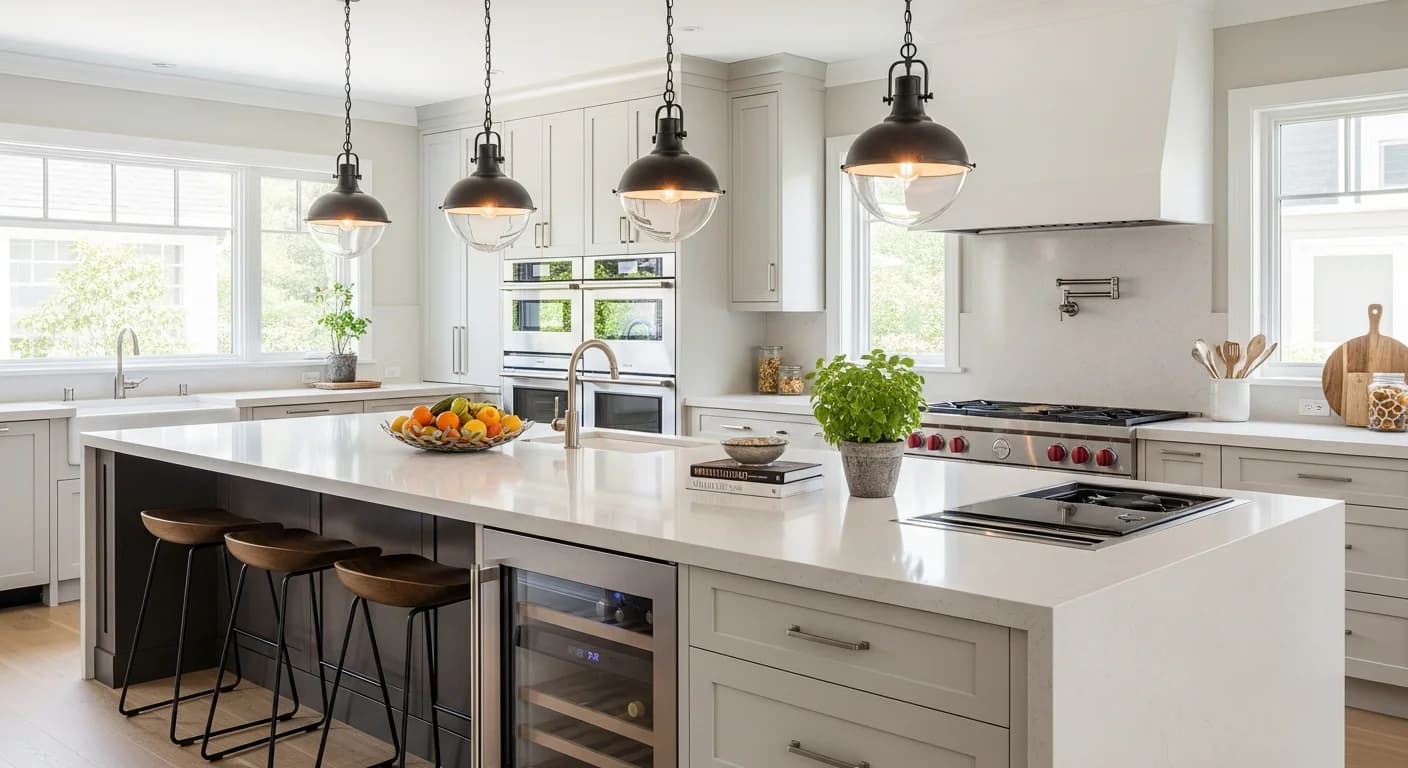
Understanding how to redesign kitchen countertops is one of the highest-impact changes you can make in a kitchen renovation. Countertops cover more visible surface area than almost any other element, and they influence everything from daily meal prep to how your kitchen photographs in listing photos. The right countertop material can transform a dated kitchen into a modern showcase — while the wrong choice can lead to years of maintenance headaches.
In 2026, homeowners have more countertop options than ever, ranging from engineered quartz and natural stone to sustainable recycled materials and ultra-compact surfaces. Prices span from $15 per square foot for basic laminate to $200 or more per square foot for exotic natural stone. This guide breaks down every major material option, compares costs and durability, and helps you choose the best countertop for your kitchen, budget, and lifestyle.
Not sure how a new countertop will look in your space? Use HanoDecor's kitchen remodel visualizer to upload a photo of your current kitchen and see different countertop materials and colors before you visit a showroom.
Kitchen Countertop Materials Compared: 2026 Guide
Choosing the right countertop material depends on five key factors: durability (how well it resists scratches, heat, and stains), maintenance (daily care and periodic sealing requirements), aesthetics (color options, patterns, edge profiles), cost (material plus fabrication and installation), and resale value (how buyers perceive the material). Below, we compare the seven most popular options across all five factors.
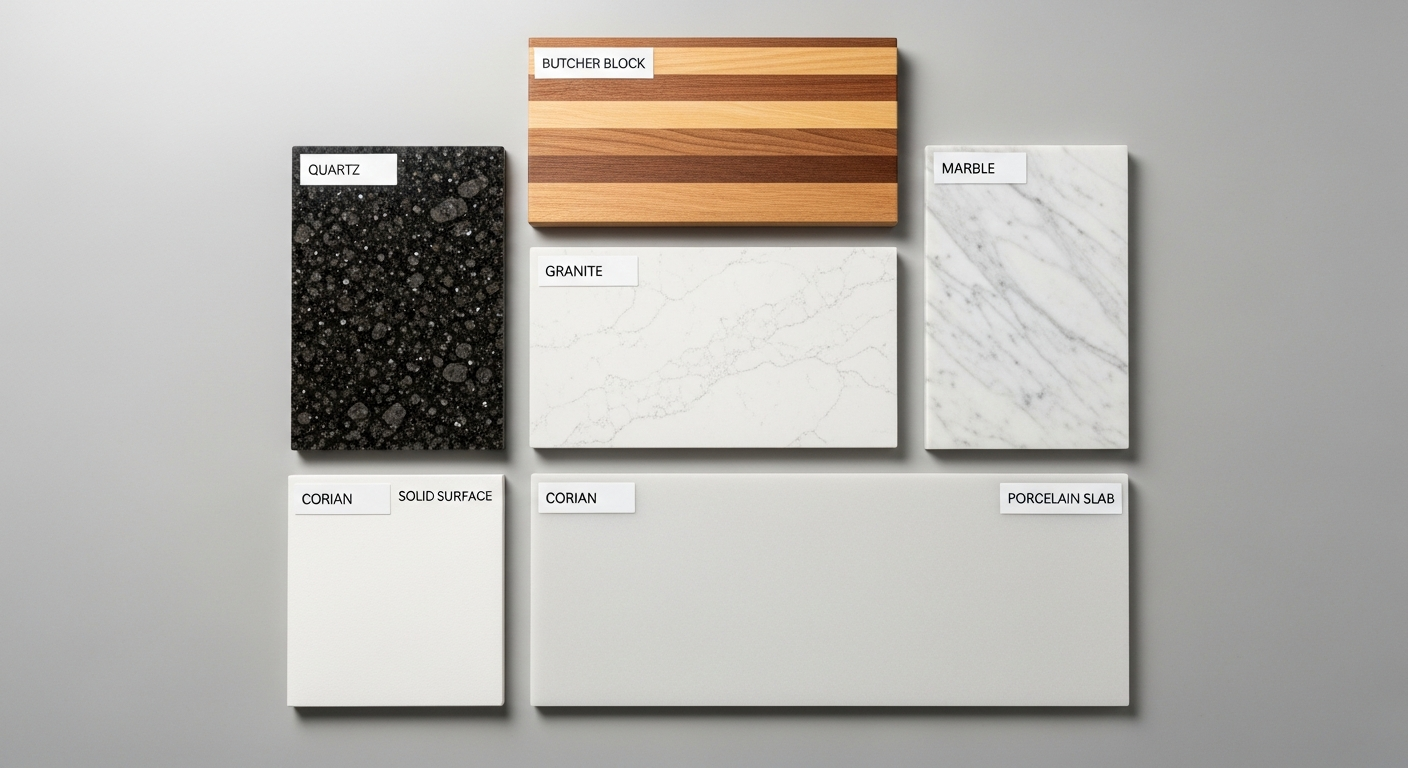
Quartz (Engineered Stone)
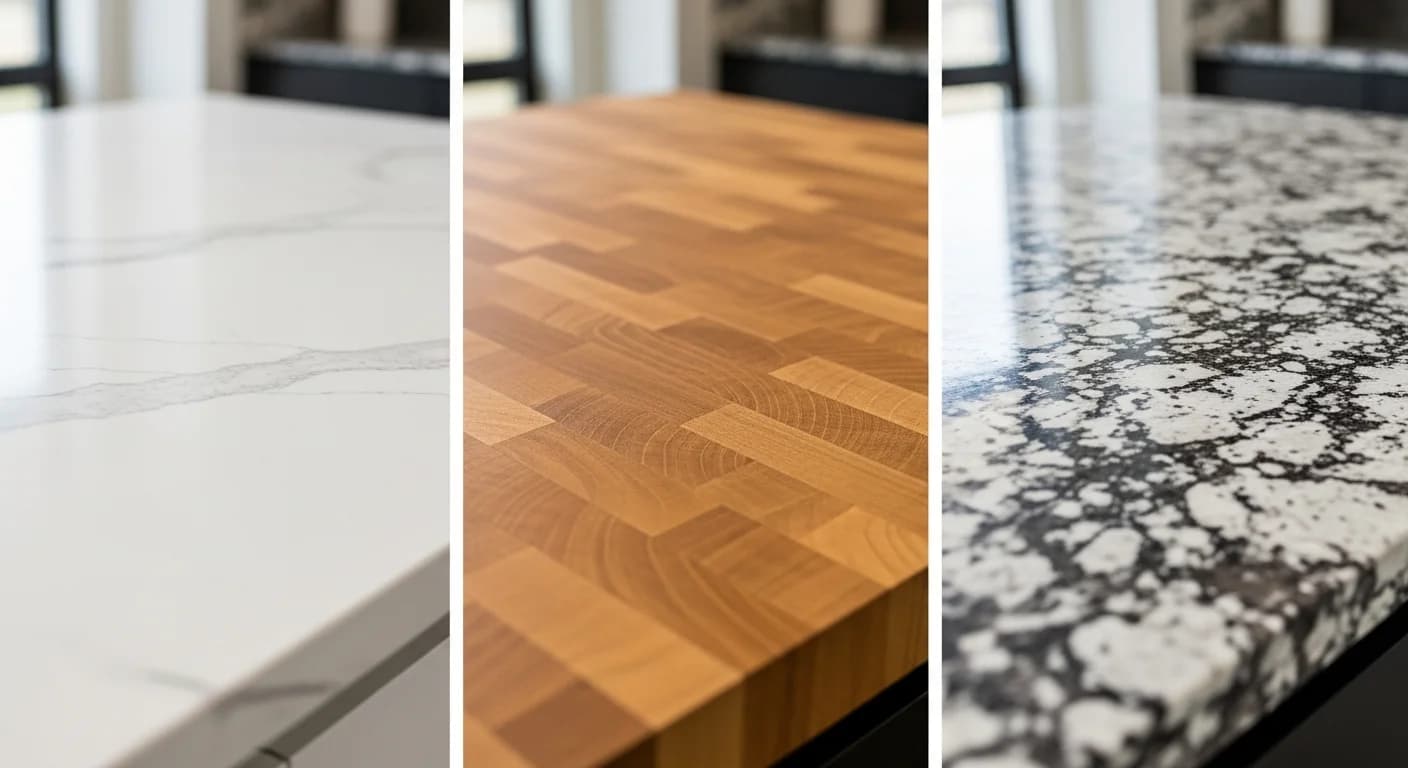
Quartz countertops are engineered from approximately 90 to 94 percent ground natural quartz bound with polymer resins and pigments. This manufacturing process creates a surface that's harder than granite, non-porous (meaning it never needs sealing), and available in a virtually unlimited range of colors and patterns — including convincing marble and concrete looks.
Quartz is the most popular countertop material in the United States, and for good reason. It's extremely durable, resists staining from coffee, wine, and cooking oils, and requires nothing more than soap and water for daily cleaning. The main limitation is heat sensitivity — quartz can crack or discolor from direct contact with hot pans, so trivets are essential. Cost ranges from $50 to $150 per square foot installed, with most mid-range selections falling between $65 and $90.
Granite (Natural Stone)
Granite remains a classic kitchen countertop choice, prized for its natural beauty and each-slab-is-unique character. As a natural stone, granite offers excellent heat resistance — you can place a hot pan directly on it without damage. It's extremely hard and scratch-resistant, making it ideal for heavy-use kitchens.
The trade-off is maintenance. Granite is porous and requires sealing once or twice per year to prevent stain absorption. Some colors (particularly lighter shades) stain more easily than others. Granite also has natural fissures that can sometimes be mistaken for cracks — they're structural features, not defects, but they can catch debris if not sealed properly. Installed cost ranges from $45 to $200 per square foot depending on rarity and origin, with popular colors averaging $55 to $100.
Marble (Natural Stone)
Marble is the gold standard of luxury countertops, and nothing else truly replicates its distinctive veining and luminous depth. Calacatta and Carrara marble have been used in the world's finest kitchens for centuries, and they continue to command premium pricing. Marble is also excellent for baking because its naturally cool surface is ideal for rolling pastry dough.
However, marble is the highest-maintenance countertop material. It's softer than granite or quartz, meaning it scratches more easily. It's highly porous and etches from acidic substances — lemon juice, vinegar, tomato sauce, and wine will leave dull marks if not wiped up immediately. Marble requires sealing every 3 to 6 months and develops a patina over time that some homeowners love and others find frustrating. Installed cost ranges from $75 to $250 per square foot, with Calacatta varieties at the top of that range.
Butcher Block (Wood)
Butcher block countertops bring natural warmth and texture to kitchens in a way no stone or engineered material can match. Hard maple, walnut, cherry, and white oak are the most popular wood species. Butcher block is the most DIY-friendly countertop option — pre-made slabs are available at home improvement stores and can be cut and installed with standard woodworking tools.
Wood countertops require regular oiling (monthly for the first year, quarterly thereafter) with food-safe mineral oil or a beeswax blend. They can be sanded and refinished to remove scratches and stains, which no other countertop material can claim — this means a well-maintained butcher block surface can last indefinitely. The downside is water sensitivity: standing water can cause warping, and areas around the sink need extra protection or should be paired with a different material. Installed cost is $40 to $100 per square foot, making it one of the most affordable premium options. For more on kitchen redesign planning, see our complete guide on how to redesign a kitchen.
Laminate (Budget-Friendly)
Modern laminate countertops have come a long way from the dated patterns of decades past. Today's high-pressure laminate (HPL) surfaces convincingly mimic marble, concrete, wood, and quartz at a fraction of the cost. Brands like Formica and Wilsonart offer hundreds of realistic patterns with textured finishes that feel surprisingly authentic.
Laminate is the most budget-friendly countertop option, ranging from $15 to $40 per square foot installed. It's non-porous (no sealing needed), lightweight, and available in more colors and patterns than any other material. The limitations are durability-related: laminate can be scratched by knives, damaged by hot pans, and the edges can chip over time. Once damaged, laminate cannot be repaired — only replaced. For budget kitchen redesigns, laminate is an excellent choice that allows you to spend more on other high-impact upgrades like hardware, lighting, or backsplash. Learn more budget strategies in how much it costs to redesign a kitchen.
Solid Surface (Corian)
Solid surface countertops (the most well-known brand being Corian by DuPont) are made from acrylic and polyester resins blended with mineral fillers. Their key advantage is seamless fabrication — seams between sections are virtually invisible, and integrated sinks can be molded directly into the countertop for a completely smooth, crevice-free surface that's exceptionally hygienic and easy to clean.
Solid surface materials are non-porous, never need sealing, and minor scratches can be sanded out with fine-grit sandpaper. They're available in hundreds of colors, including realistic stone patterns. The main downside is heat sensitivity (similar to quartz) and lower scratch resistance compared to stone. Installed cost ranges from $45 to $100 per square foot, positioning solid surface in the mid-range between laminate and natural stone.
Kitchen Countertop Cost Comparison Table
| Material | Cost/sq ft (Installed) | Durability | Maintenance | Heat Resistance | Best For |
|---|---|---|---|---|---|
| Quartz | $50 – $150 | Excellent | Very Low | Moderate | Most kitchens, busy families |
| Granite | $45 – $200 | Excellent | Moderate (seal yearly) | Excellent | Traditional and transitional kitchens |
| Marble | $75 – $250 | Good | High (seal 2-4x/year) | Good | Luxury kitchens, baking enthusiasts |
| Butcher Block | $40 – $100 | Good (repairable) | Moderate (oil monthly) | Low | Farmhouse, warm modern kitchens |
| Laminate | $15 – $40 | Fair | Very Low | Low | Budget renovations, rentals |
| Solid Surface | $45 – $100 | Good | Low | Moderate | Seamless designs, integrated sinks |
How to Choose the Right Countertop for Your Kitchen
Selecting the ideal countertop material starts with honestly assessing your kitchen habits and priorities. If you cook daily and place hot pans on counters frequently, granite's heat resistance makes it the strongest choice. If you have young children and staining is a constant concern, quartz's non-porous surface gives you worry-free performance. If you're renovating on a tight budget but want a high-end look, today's laminate options are remarkably convincing.
Consider your kitchen's style direction as well. Modern and contemporary kitchens pair beautifully with quartz in solid colors or subtle veining patterns. Traditional kitchens look stunning with granite or marble. Farmhouse and rustic kitchens benefit from the warmth of butcher block, especially when combined with stone on the perimeter for contrast and practicality.
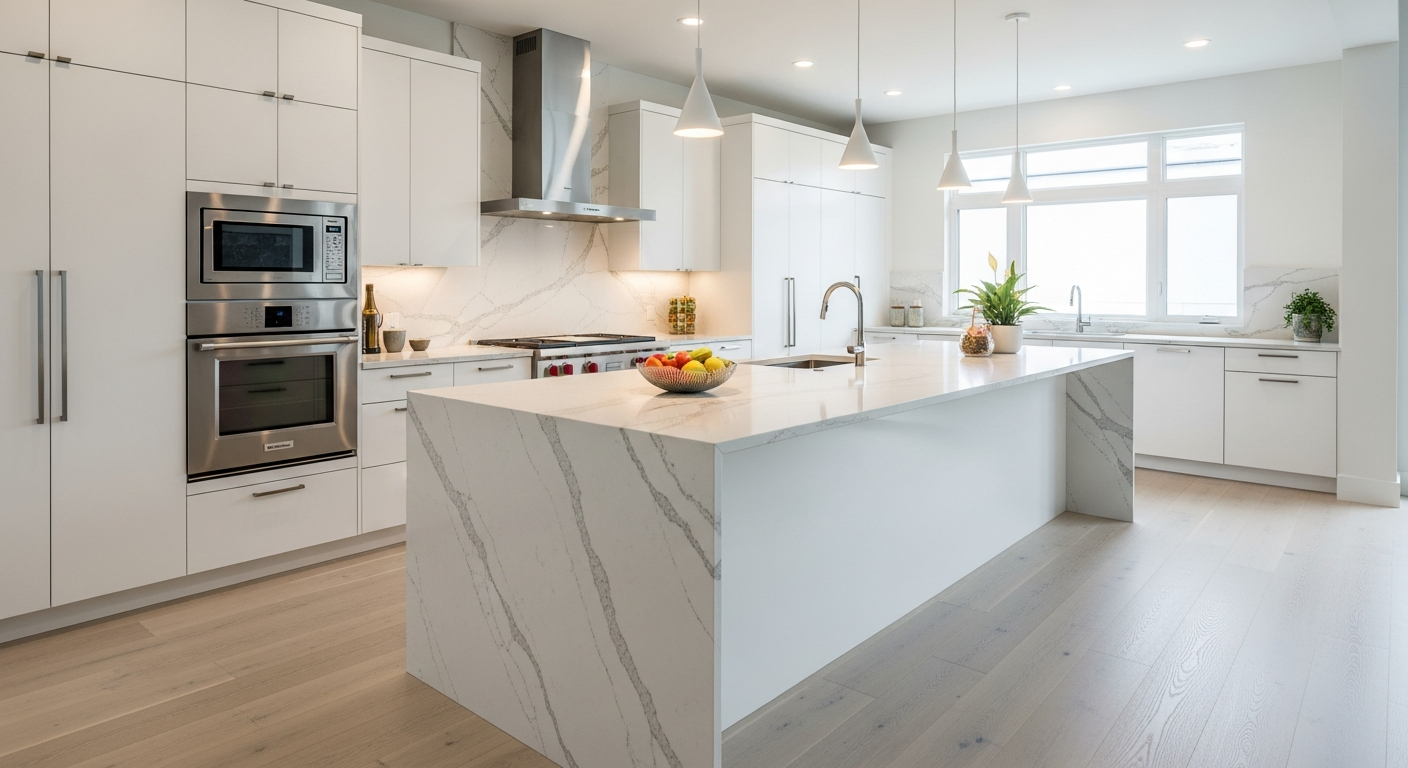
Don't overlook the edge profile — the shape of the countertop's front edge significantly impacts the overall look. Eased (slightly rounded) and beveled edges read as modern. Ogee and bullnose profiles feel more traditional. Mitered edges create a thick-slab appearance that's currently trending in luxury kitchens. Waterfall edges (where the countertop continues down the side of an island to the floor) add dramatic visual impact but increase material cost by 30 to 50 percent.
Step-by-Step: How to Redesign Your Kitchen Countertops
Step 1: Measure and template. Measure your existing countertop surface area (length times depth for each section, including overhangs). Most fabricators will send a technician to create precise digital templates using laser measurement tools. For a standard kitchen, expect 30 to 50 square feet of countertop surface area.
Step 2: Select your material and color. Visit stone yards, showrooms, or home improvement stores to see material samples in person. Photos and digital previews are helpful for narrowing options, but natural stone especially can look different in person than on screen. Ask for large samples (at least 12 by 12 inches) to evaluate at home in your kitchen's lighting.
Step 3: Choose your edge profile and sink style. Decide between an undermount sink (clean, modern look — requires stone or solid surface countertop) and a drop-in sink (works with any material including laminate). Undermount sinks are overwhelmingly preferred in kitchen redesigns because they create a seamless surface that's easy to wipe clean.
Step 4: Get fabrication quotes. Contact 3 to 4 fabricators for quotes. Provide your measurements, material choice, edge profile, sink cutout requirements, and any special features (waterfall edges, extra thickness, integrated drainboards). Quotes should include material, fabrication, delivery, and installation. Compare total installed prices, not just material costs.
Step 5: Coordinate installation timing. Countertop installation typically takes 1 to 2 days. You'll need disconnected plumbing (sink and dishwasher) before installers arrive, and reconnection afterward. Plan for 2 to 3 days without a functioning kitchen sink. If you're also replacing the backsplash, install countertops first — the backsplash sits on top of the counter.
Can You Redesign Countertops Without Replacing Cabinets?
Absolutely — and this is one of the most popular kitchen updates precisely because it delivers dramatic visual change without the expense and disruption of a full cabinet replacement. New countertops can be installed on top of existing cabinets as long as the cabinet boxes are structurally sound and level. A countertop swap typically takes 1 to 2 days versus 2 to 4 weeks for a full cabinet and counter replacement.
To maximize the impact of a countertop-only upgrade, consider pairing new countertops with updated cabinet hardware, a fresh coat of paint on the cabinets, and a new backsplash. This combination delivers 80 percent of the visual impact of a full kitchen redesign at roughly 30 percent of the cost. See our guide on how to redesign kitchen cabinets without replacing them for detailed strategies.
One important consideration: if you're changing from a drop-in sink to an undermount sink during the countertop swap, the cabinet below the sink may need modifications to accommodate the new mounting style. Undermount sinks require clips attached to the underside of the countertop, and the cabinet opening may need to be enlarged slightly. This is standard work for any experienced fabricator.
Kitchen Countertop Trends for 2026
Warm-toned quartz: Cool gray quartz dominated the 2020s, but 2026 is seeing a strong shift toward warm tones — creamy whites, soft beiges, and warm greiges with subtle gold or brown veining. These warmer palettes pair beautifully with the warm wood cabinet tones that are replacing all-white kitchens.
Textured and leathered finishes: Polished stone is being replaced by 'leathered' or 'honed' finishes that have a soft, matte texture. These finishes hide fingerprints and water spots better than polished surfaces and add a tactile, organic quality that feels more relaxed and approachable. Leathered granite in particular has become a top request at fabrication shops.
Ultra-compact surfaces: Brands like Dekton and Neolith are gaining market share with ultra-compact porcelain surfaces that offer exceptional heat, scratch, and UV resistance. These materials are thinner than traditional stone (as thin as 8mm for wall applications, 20mm for countertops) but extremely strong. They're particularly popular for outdoor kitchens because they won't fade in sunlight. Prices are comparable to premium quartz at $65 to $130 per square foot.
Mixed materials: Using two different countertop materials in the same kitchen is a growing trend. The most popular combination is stone perimeters with butcher block on the island (or vice versa). This creates visual interest, allows each zone to use the most practical material, and can save money by using a premium material only where it's most visible. For more inspiration, explore our kitchen island redesign guide.
Common Mistakes When Redesigning Kitchen Countertops
Mistake 1: Choosing based on photos alone. Countertop materials look dramatically different in person than in photographs. Always view physical samples in your kitchen's specific lighting before making a final selection. Take samples home if possible and observe them at different times of day.
Mistake 2: Ignoring maintenance requirements. Marble and granite require regular sealing. Butcher block needs monthly oiling. If you know you won't keep up with maintenance, choose quartz or laminate — no maintenance schedule required.
Mistake 3: Forgetting about the backsplash. New countertops often clash with the existing backsplash. Budget for backsplash replacement or at least a fresh coat of paint on the wall between the counter and upper cabinets. A cohesive counter-to-backsplash transition is what separates a professional-looking kitchen from a piecemeal update.
Mistake 4: Skipping the undermount sink upgrade. If you're investing in stone or quartz countertops, pairing them with a drop-in sink undermines the premium look. Undermount sinks create a seamless transition from counter to basin and are easier to clean. The additional cost is minimal — typically $100 to $200 more than a drop-in installation.
Frequently Asked Questions
Q: What is the most durable kitchen countertop material?
A: Quartz and granite are the most durable countertop materials for everyday kitchen use. Quartz is slightly more scratch-resistant and never needs sealing, while granite offers superior heat resistance. Both materials can last 25 years or more with basic care. Ultra-compact surfaces like Dekton may surpass both in overall durability but are less widely available.
Q: How much does it cost to replace kitchen countertops?
A: For a typical kitchen with 35 to 40 square feet of countertop area, expect to pay $1,500 to $4,000 for mid-range quartz or granite (material, fabrication, and installation). Budget laminate runs $500 to $1,500 total, while premium marble or exotic granite can reach $5,000 to $10,000 or more. Always get 3 to 4 quotes from local fabricators.
Q: Can I install new countertops over existing countertops?
A: In some cases, yes. Thin porcelain or quartz overlay systems (sometimes called 'resurfacing') can be installed over existing laminate countertops without removal. This option costs 20 to 40 percent less than full replacement and creates significantly less disruption. However, it works best when the existing countertop is flat, stable, and level.
Q: Which countertop material has the best resale value?
A: Quartz and granite countertops offer the highest resale value according to most real estate professionals. Quartz has a slight edge because buyers appreciate its zero-maintenance appeal. Marble adds luxury cachet in high-end markets but can be a concern for buyers who worry about maintenance. Butcher block adds value in farmhouse and transitional-style kitchens.
Q: How long does it take to replace kitchen countertops?
A: From material selection to completed installation, expect 2 to 4 weeks total. The timeline includes template measurement (1 day), fabrication (5 to 10 business days), and installation (1 to 2 days). You'll be without a kitchen sink for 1 to 3 days during the installation phase. Rush orders are usually available for an additional fee.
Q: Can I use AI to visualize different countertop materials in my kitchen?
A: Yes. HanoDecor's kitchen remodel visualizer lets you upload a photo of your current kitchen and see how different countertop materials, colors, and edge profiles would look in your specific space. This is one of the most effective ways to narrow your material choices before visiting showrooms.
Visualize Your New Kitchen Countertops with HanoDecor
Choosing a countertop material is a big decision — one you'll live with for years. HanoDecor's AI kitchen remodel visualizer takes the guesswork out of the process. Upload a photo of your current kitchen, select different countertop styles, and see photorealistic previews of how each option transforms your space.
Compare white quartz against warm granite, see how butcher block looks on your island, or test whether that marble you love actually works with your existing cabinets. Based on our analysis of thousands of kitchen redesigns, countertop visualization is the feature most homeowners say helped them make a confident final decision.
Start your free kitchen countertop visualization now — no credit card required.
Related Articles
How to Redesign a Kitchen: 13 Essential Steps for a Beautiful Makeover
How Much Does It Cost to Redesign a Kitchen? 2026 Complete Price Guide
How to Redesign Kitchen Cabinets: 8 Affordable Ideas Without Replacing
How to Redesign a Kitchen Island: 8 Smart Ideas for Function and Style
How to Redesign Kitchen Countertops FAQs
Written by
Sarah Chen
Senior Color Consultant with 12 years of residential exterior design experience. Specializes in architectural color theory, paint technology, and curb appeal optimization.