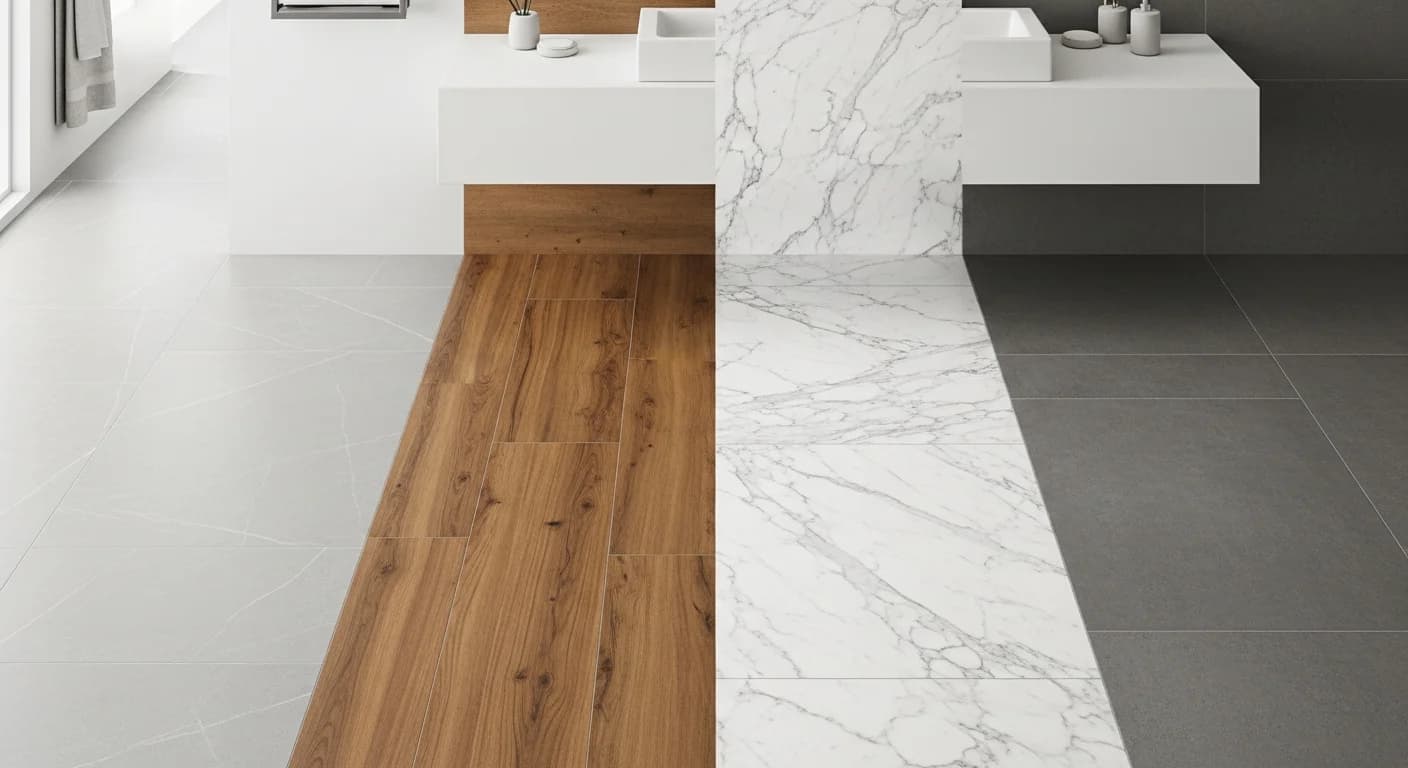
Bathroom Materials Compared: Quartz vs Porcelain vs Marble vs Ceramic
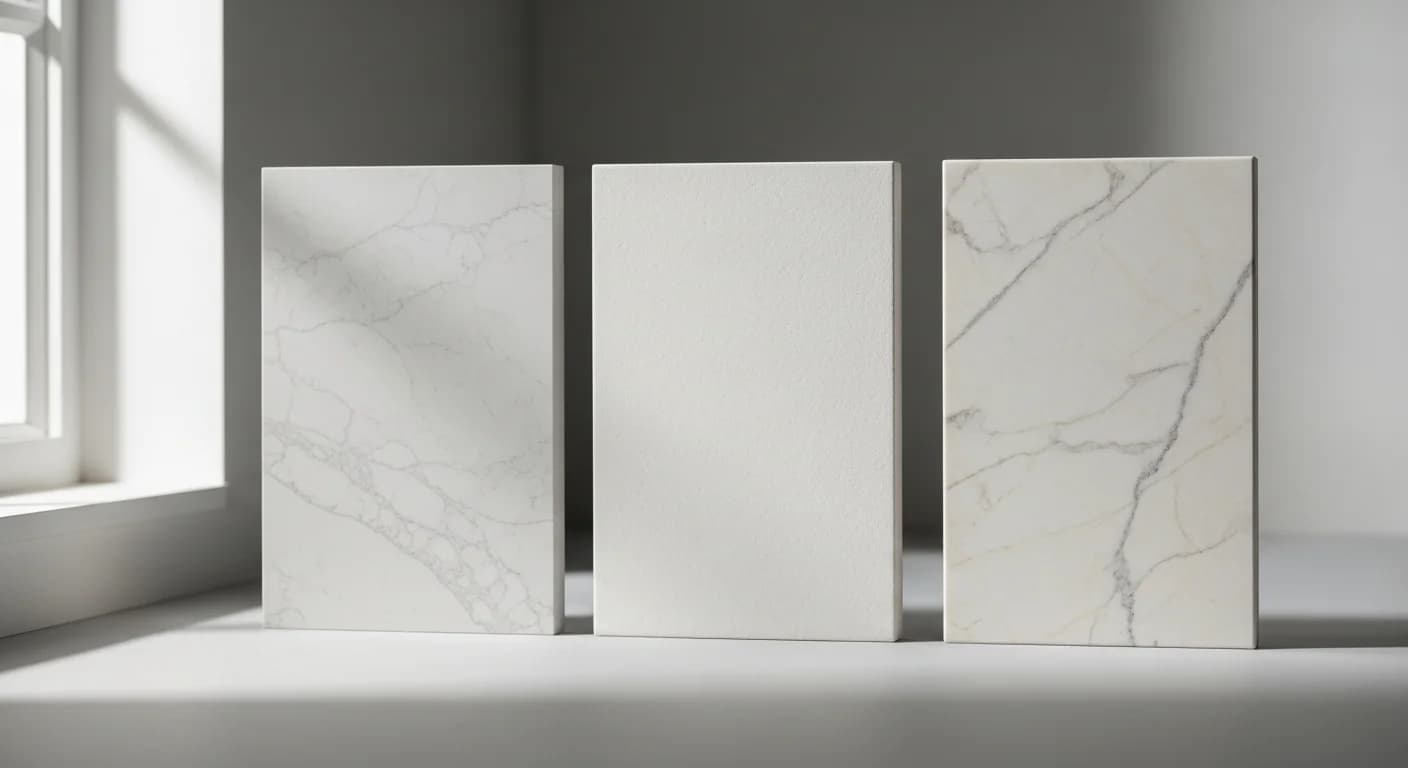
Choosing the right surface material for a bathroom remodel ranks among the most consequential decisions any homeowner faces. The material covering countertops, shower walls, and floors determines how a space looks on day one — and how it holds up five, ten, or twenty years later. A bathroom materials comparison reveals that no single option wins in every category; quartz excels on vanity tops, porcelain dominates large-format shower walls, marble delivers unmatched luxury, and ceramic offers the most budget-friendly path to a beautiful bathroom.
The average American bathroom contains between 80 and 200 square feet of surfacing material when accounting for floors, walls, countertops, and shower enclosures. At installed prices ranging from $3 to $75 per square foot depending on the material, the total spend on surfaces alone can swing from $1,500 to over $15,000. Understanding the properties, strengths, and limitations of each material ensures that every dollar spent delivers lasting value — and prevents the costly mistake of installing a beautiful but impractical surface in a high-moisture environment.
This guide breaks down four of the most popular bathroom surface materials — quartz, porcelain, marble, and ceramic — plus several alternatives worth considering. Each section covers composition, ideal applications, maintenance requirements, and realistic cost expectations so you can make a confident, informed bathroom remodel decision.
Quick Summary
- Quartz: Best for vanity countertops — non-porous, zero sealing, $50-$150/sq ft installed
- Porcelain: Most versatile — floors, walls, countertops — $5-$25/sq ft installed
- Marble: Highest visual impact — requires sealing every 6-12 months — $15-$75/sq ft installed
- Ceramic: Best budget option for walls and backsplashes — $3-$12/sq ft installed
- Best for: Homeowners comparing surface materials for a bathroom remodel, renovation, or upgrade
- Reading time: 14 minutes
Why Material Choice Matters in Bathrooms
Bathrooms present a uniquely hostile environment for building materials. Daily exposure to water, steam, humidity levels exceeding 80%, soap residue, cleaning chemicals, and temperature fluctuations from hot showers all conspire to degrade surfaces that perform perfectly in other rooms. A countertop material that works flawlessly in a kitchen may fail spectacularly in a bathroom if it lacks adequate moisture resistance.
Beyond durability, material selection directly affects maintenance burden, resale value, and long-term cost of ownership. A polished marble vanity top that requires professional resealing every six months carries ongoing costs that a non-porous quartz surface eliminates entirely. Similarly, choosing a ceramic floor tile with a low slip coefficient rating creates a safety hazard that a textured porcelain tile would prevent. The right bathroom materials comparison weighs not just purchase price but total lifetime cost, maintenance requirements, and suitability for each specific application within the bathroom.
Material choice also impacts your bathroom remodel ROI. Real estate professionals consistently report that natural stone and engineered stone surfaces command higher resale premiums than laminate or basic ceramic alternatives, with quartz countertops delivering an estimated 60-70% return on investment at resale.
Quartz for Bathrooms
Composition and Properties
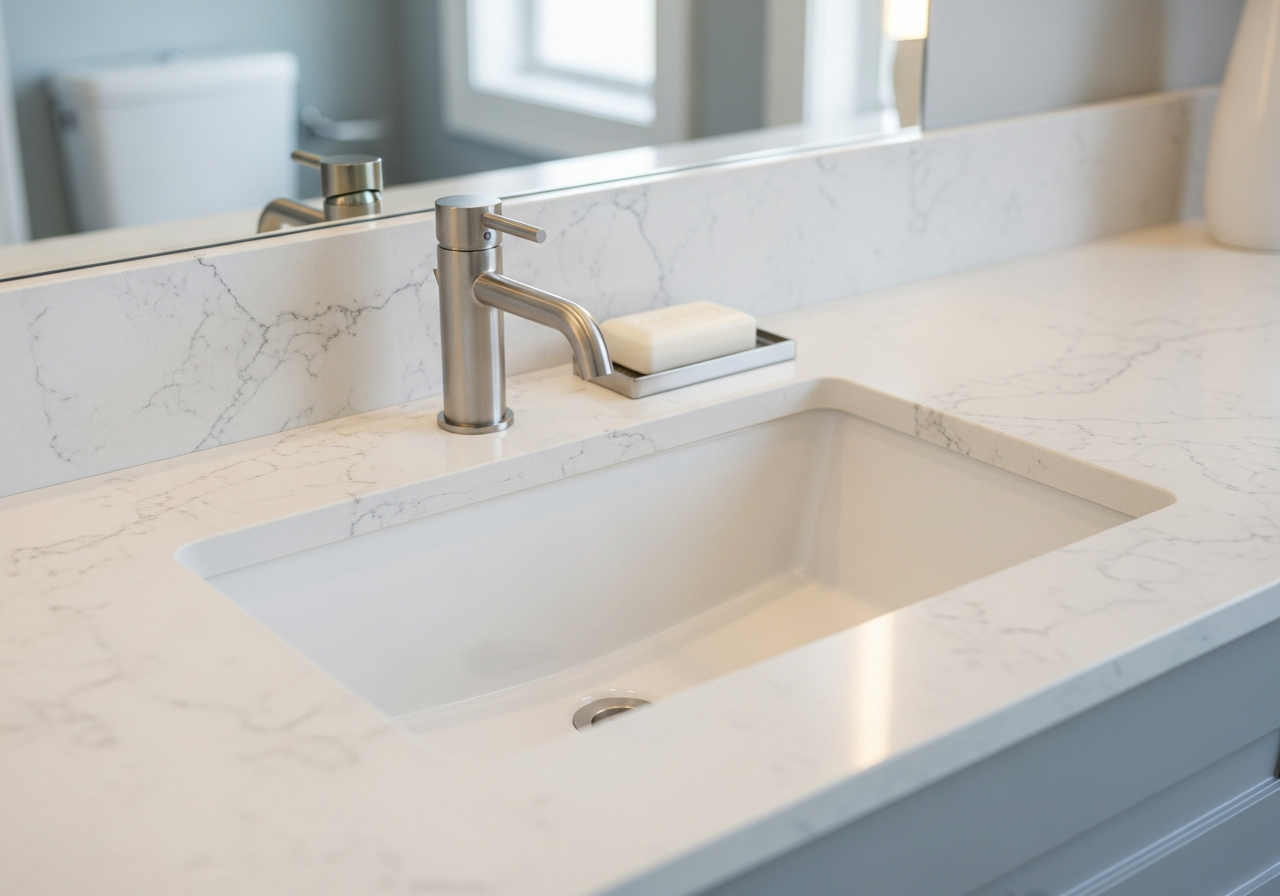
Quartz countertops are engineered stone surfaces composed of approximately 90-94% ground natural quartz crystals bound together with 6-10% polymer resins and pigments. This manufacturing process, pioneered by Breton S.p.A. in Italy, produces slabs that combine the hardness of natural quartz (7 on the Mohs scale) with the consistency and non-porosity that natural stone cannot match. Unlike granite or marble, engineered quartz has virtually zero water absorption — rated at less than 0.05% — making it inherently resistant to staining, bacterial growth, and moisture damage without any sealing treatment.
Modern quartz slabs are available in over 200 colors and patterns, including remarkably convincing marble-look designs with realistic veining. Standard slab dimensions measure 55 x 120 inches or 65 x 130 inches, with thicknesses of 2 cm (three-quarter inch) or 3 cm (one and one-quarter inch). Edge profiles range from simple eased edges to decorative ogee and bullnose options, adding $10-$30 per linear foot to the fabrication cost.
Best Uses in Bathrooms
Quartz performs best as a vanity top material. Its non-porous surface resists toothpaste stains, makeup, hair dye, and soap scum without requiring any protective sealant. For bathroom vanity installations, quartz offers seamless undermount sink cutouts and integrated backsplashes that eliminate grout lines where moisture could accumulate. Single vanity tops typically measure 24-36 inches wide, while double vanity configurations span 48-72 inches.
Quartz is less commonly used for shower walls or floors due to its weight (approximately 20-25 pounds per square foot at 3 cm thickness) and the difficulty of fabricating large vertical panels. However, quartz shower surrounds are growing in popularity for homeowners willing to invest $4,000-$8,000 in a seamless, grout-free shower enclosure.
Pros and Cons
Pros: Non-porous with zero water absorption, never needs sealing, extremely consistent color and pattern, scratch resistant (7 Mohs hardness), stain resistant against common bathroom chemicals, wide color selection including marble-look options, 15-25 year manufacturer warranties.
Cons: Higher cost than ceramic or porcelain ($50-$150 per square foot installed), not heat resistant above 300 degrees Fahrenheit (curling irons and flat irons can cause damage), heavy weight limits wall applications, visible seams on longer countertops, UV exposure can cause yellowing in direct sunlight over time, limited to indoor use only.
Porcelain for Bathrooms
Types of Porcelain
Porcelain is a dense, kiln-fired ceramic material made from refined clay (kaolin), feldspar, and silica fired at temperatures between 2,200 and 2,500 degrees Fahrenheit. This extreme heat vitrifies the clay body, producing a tile with a water absorption rate below 0.5% — the threshold that distinguishes porcelain from standard ceramic per ASTM C373 testing standards. Porcelain tile comes in several distinct types suited to different bathroom applications.
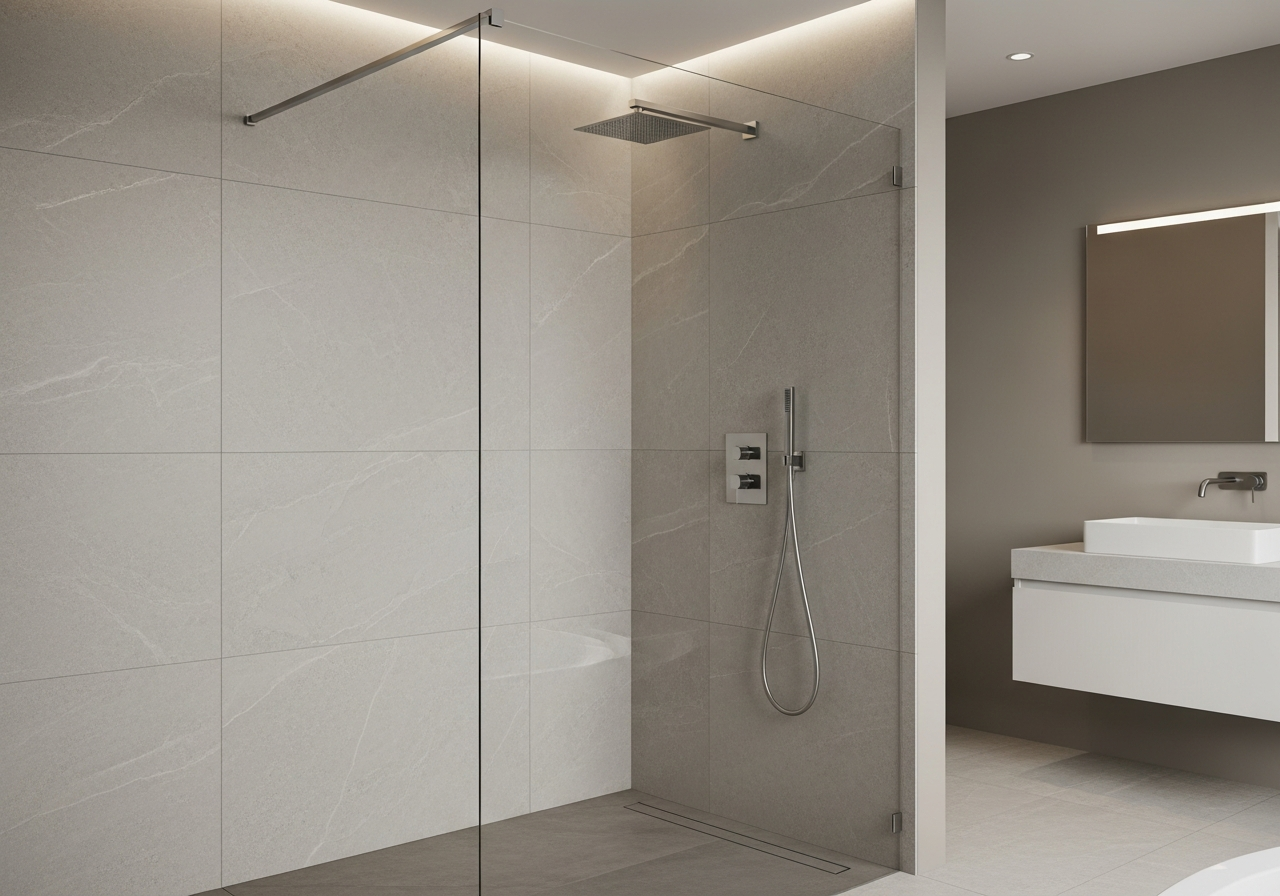
Standard porcelain tile ranges from 1 x 1 inch mosaics to 12 x 24 inch rectangles. Large-format porcelain slabs — measuring up to 60 x 120 inches and as thin as 6 mm — represent one of the fastest-growing segments in bathroom design, offering near-seamless walls and floors with minimal grout lines. Through-body porcelain carries its color and pattern throughout the entire thickness, making chips and scratches virtually invisible, while glazed porcelain features a decorative surface layer that offers unlimited design possibilities.
Best Uses in Bathrooms
Porcelain is the most versatile material in any bathroom materials comparison. It excels as floor tile (textured finishes achieve slip resistance ratings of 0.60+ DCOF), shower wall cladding (especially in large-format slabs that minimize grout maintenance), and increasingly as vanity countertop material in ultra-thin slab form. For bathroom tile installations, porcelain's low water absorption makes it suitable for wet areas where ceramic tile may be inadequate.
Floor applications benefit from textured or matte-finish porcelain that provides adequate traction when wet. Polished porcelain, while stunning on walls, creates a dangerously slippery floor surface with DCOF values as low as 0.35 — well below the 0.42 minimum recommended by ANSI A137.1 for level interior wet areas.
Pros and Cons
Pros: Extremely low water absorption (under 0.5%), frost resistant for unheated spaces, available in virtually unlimited designs including wood-look and stone-look patterns, through-body options hide chips, large-format slabs minimize grout, excellent scratch resistance, lower cost than natural stone, compatible with radiant floor heating systems.
Cons: Harder to cut than ceramic (requires wet saw with diamond blade), heavier than ceramic (6-8 lbs per square foot vs 4-5 lbs), large-format slabs require perfectly flat substrates (lippage tolerance of 1/16 inch), higher material cost than ceramic ($5-$25/sq ft vs $3-$12/sq ft), grout lines still require maintenance unless using large-format slabs.
Marble for Bathrooms
Classic Appeal and Varieties
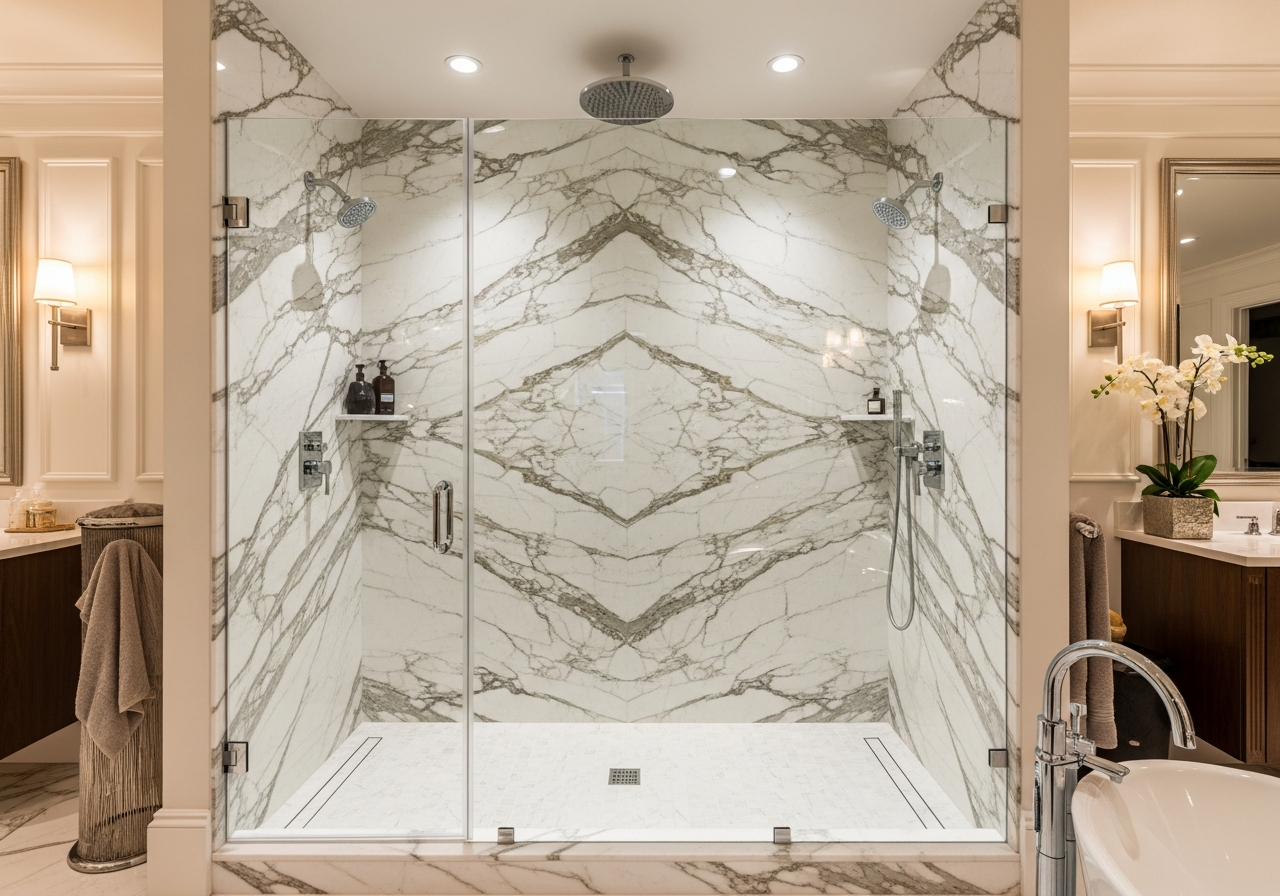
Marble is a metamorphic rock formed when limestone undergoes intense heat and pressure deep within the earth's crust, recrystallizing calcite minerals into the distinctive veined patterns that have defined luxury interiors for thousands of years. No two marble slabs are identical — each carries unique veining patterns created by mineral impurities including iron oxide (gold and rust tones), serpentine (green veining), and graphite (gray veining).
Popular marble varieties for bathrooms include Carrara (gray-white with subtle veining, $15-$40/sq ft), Calacatta (white with bold dramatic veining, $40-$75/sq ft), Statuario (bright white with gray veining, $30-$60/sq ft), Emperador (rich brown tones, $20-$45/sq ft), and Nero Marquina (black with white veining, $25-$50/sq ft). The visual warmth and depth of natural stone remains unmatched by any engineered alternative, which explains why marble consistently ranks as the most aspirational bathroom surface material.
Maintenance Requirements
Marble's primary drawback is its porosity and chemical sensitivity. As a calcium carbonate-based stone, marble etches (develops dull spots) when exposed to acidic substances including lemon juice, vinegar, many bathroom cleaners, and even some shampoos with low pH levels. This etching is a chemical reaction that removes the polished surface layer, not a stain — meaning it cannot be wiped away but must be professionally honed or polished to restore.
Sealing marble every 6-12 months with an impregnating sealer reduces (but does not eliminate) staining risk. A quality impregnating sealer costs $15-$30 per pint and takes approximately 30 minutes to apply to a typical vanity top. For shower walls, sealing frequency increases to every 3-6 months due to constant water exposure. Many homeowners choose a honed (matte) finish over polished marble in bathrooms specifically because honed surfaces show etching marks far less than their polished counterparts.
Pros and Cons
Pros: Unmatched natural beauty with unique veining, increases home value and perceived luxury, naturally cool to the touch (pleasant in warm climates), available in slabs, tiles, and mosaics, timeless aesthetic that never looks dated, each piece is one-of-a-kind, excellent for shower wall applications when properly sealed.
Cons: Porous — requires sealing every 6-12 months, etches from acidic cleaners and products, softer than quartz or porcelain (3-4 Mohs hardness), scratches more easily, significantly more expensive than porcelain or ceramic, heavy (approximately 13-18 lbs per square foot at three-quarter inch thickness), requires professional installation for best results, ongoing maintenance costs.
Ceramic for Bathrooms
How Ceramic Differs from Porcelain
Ceramic and porcelain tiles are both made from clay fired in a kiln, but the similarities end there. Ceramic tile uses less refined clay bodies fired at lower temperatures (1,800-2,000 degrees Fahrenheit), resulting in a more porous finished product with water absorption rates between 0.5% and 20%. The ASTM C373 standard draws the dividing line at 0.5% water absorption: anything below is classified as porcelain, anything above is ceramic.
This higher porosity means ceramic tile is lighter (4-5 lbs per square foot vs 6-8 lbs for porcelain), easier to cut with basic tile nippers or a manual tile cutter, and significantly less expensive. However, it also means ceramic is more susceptible to moisture penetration, frost damage, and staining in wet areas. For bathroom applications, this distinction matters most in shower floors and exterior-facing walls where sustained moisture exposure occurs.
Best Uses in Bathrooms
Ceramic tile performs well as wall cladding, backsplash material, and decorative accents where direct water saturation is limited. Bathroom walls above the shower line, vanity backsplashes, and accent walls benefit from ceramic's lower cost and easier installation without sacrificing aesthetics. Glazed ceramic tile is available in thousands of colors, patterns, and textures — from hand-painted artisanal designs to precision-printed wood and stone replicas.
For floor applications, ceramic tile functions adequately in powder rooms and half baths where water exposure is minimal. In full bathrooms with showers or tubs, porcelain is the safer choice for flooring due to its lower water absorption. Ceramic mosaic tiles (1 x 1 inch or 2 x 2 inch) remain popular for shower floors because the extensive grout network provides inherent slip resistance, though the grout itself requires regular sealing.
Pros and Cons
Pros: Most affordable tile option ($3-$12/sq ft installed), lightest weight among tile options, easiest to cut and install (DIY-friendly), available in vast design variety, glazed surface resists staining on the tile face, suitable for walls and low-moisture floors, widely available at home improvement stores.
Cons: Higher water absorption than porcelain (not ideal for shower floors), less durable — chips and cracks more easily, not frost resistant (unsuitable for unheated spaces), glaze can wear over time in high-traffic areas, pattern is surface-only (chips reveal the clay body underneath), lower perceived value than natural stone or quartz for resale purposes.
Other Materials Worth Considering
Beyond the four primary bathroom surface materials, several alternatives deserve consideration depending on your design goals and budget. Terrazzo — a composite of marble, quartz, granite, and glass chips set in cement or resin — has experienced a significant design revival, offering speckled patterns at $15-$45 per square foot installed. Solid surface materials like Corian provide seamless, non-porous countertops at $40-$100 per square foot with integrated sink options that eliminate undermount seams.
Travertine, a form of limestone, delivers warm earth tones and a textured surface at $5-$30 per square foot but requires even more diligent sealing than marble due to its naturally pitted surface. Granite remains a durable natural stone option at $15-$60 per square foot with superior scratch and heat resistance compared to marble, though its busy patterns may not suit minimalist bathroom designs. Microcement offers a seamless, industrial-chic surface treatment at $8-$20 per square foot applied, though it requires professional application and periodic resealing.
Head-to-Head Comparison Table
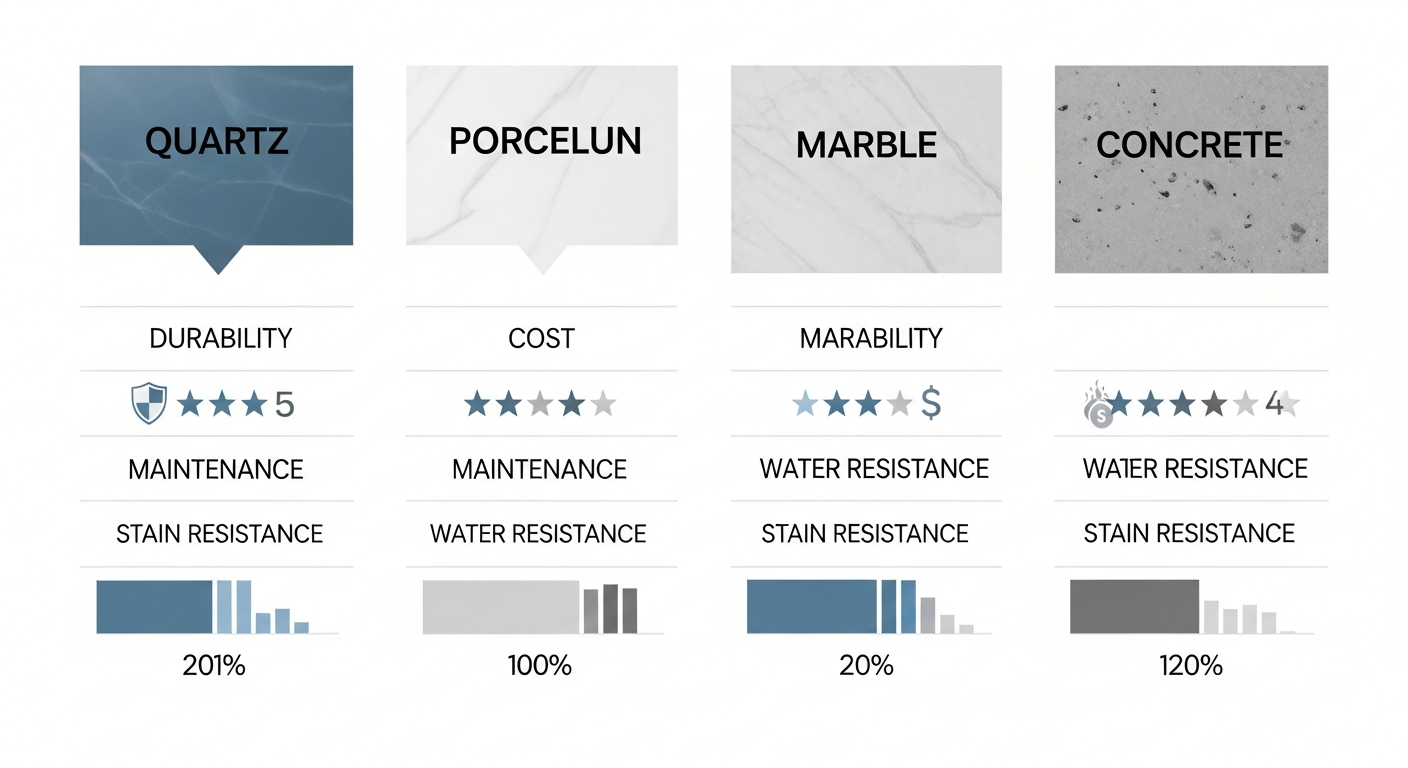
The following table provides a direct bathroom materials comparison across the criteria that matter most for bathroom applications. Ratings use a 5-star scale where 5 represents the best performance in that category.
Water Resistance: Quartz 5/5, Porcelain 5/5, Marble 2/5, Ceramic 3/5
Scratch Resistance: Quartz 4/5, Porcelain 4/5, Marble 2/5, Ceramic 3/5
Stain Resistance: Quartz 5/5, Porcelain 4/5, Marble 2/5, Ceramic 4/5 (glazed)
Heat Resistance: Quartz 3/5, Porcelain 5/5, Marble 4/5, Ceramic 5/5
Maintenance Level: Quartz 5/5 (lowest), Porcelain 4/5, Marble 2/5 (highest), Ceramic 3/5
Aesthetic Range: Quartz 4/5, Porcelain 5/5, Marble 5/5, Ceramic 4/5
Cost (Lower = Better): Quartz 2/5, Porcelain 4/5, Marble 1/5, Ceramic 5/5
Resale Value Impact: Quartz 4/5, Porcelain 3/5, Marble 5/5, Ceramic 2/5
DIY Friendliness: Quartz 1/5, Porcelain 3/5, Marble 1/5, Ceramic 5/5
Material Recommendations by Application
Best Materials for Countertops
For bathroom vanity tops, quartz earns the top recommendation based on its combination of durability, zero maintenance, and consistent aesthetics. A 48-inch double vanity top in quartz costs $800-$2,400 installed, with no ongoing sealing costs over its 15-25 year lifespan. Marble ranks second for homeowners prioritizing luxury aesthetics and willing to maintain the surface, while porcelain slab countertops offer a cost-effective middle ground at $600-$1,500 for the same 48-inch configuration.
Solid surface (Corian) countertops deserve consideration for their seamless integrated sink options and renewable surface — scratches and minor damage can be sanded out by a homeowner with fine-grit sandpaper. At $40-$100 per square foot installed, solid surface falls between porcelain and quartz in both price and performance.
Best Materials for Shower Walls
Large-format porcelain slabs represent the optimal choice for shower walls, combining excellent moisture resistance with minimal grout maintenance. A standard 36 x 60 inch shower enclosure requires approximately 80-100 square feet of wall material, costing $800-$3,000 in porcelain tile or $3,000-$7,000 in large-format slabs. Marble slab shower walls deliver the ultimate luxury aesthetic at $4,000-$12,000 for the same enclosure but demand rigorous sealing protocols. Explore more bathroom tile ideas for walls and showers for pattern inspiration.
Best Materials for Floors
Textured porcelain tile with a DCOF rating of 0.42 or higher provides the safest and most durable bathroom flooring. Sizes between 12 x 24 inches and 24 x 24 inches balance visual scale with practical grout line maintenance. For budget-conscious projects, ceramic tile in smaller formats (6 x 6 or 12 x 12 inches) offers adequate performance in half baths and powder rooms at 40-60% lower material cost. Natural stone floors — marble, travertine, or slate — require textured or honed finishes for slip resistance and ongoing sealing maintenance.
Cost Comparison Per Square Foot (Installed)
Material costs vary significantly by region, complexity of installation, and specific product grade. The following ranges represent national averages for professionally installed bathroom surfaces as of early 2026, including materials, labor, and standard preparation:
Ceramic Tile: $3-$12 per square foot (budget: $3-$6, mid-range: $6-$9, premium: $9-$12)
Porcelain Tile: $5-$25 per square foot (standard tile: $5-$12, large-format: $12-$18, ultra-thin slab: $18-$25)
Marble: $15-$75 per square foot (Carrara: $15-$40, Calacatta: $40-$75, mosaic: $20-$50)
Quartz: $50-$150 per square foot (standard: $50-$80, premium/designer: $80-$120, ultra-premium: $120-$150)
Granite: $15-$60 per square foot
Solid Surface (Corian): $40-$100 per square foot
Terrazzo: $15-$45 per square foot
For a complete 5 x 8 foot bathroom (40 square feet of floor, 60-80 square feet of wall tile, plus a 30-inch vanity top), total surface material costs range from $1,200-$3,000 using ceramic tile and laminate, $2,500-$6,000 using porcelain and quartz, or $5,000-$15,000 using marble and premium quartz. Refer to the 2026 bathroom remodel cost guide for comprehensive budgeting information.
Frequently Asked Questions
What is the most durable material for a bathroom countertop?
Quartz is the most durable bathroom countertop material overall. Its engineered composition delivers a non-porous surface with a Mohs hardness rating of 7, superior stain resistance, and zero sealing requirements. Quartz vanity tops typically last 15-25 years with minimal maintenance — occasional cleaning with mild soap and water is all that is needed.
Can marble be used in a shower without problems?
Marble can be used in showers but requires diligent maintenance. Apply an impregnating sealer every 3-6 months for shower applications and use only pH-neutral cleaners (never acidic products). Choose a honed finish rather than polished to minimize visible etching. Many homeowners successfully maintain marble showers for decades, but the commitment to regular sealing is non-negotiable.
Is porcelain tile better than ceramic for bathroom floors?
For full bathrooms with showers or tubs, porcelain tile is the superior floor choice due to its water absorption rate below 0.5% compared to ceramic's 0.5-20%. Porcelain's density also provides better scratch resistance and durability under foot traffic. Ceramic tile remains a perfectly acceptable option for powder rooms and half baths where moisture exposure is limited.
How much does a full bathroom materials comparison save over choosing wrong materials?
Selecting the wrong material can cost $2,000-$8,000 in replacement costs within the first five years. Common expensive mistakes include installing unsealed marble on a shower floor (etching and staining within months), using polished porcelain on a bathroom floor (slip hazard requiring replacement), or choosing ceramic tile in a steam shower (moisture penetration causing mold). A thorough bathroom materials comparison before purchasing prevents these costly errors.
What bathroom material offers the best return on investment?
Quartz countertops and porcelain tile floors deliver the strongest combined ROI for bathroom remodels. Quartz vanity tops return an estimated 60-70% of their cost at resale, while porcelain tile floors return 50-60%. Marble surfaces command the highest perceived luxury but return only 40-50% due to their higher initial cost. View the HanoDecor gallery for material inspiration from completed projects, or explore pricing options for design visualization.
Preview Materials in Your Bathroom with HanoDecor
Choosing between quartz, porcelain, marble, and ceramic becomes dramatically easier when you can see each material in your actual bathroom space. Upload a photo of your bathroom and experiment with different surface materials, colors, and patterns before committing to a purchase. Our bathroom remodel visualizer lets you compare how Carrara marble walls look alongside quartz countertops, or how large-format porcelain transforms a shower enclosure — all in your real space with accurate lighting and proportions. Start your bathroom materials comparison today and make every surface decision with confidence.
Bathroom Materials Compared FAQs
Written by
Michael Torres
Bathroom and Kitchen Design Specialist with 15 years of remodeling experience. NKBA-certified designer focused on functional layouts, fixture selection, and spa-inspired wellness spaces.