Bathroom Remodel ROI: Which Upgrades Add the Most Value in 2026
A bathroom remodel is one of the strongest investments you can make in your home, but not all upgrades return equal value. Understanding bathroom remodel ROI by upgrade type, project scope, and regional market helps you spend strategically and avoid the over-improvement trap. This guide breaks down the data so every dollar you invest works harder.
Quick Summary
- Average bathroom remodel ROI: 55-70% depending on scope and market (2026 national data)
- Highest ROI upgrades: Updated fixtures (85-100%), improved lighting (80-95%), and cosmetic refreshes outperform full renovations on percentage return
- Best full-renovation ROI: Mid-range projects ($15K-$30K) return 60-70%, outperforming both budget and luxury scopes on percentage
- Regional variation: Pacific and Northeast markets return 5-15% more than Midwest on comparable projects
- Over-improvement threshold: Bathroom renovation cost should not exceed 5-7% of home value
ROI by Individual Upgrade Type
Not every bathroom upgrade that adds value costs the same or returns the same. Here is the breakdown by individual improvement, ranked by ROI percentage.
Fixtures and Hardware (85-100% ROI)
Cost: $200-$800 for faucets, showerhead, towel bars, and cabinet pulls.
Value added: $200-$800.
Coordinated modern fixtures in a consistent finish (matte black, brushed nickel, or brushed gold) signal an updated bathroom to buyers even when surfaces remain unchanged. This is the single highest-ROI bathroom investment because the cost is low and the visual impact is immediate. Buyers notice dated brass or chrome fixtures instantly. See our fixture finishes comparison for choosing the right metal tone.
Lighting Upgrades (80-95% ROI)
Cost: $150-$600 for vanity sconces, overhead fixture, and dimmer switch.
Value added: $130-$550.
Proper lighting transforms how every other element in the bathroom looks. Replacing a single dated fixture with modern vanity sconces and adding a dimmer switch creates a quality impression disproportionate to the cost. Lighting is the most underinvested category in bathroom renovations. See our lighting guide for layered approaches.
Vanity Replacement (70-85% ROI)
Cost: $800-$3,500 depending on size and material.
Value added: $600-$2,800.
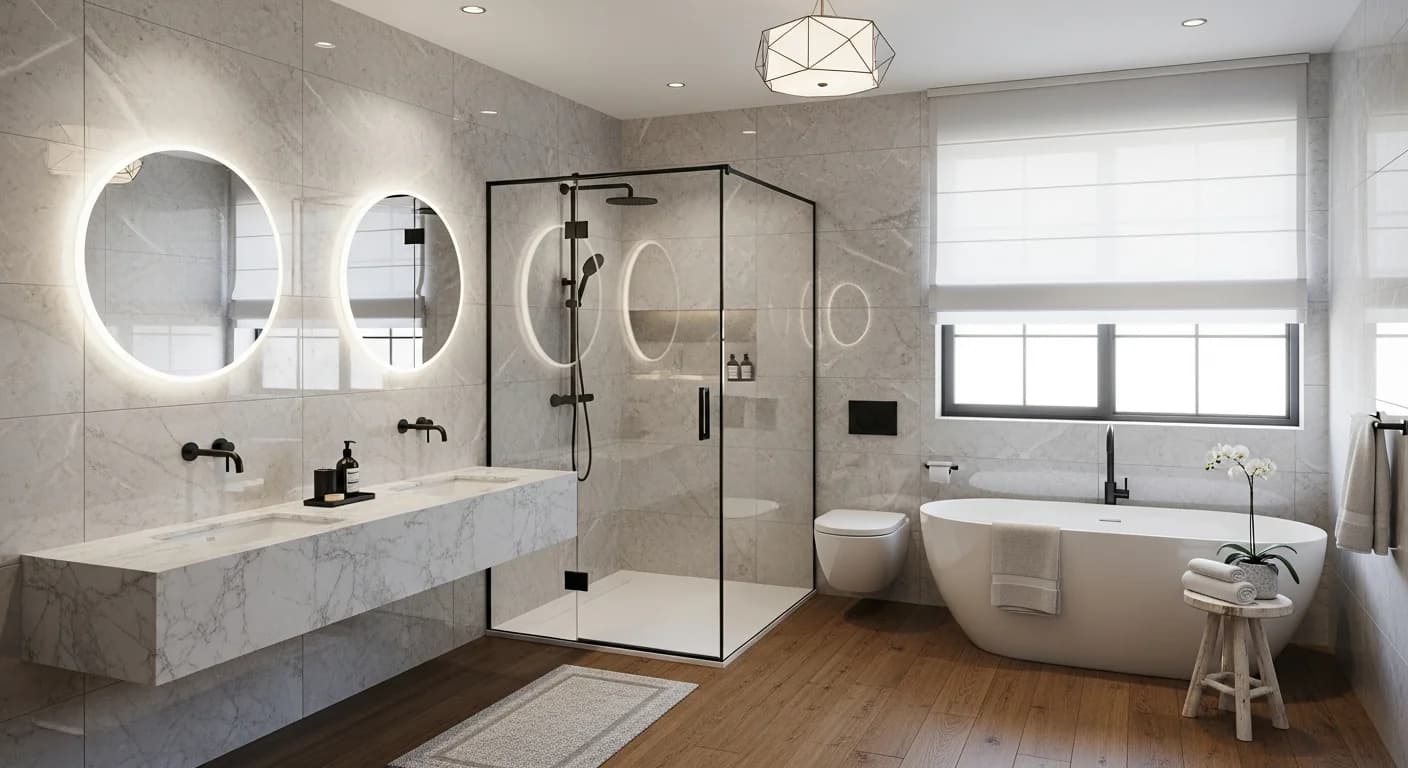
A floating vanity with quartz countertop reads as modern and high-quality. Double vanities in master bathrooms are expected by most buyers. The vanity is the visual anchor of the bathroom and the first thing buyers assess. Avoid overspending on ultra-premium vanities in mid-range homes; a $1,500 vanity returns better than a $5,000 custom piece in a $350,000 home.
Tile Upgrade (65-80% ROI)
Cost: $1,500-$6,000 for floor and shower tile.
Value added: $1,000-$4,500.
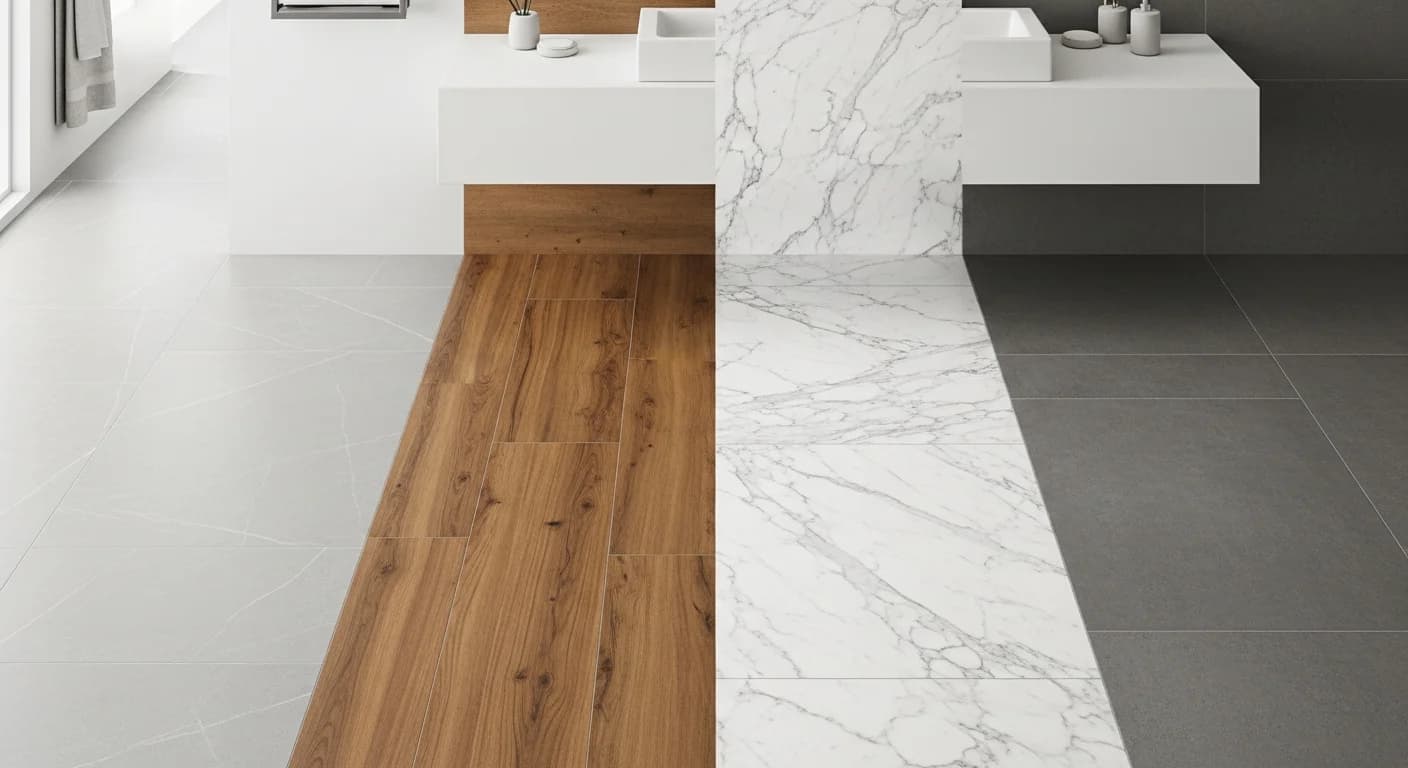
Tile covers the most surface area and sets the quality perception. Large-format porcelain in neutral tones has the broadest buyer appeal. Subway tile with contrasting grout delivers high visual impact at low material cost ($2-$4/sq ft). Natural stone delivers luxury perception but at higher cost. For pattern options, browse our shower tile patterns guide and tile ideas guide.
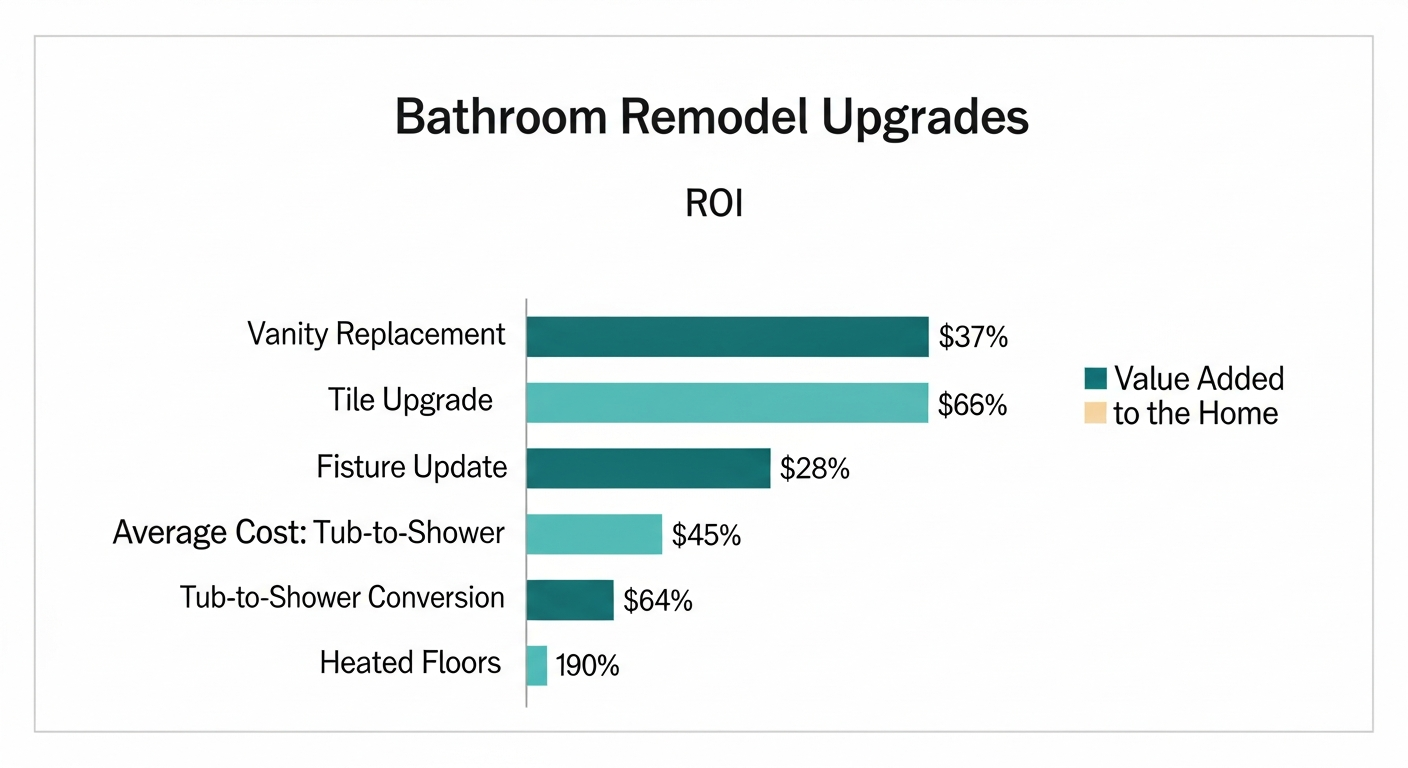
Tub-to-Shower Conversion (60-75% ROI)
Cost: $5,000-$15,000 depending on finish level.
Value added: $3,500-$10,000.
Converting an underused tub-shower combo to a walk-in shower with frameless glass is one of the most impactful upgrades for daily use and buyer appeal. Important caveat: keep at least one bathtub in the home. Removing the only tub reduces value for families with young children. See our walk-in shower guide for design options that maximize appeal.
Heated Floors (55-70% ROI)
Cost: $800-$2,000 when installed during a tile project.
Value added: $500-$1,300.
Radiant floor heating delivers outsized daily satisfaction relative to cost. During a full renovation when floors are already torn up, adding radiant heat costs $8-$15 per square foot. Buyers in cold climates increasingly expect heated floors in master bathrooms. The ROI is modest but the enjoyment value is high. Learn about compatible options in our flooring guide.
Smart Features (40-55% ROI)
Cost: $500-$3,000 for smart mirror, digital shower, touchless faucet.
Value added: $200-$1,500.
Smart bathroom technology is still emerging in the mass market. A backlit smart mirror ($200-$600) returns well because it replaces a standard mirror while adding function. Digital shower systems and touchless faucets return lower percentages because many buyers do not yet value them enough to pay a premium. Technology that is visible and easily demonstrated (like a smart mirror) returns better than hidden tech (like a digital shower valve).
ROI by Project Scope
The scope of your renovation significantly affects bathroom renovation value and return percentages.
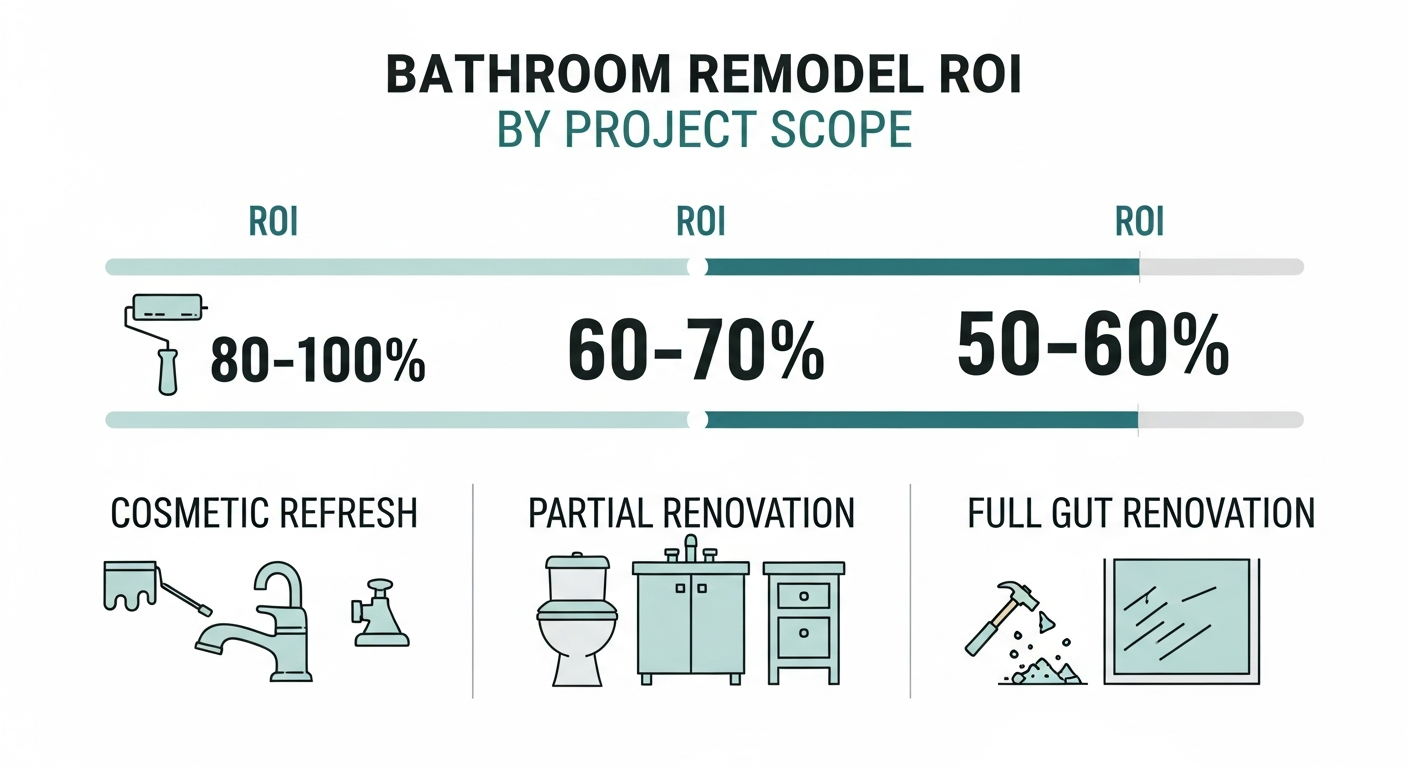
Cosmetic Refresh: 80-100% ROI
Typical cost: $1,000-$5,000.
What is included: Paint, fixtures, hardware, mirror, light fixture, accessories. No plumbing changes, no tile, no structural work.
Cosmetic refreshes return the highest percentage because the cost is low and the perception change is significant. A $3,000 cosmetic refresh can make a bathroom competitive with homes that spent $15,000 on renovations, especially if the existing bones (layout, tile condition, vanity structure) are sound. For DIY-friendly cosmetic projects, see our beginner remodel guide.
Partial Renovation: 60-70% ROI
Typical cost: $8,000-$20,000.
What is included: New vanity, tile (floor and/or shower), toilet, fixtures, lighting. Same layout, no plumbing relocation.
Partial renovations hit the sweet spot for most homeowners. They produce a visibly transformed bathroom without the cost and disruption of a full gut. The 60-70% ROI on a $15,000 project means $9,000-$10,500 in added value, which may be enough to justify the investment if you plan to sell within 5-10 years.
Full Gut Renovation: 50-60% ROI
Typical cost: $20,000-$50,000.
What is included: Complete tear-out to studs, new plumbing, electrical, tile, vanity, fixtures, potentially layout changes.
Full gut renovations return a lower percentage but may be necessary when the existing bathroom has structural issues, water damage, or a fundamentally poor layout. The lower percentage ROI still represents significant absolute value: 55% return on a $35,000 renovation adds $19,250 to home value. For planning a full renovation, use our planning checklist.
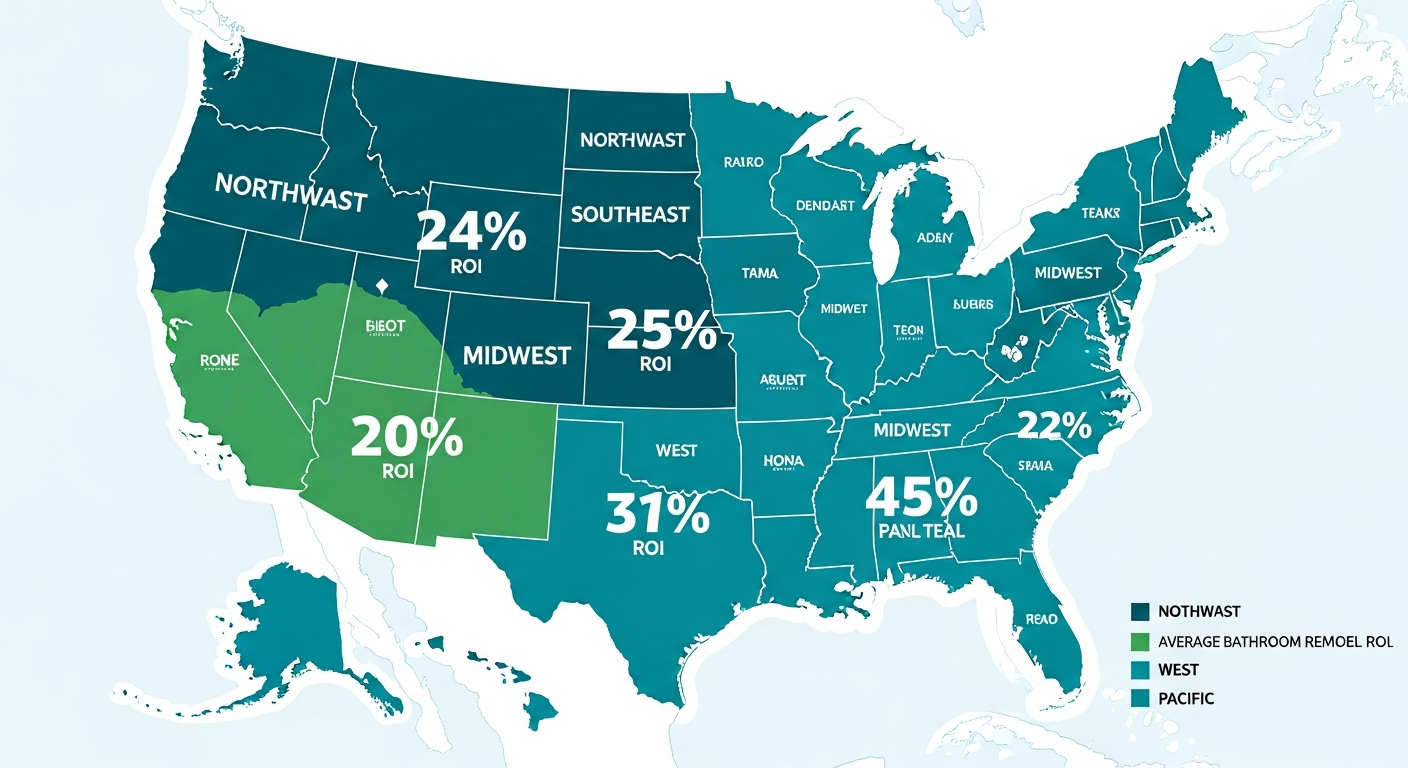
Regional ROI Differences
Bathroom remodel ROI varies meaningfully by region. Local real estate markets, climate, labor costs, and buyer expectations all influence returns.
Pacific (Seattle, Portland, San Francisco, Los Angeles)
Mid-range bathroom ROI: 65-75%.
High home values and competitive markets push bathroom ROI higher. Buyers in Pacific markets expect updated bathrooms and are willing to pay premiums for modern finishes. The higher labor costs are offset by higher home values.
Northeast (Boston, New York, Philadelphia, Washington DC)
Mid-range bathroom ROI: 60-72%.
Older housing stock means many bathrooms are significantly dated, creating strong upgrade opportunities. Heated floors and proper ventilation are particularly valued in cold-weather Northeast markets.
Southeast (Atlanta, Charlotte, Miami, Nashville)
Mid-range bathroom ROI: 58-68%.
Lower labor costs keep project costs down, which helps percentage returns. Growing markets with new construction mean buyers have modern comparables, making updates important for resale competitiveness.
West (Denver, Phoenix, Las Vegas, Salt Lake City)
Mid-range bathroom ROI: 55-67%.
Fast-growing markets with significant new construction. Existing homes compete against new builds with modern bathrooms, making updates important. Water-efficient fixtures are particularly valued in drought-prone areas.
Midwest (Chicago, Minneapolis, Detroit, Columbus)
Mid-range bathroom ROI: 52-63%.
Lower home values relative to renovation costs reduce percentage returns, but the absolute cost of renovation is also lower. Focus on mid-range updates rather than luxury finishes to maximize ROI in Midwest markets.
What Real Estate Agents Say Buyers Look For
Real estate professionals consistently identify these bathroom features as most influential in buyer decisions.
Updated, not necessarily new: Buyers respond to bathrooms that feel current and well-maintained. A 5-year-old bathroom with quality finishes tests as well as a brand-new renovation in most markets.
Clean grout and caulk: Stained grout and deteriorating caulk signal neglect more than any other single element. Re-grouting and re-caulking before listing costs under $300 and has outsized impact on buyer perception.
Adequate storage: Lack of bathroom storage is a top buyer complaint. Medicine cabinets, vanity drawers, and built-in shelving address a real functional need. See our small bathroom guide for storage strategies.
Neutral palette: Bold color choices narrow the buyer pool. Warm white, soft gray, and greige appeal to the broadest audience. Personality can come from easily changed accessories rather than permanent tile or paint. Our color schemes guide covers resale-friendly palettes.
No visible problems: Water stains, running toilets, dripping faucets, and poor ventilation concern buyers more than dated style. Fix functional issues before cosmetic ones. Proper ventilation is critical; see our ventilation guide.
The Over-Improvement Trap
Over-improvement is the most common way homeowners destroy bathroom renovation value. It happens when renovation cost exceeds what the market can recover.
The 5-7% rule: Your bathroom renovation budget should not exceed 5-7% of your home's current market value. For a $400,000 home, that means $20,000-$28,000 maximum. Exceeding this threshold increasingly reduces ROI regardless of how beautiful the renovation.
Neighborhood ceiling: Your bathroom should match or slightly exceed comparable homes in your neighborhood, not dramatically exceed them. A $60,000 master bath renovation in a neighborhood where homes sell for $300,000-$350,000 will not return proportional value because buyers in that price range have budget expectations.
Material mismatch: Natural marble in a home with laminate kitchen counters creates a quality inconsistency that buyers notice. The bathroom should align with the overall home quality level. If your kitchen has granite, your bathroom can have quartz or granite. If your kitchen has laminate, quality porcelain is the right bathroom choice.
Ultra-luxury features in standard homes: Steam showers, smart toilets, and chromatherapy lighting are wonderful for personal enjoyment but return poorly in mid-range markets where buyers do not value or expect them. These features are worth the investment only in luxury markets ($600K+ homes) where competing homes offer similar amenities.
To avoid over-improvement, always check comparable home sales in your area before setting a renovation budget. Our 2026 cost guide helps you estimate realistic budgets by project scope.
Bathroom ROI vs. Other Home Renovation Projects
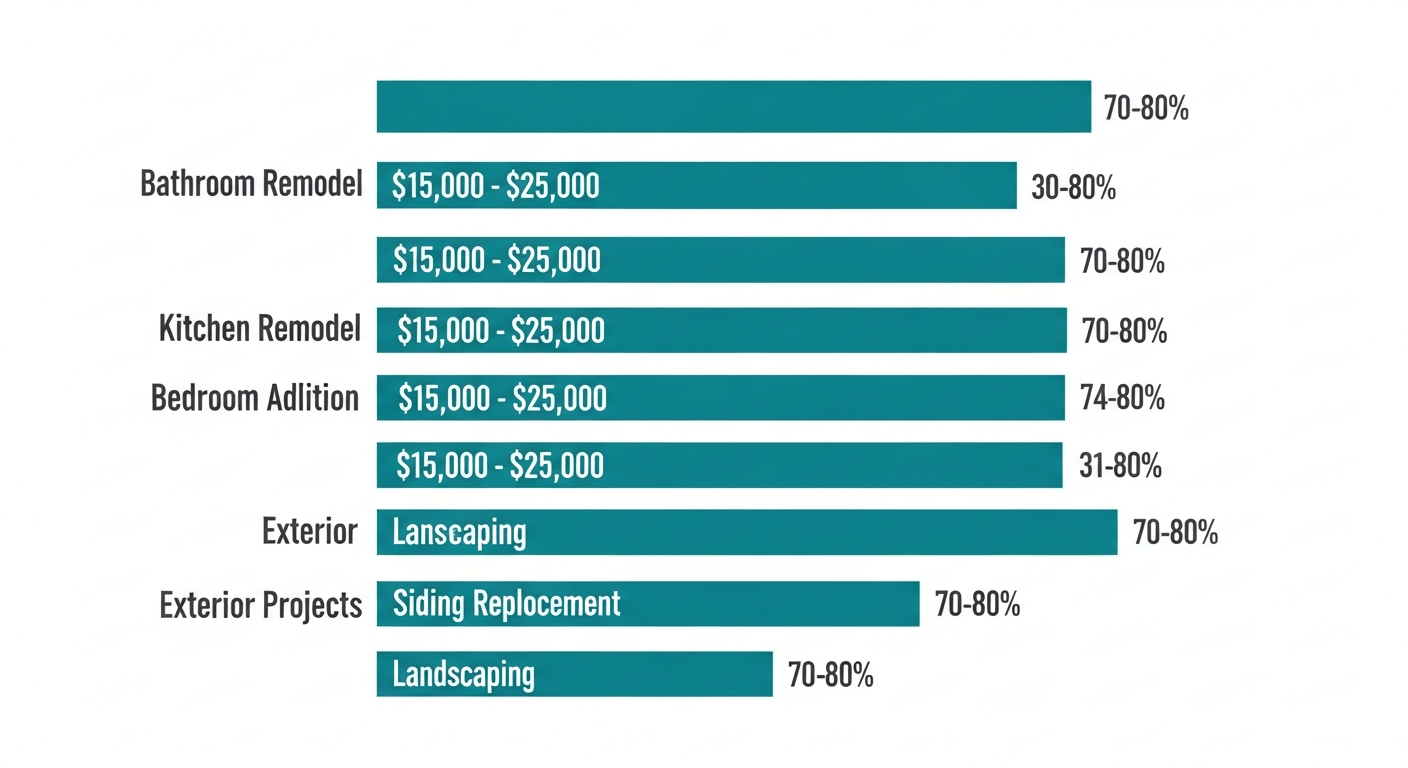
How does bathroom remodel ROI compare to other common home improvement projects?
Minor kitchen remodel: 72-78% ROI. Kitchens consistently return more than bathrooms because they are the center of daily life and the most scrutinized room by buyers.
Mid-range bathroom remodel: 60-70% ROI. Bathrooms rank second behind kitchens for interior renovation returns. Master bath updates are particularly valued.
Exterior improvements: Garage door replacement (95-100% ROI), manufactured stone veneer (90-95%), and new entry door (75-85%) offer strong returns because they affect first impressions and curb appeal.
Bedroom addition: 50-60% ROI. Adding bedrooms returns less per dollar than updating existing bathrooms, and the disruption is far greater.
Major kitchen remodel: 50-60% ROI. Full luxury kitchen renovations return similar percentages to full bathroom guts: the higher spending drives down percentage returns.
The takeaway: mid-range bathroom renovations deliver the second-best interior ROI after minor kitchen updates. The combination of moderate cost and high buyer impact makes bathrooms one of the most strategic renovation investments.
Timeline to Recoup Your Investment
When do you break even on a bathroom renovation? The answer depends on how you measure value.
At sale: You recover 50-70% of the renovation cost in the sale price. You never fully "break even" on resale alone for most renovations. However, an updated bathroom can reduce time on market by 10-20 days, which has its own financial value (carrying costs, mortgage payments, flexibility).
Daily enjoyment value: If you assign even $5/day in enjoyment value to an updated bathroom (a conservative estimate for a room you use multiple times daily), a $15,000 renovation generates $1,825/year in satisfaction value. Over 8 years of ownership, that is $14,600 in enjoyment plus 60% resale recovery ($9,000), totaling $23,600 in combined value on a $15,000 investment.
Avoided maintenance costs: A gut renovation that replaces aging plumbing, addresses water damage, and installs proper ventilation prevents future repair costs that can range from $3,000-$15,000 for mold remediation, pipe replacement, or structural repair. Prevention value is real but difficult to quantify precisely.
Competitive listing advantage: In balanced or buyer's markets, an updated bathroom can mean the difference between selling at asking price versus accepting a below-ask offer. A $20,000 renovation that prevents a $30,000 price reduction generates a positive net return.
How to Maximize ROI on a Limited Budget
If your renovation budget is constrained, these strategies maximize every dollar of bathroom renovation value.
Prioritize what buyers see first: Vanity, mirror, light fixture, and faucet are the first things buyers notice when opening a bathroom door. Spend here first.
Fix functional issues before cosmetic ones: A leaking faucet, running toilet, or inadequate ventilation will negate the value of any cosmetic upgrade. Functional problems create buyer anxiety that pretty tile cannot overcome. Review common pitfalls in our renovation mistakes guide.
Use mid-range materials, not budget or luxury: The sweet spot for ROI is mid-range materials. Budget materials (plastic laminate, vinyl peel-and-stick, builder-grade fixtures) look cheap and buyers know it. Luxury materials (natural marble, custom cabinetry, designer fixtures) cost more than the market recovers. Mid-range porcelain tile, quartz countertops, and quality fixtures deliver the best value-to-cost ratio. Our materials comparison breaks down the options.
Keep the existing layout: Moving plumbing costs $3,000-$8,000 and rarely returns proportional value unless the existing layout is fundamentally dysfunctional. Same-layout renovations stretch budgets further. See our layout guide for optimizing within existing footprints.
Coordinate, do not randomize: A bathroom with coordinated finishes (all matte black hardware, consistent tile, matching accessories) reads as professionally designed. A bathroom with mixed finishes, varied styles, and uncoordinated colors reads as patched together over time, regardless of what each individual element cost.
Frequently Asked Questions
What is the average ROI on a bathroom remodel?
The national average bathroom remodel ROI is 60-70% for mid-range projects ($15,000-$30,000). Cosmetic refreshes under $5,000 return 80-100%. Full luxury renovations over $40,000 return 50-60%. These percentages represent resale value only; when you factor in years of daily enjoyment, the total return is significantly higher.
Which single bathroom upgrade has the highest ROI?
Coordinated fixture and hardware replacement delivers the highest percentage ROI (85-100%) because the cost is low ($200-$800) and the visual impact is high. Replacing dated brass or chrome fixtures with modern matte black or brushed gold hardware in a matching set transforms the bathroom's perceived age and quality for minimal investment.
Does a bathroom remodel increase home value more than a kitchen remodel?
Kitchens typically return 5-10% more ROI than bathrooms at comparable investment levels. However, bathrooms cost less to renovate, so the absolute investment is lower and the risk is smaller. Many real estate professionals recommend updating all bathrooms before investing in a major kitchen renovation because the per-dollar impact on buyer perception is comparable.
Should I renovate my bathroom before selling my house?
It depends on your bathroom's current condition relative to comparable homes. If your bathroom is noticeably dated compared to competing listings, a cosmetic refresh ($2,000-$5,000) almost always pays for itself through faster sale time and stronger offers. A full renovation before listing only makes sense if the bathroom has significant functional problems (water damage, mold, failing plumbing) or is so dated it would reduce your listing price by more than the renovation cost.
How do I know if I am over-improving my bathroom?
Apply the 5-7% rule: if your planned renovation exceeds 5-7% of your home's market value, you are likely over-improving. Also compare your planned materials and features against comparable homes in your neighborhood. If no home within a half-mile radius has marble walls and a steam shower, installing them will not return proportional value regardless of how beautiful the result. Invest at or slightly above your neighborhood standard for maximum ROI.
Plan Your High-ROI Bathroom Renovation
Strategic bathroom renovation balances personal enjoyment with investment return. Use the data in this guide to prioritize bathroom upgrades that add value while creating a space you love using daily.
For detailed cost planning by project scope, reference our 2026 bathroom remodel cost guide. To see how upgrades will look in your actual bathroom before spending, use HanoDecor's Bathroom Visualizer to preview changes and make confident decisions.
For more planning resources, explore our before-and-after transformations to see real projects at every budget, our 2026 trends guide for current buyer preferences, and our modern bathroom ideas for the most broadly appealing design direction.
Bathroom Remodel ROI FAQs
Written by
Tony Vu
Tony is the founder of HanoDecor with over 15 years of experience in interior design and technology. He combines his passion for beautiful spaces with cutting-edge AI technology to help homeowners visualize their dream interiors.