Bathroom Shower Tile Patterns: Layouts, Combinations, and Installation Tips
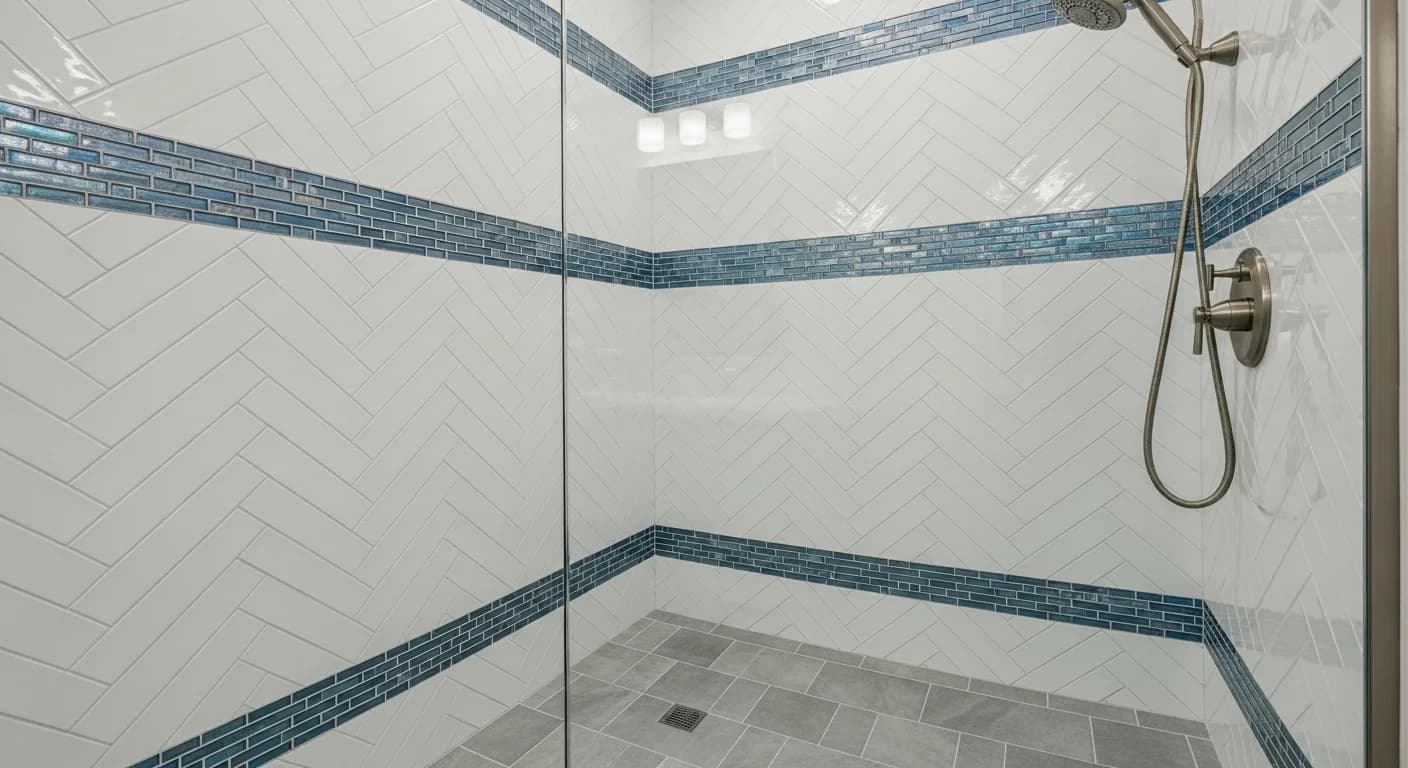
The tile pattern in a shower establishes visual rhythm, influences the perception of size, and determines whether the shower reads as a calm retreat or a bold design statement. Two showers using the identical 3x6-inch white ceramic tile look entirely different depending on whether that tile is laid in a classic brick bond, a stacked vertical orientation, or a herringbone pattern. Pattern selection is one of the highest-impact, lowest-cost design decisions in any shower project, because herringbone labor costs only $2–$4 more per square foot than running bond — but the visual difference is dramatic.
Understanding bathroom shower tile patterns requires more than browsing inspiration photos. Each pattern has structural implications: herringbone generates more waste than running bond (10–15% versus 5–8%), large-format tiles need flatter substrates than small-format mosaics, and certain patterns create optical illusions that make narrow showers feel wider or low ceilings feel taller. The grout color and width interact with every pattern to either emphasize or minimize the individual tile shapes.
This guide covers every major bathroom shower tile patterns category — classic, modern, decorative, and accent strategies — with specific dimensions, waste factors, cost implications, grout recommendations, and design rules for combining multiple patterns within a single shower. For broader tile design inspiration beyond showers, explore the complete bathroom tile guide.
Quick Summary
- Tile pattern choice affects cost, waste percentage, installation difficulty, and visual impact
- Classic patterns (subway, running bond, grid stack) suit traditional and transitional styles at the lowest installation cost
- Modern patterns (herringbone, chevron, stacked vertical) add visual energy with moderate cost increases
- Decorative patterns (hexagon, penny round, fish scale, arabesque) create artisanal character at higher material and labor costs
- Grout color selection has as much visual impact as the tile pattern itself — matching grout minimizes pattern, contrasting grout emphasizes it
- Feature walls using accent patterns on a single shower wall reduce cost while maximizing design impact
- Best for: Homeowners planning shower renovations, tile selection for new construction, upgrading shower aesthetics
- Reading time: 14 minutes
How Tile Pattern Affects Your Shower
Pattern determines three things simultaneously: the visual scale of the shower, the perceived direction of the space, and the level of visual activity. Horizontal patterns like running bond draw the eye sideways, making narrow showers feel wider. Vertical patterns like stacked vertical draw the eye upward, making low ceilings feel taller. Diagonal patterns like herringbone create visual energy that makes the shower a focal point. Large-format tiles with minimal grout lines create a calm, expansive feel, while small-format mosaics with dense grout lines add texture and visual complexity.
Installation difficulty and cost also vary by pattern. A basic grid stack or running bond pattern is the simplest to install, requiring standard cuts and minimal waste. Herringbone and chevron patterns require precise 45-degree cuts, generating 10–15% waste compared to 5–8% for straight patterns. Arabesque and fish scale tiles — with their curved edges — require careful hand-setting and produce 15–20% waste. Labor costs typically add $2–$6 per square foot above the base tile installation rate for complex patterns. Understanding these trade-offs helps balance the design vision with the project budget, and the tile ideas guide for floors and walls provides additional context for whole-bathroom tile planning.
Classic Patterns
Subway and Brick Bond
The subway tile pattern — originally designed for the New York City subway system in 1904 — remains the most popular shower tile layout in residential bathrooms. The classic configuration uses 3x6-inch rectangular tiles set in a brick bond (each row offset by half the tile width). The pattern reads as clean, timeless, and versatile enough to complement styles from farmhouse to contemporary. Subway tile in ceramic costs $1–$4 per square foot for material; in handmade or artisanal ceramic, $8–$25 per square foot. Installation labor runs $5–$10 per square foot for standard brick bond.
Running Bond
Running bond is the general term for any rectangular tile set with offset rows, regardless of tile size. While subway tile is a specific size (3x6 or 4x8), running bond applies to any rectangle — 4x16, 6x24, 3x12 — with the same half-offset alignment. Larger running bond tiles create a contemporary look with fewer grout lines. The offset can vary: 50% creates classic brick bond, while 33% (one-third stagger) creates a subtler rhythm.
Grid Stack
Grid stack — also called straight stack or straight set — aligns tiles in a perfect grid with no offset between rows. The resulting vertical and horizontal grout lines create a precise, geometric pattern that reads as contemporary and intentional. Grid stack works best with square tiles (4x4, 6x6, 8x8) or with rectangular tiles set vertically. The pattern demands perfectly level substrates and consistent grout widths, because any imperfection in alignment is immediately visible in the grid's strict geometry.
Modern and Geometric Patterns
Herringbone
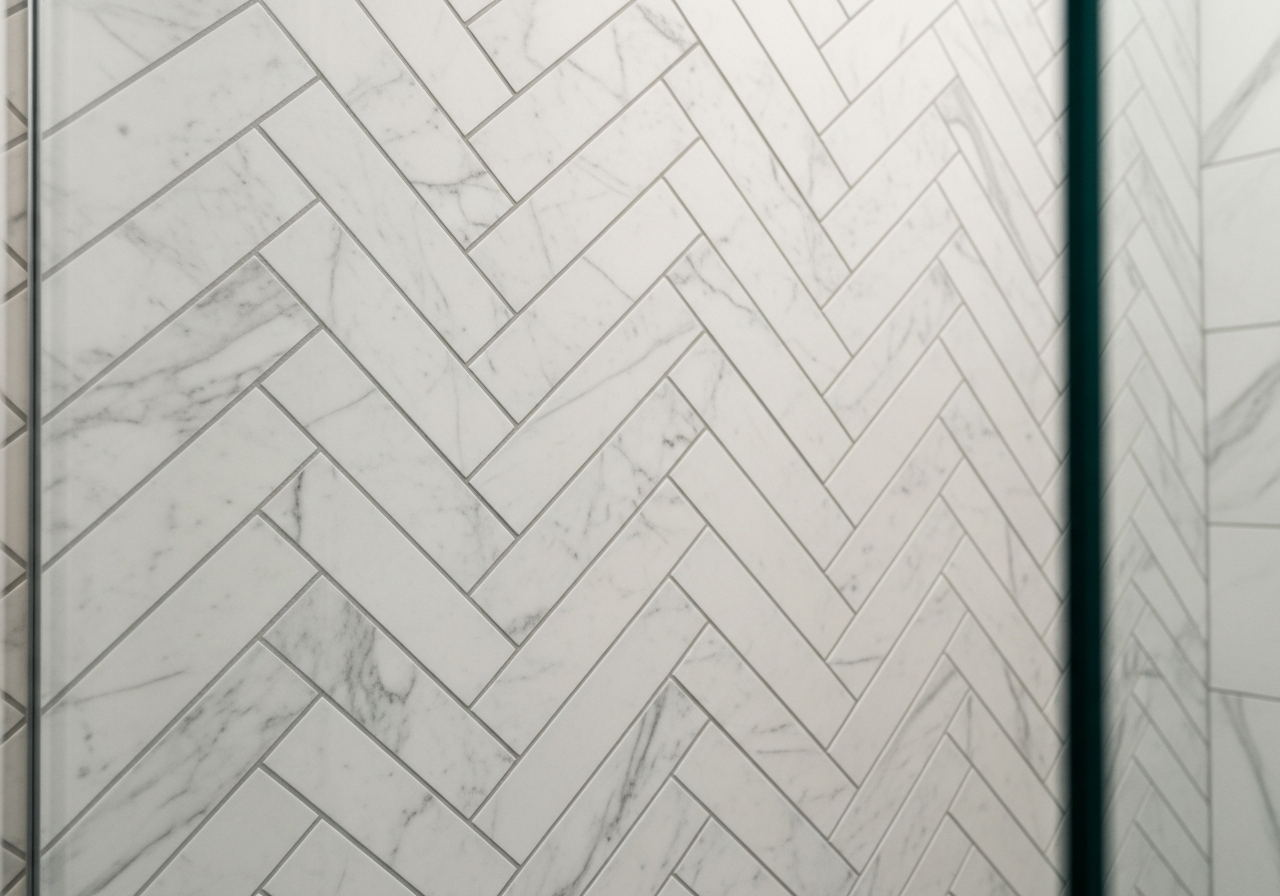
Herringbone arranges rectangular tiles in a V-shaped zigzag pattern, with each tile set at a 45-degree angle to the one beside it. The resulting pattern creates strong visual movement and a sense of luxury that elevates even basic subway tile into a design statement. Herringbone works best with tiles in a 1:2 or 1:3 length-to-width ratio — 2x4, 3x6, 2x8, or 1x4 are common choices. The 45-degree cuts at the shower edges generate 10–15% material waste, and installation labor costs $2–$4 more per square foot than running bond.
A popular variation is the double herringbone, which pairs two tiles per row instead of one, creating a wider, more relaxed zigzag. Herringbone can be oriented with the V pointing upward (adding perceived height) or sideways (adding perceived width). For walk-in shower designs, herringbone on the back wall with running bond on the side walls creates a striking focal point without overwhelming the entire enclosure.
Chevron
Chevron appears similar to herringbone but uses parallelogram-shaped tiles cut at angles rather than standard rectangles, creating a cleaner V-pattern where tiles meet at a precise point. Chevron tiles must be manufactured specifically for the pattern, with material costs running 20–40% higher due to specialized cutting. The visual effect is more formal and directional than herringbone.
Stacked Vertical
Stacked vertical takes standard rectangular tiles (3x6, 4x12, 2x8) and sets them vertically in a straight grid — no offset. The strong vertical grout lines draw the eye upward, making the shower feel taller. This pattern has gained significant popularity in contemporary and minimalist bathroom design because it feels modern without being complex. Installation cost is similar to a standard grid stack, and waste is minimal (5–8%). Stacked vertical pairs exceptionally well with contrasting grout that emphasizes the geometry, or matching grout for a subtle textured effect.
Decorative and Artisanal Patterns
Hexagon and Penny Round
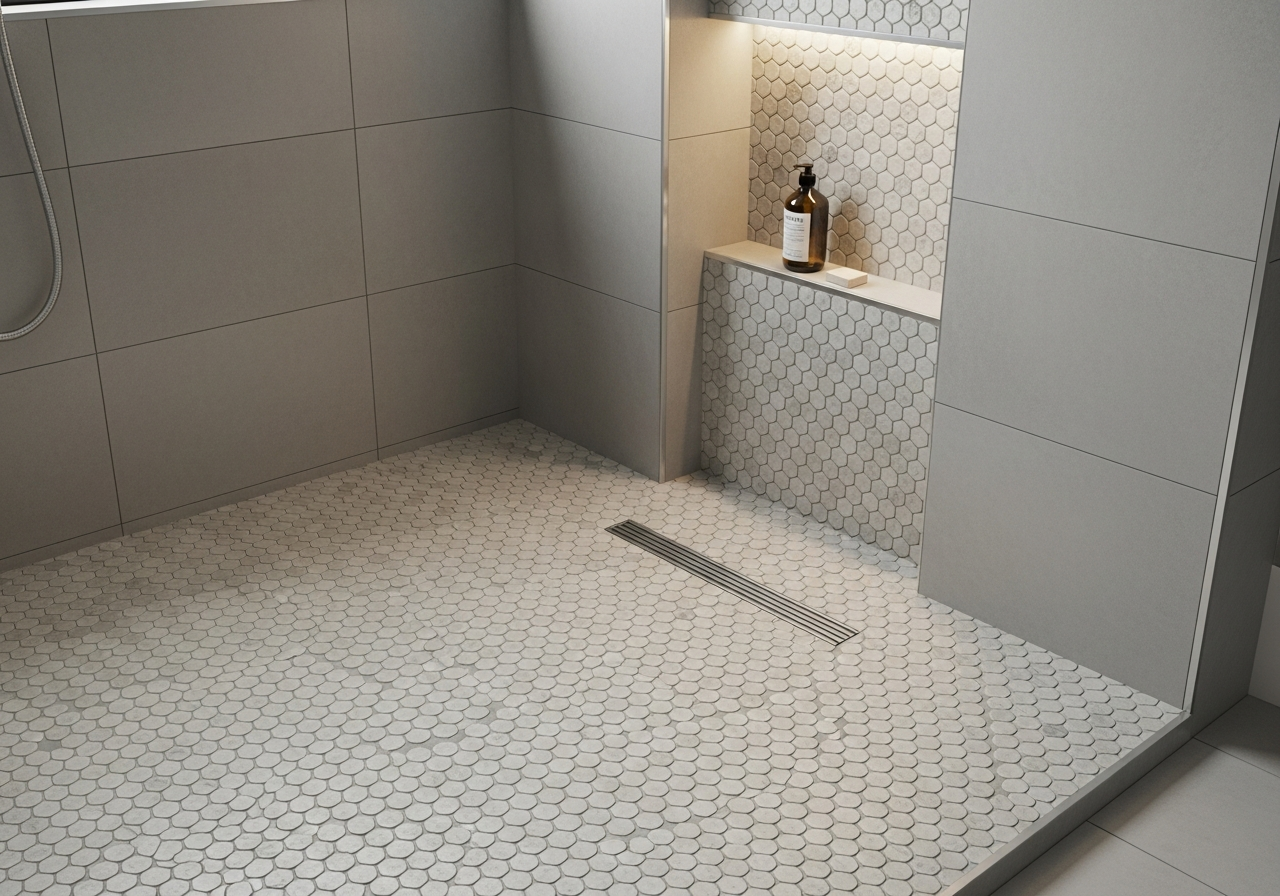
Hexagonal tiles create a honeycomb pattern that adds organic geometry to shower walls and floors. Sizes range from 1-inch hex mosaics on mesh backing to 8-inch individual hexagons. Small-format hex mosaics (1–2 inches) are particularly effective on shower floors because the dense grout lines provide traction. Penny rounds — circular tiles typically 3/4 to 1 inch in diameter — create a similar small-format mosaic with softer, more playful geometry. Both patterns conform easily to curved surfaces and recessed niches because the small individual tiles accommodate contours without cutting.
Fish Scale
Fish scale (also called fan tile or scallop) creates an overlapping arc pattern inspired by fish scales, Moorish architecture, and Art Deco design. Each tile is a semicircle or fan shape, typically 3–6 inches wide. Fish scale tiles are almost exclusively handmade or small-batch produced, with material costs of $15–$50 per square foot. Installation requires careful alignment and generates 15–20% waste at edges. The pattern reads as unmistakably decorative — best used on a feature wall or niche rather than covering all shower surfaces. Pair fish scale tiles with the warm, earthy bathroom color palettes trending in 2026 for a cohesive artisanal look.
Arabesque
Arabesque tiles (also called lantern tiles) create a Moorish-inspired pattern of interlocking curved shapes that introduces handcrafted, artisanal quality contrasting with the sharp lines of most bathroom fixtures. Arabesque tiles come in ceramic, porcelain, and natural stone, with material costs of $10–$35 per square foot. Like fish scale, the curved edges make cutting for straight borders complex — budget 15–20% extra material for waste. Arabesque pairs beautifully with luxury walk-in shower designs where the decorative tile serves as the centerpiece of the enclosure.
Feature Wall and Accent Strategies
A feature wall — one shower surface covered in a decorative or contrasting tile while the remaining walls use a simpler pattern — concentrates design impact while controlling material and labor costs. The most effective feature wall placement is the back wall (the wall facing the shower entry), because it receives the most direct visual attention. Side walls in a simpler running bond or grid stack create a neutral frame that allows the feature wall to stand out.
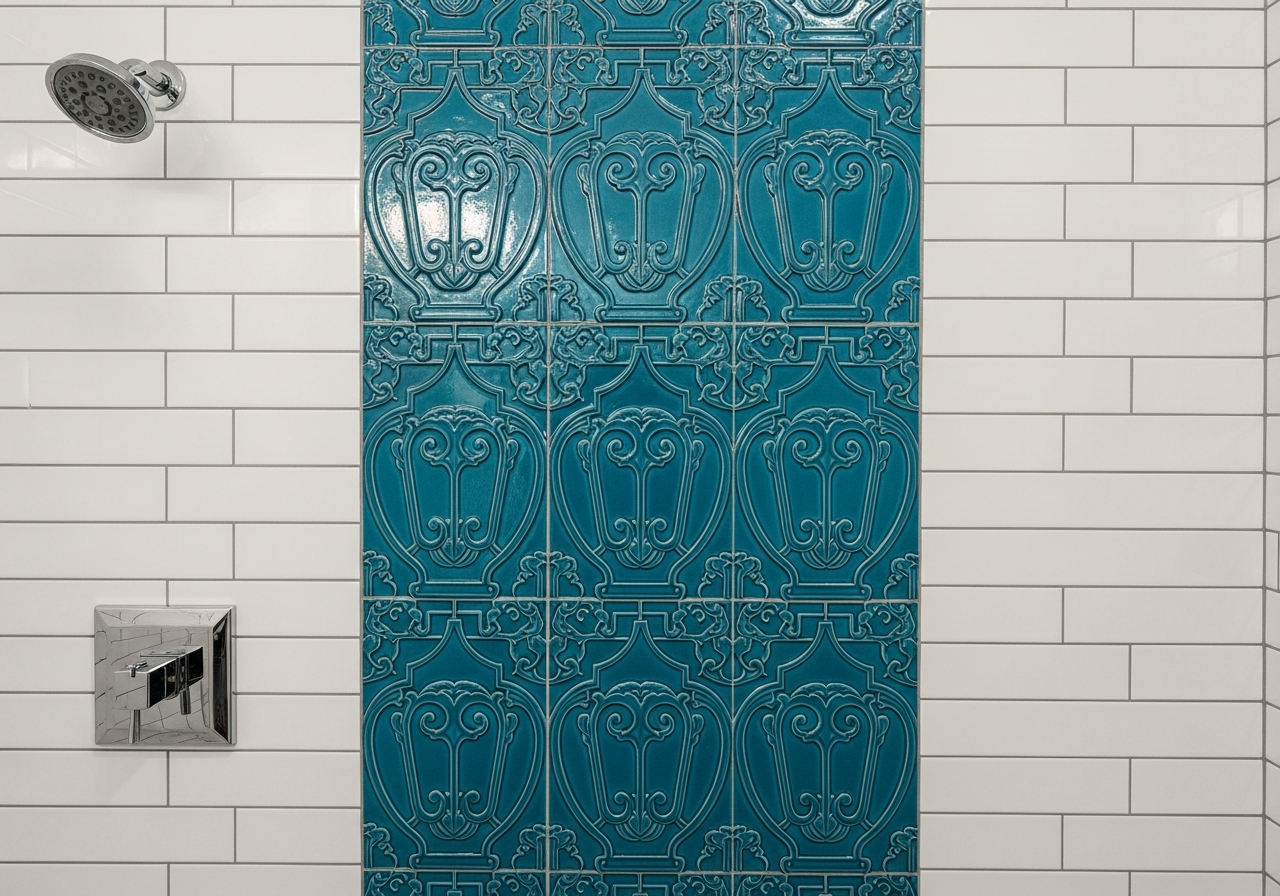
Accent strips — a horizontal band of contrasting tile running around the shower at chair-rail height (30–36 inches) or just below the showerhead (72 inches) — add visual interest with minimal material. A single row of decorative mosaic, metallic liner, or contrasting color creates a subtle break in the pattern that guides the eye. Border tiles with bullnose edges create clean transitions between different tile types on the same surface. The bathroom color scheme guide helps coordinate tile colors with the overall palette for cohesive results.
Combining Multiple Tile Types
Mixing tile patterns within a single shower follows specific rules that separate cohesive compositions from visual chaos. The luxury walk-in shower guide showcases professional examples of multi-pattern combinations that work. The primary rule: limit the shower to a maximum of three tile types. A typical three-tile combination uses a field tile (covering the majority of wall surfaces), an accent tile (feature wall or decorative band), and a floor tile (small-format for traction). Each tile should share at least one visual element — color, material, or finish — to create continuity.
Scale contrast creates the strongest compositions: pair large-format field tiles (12x24 or 4x16) with small-format accent mosaics (1x1 or 2x2). Mixing two large-format tiles or two small-format tiles creates competition rather than contrast. Pattern contrast follows the same principle: pair a simple pattern (running bond or grid stack) with a complex pattern (herringbone or arabesque) rather than two complex patterns that fight for attention.
Shower Niche Tile Design
Shower niches — recessed shelving built into the shower wall — provide storage for toiletries without protruding into the shower space. The standard niche measures 12x24 inches (fitting between standard 16-inch-on-center studs) with a 3.5-inch depth. Tiling the niche interior with a contrasting pattern transforms it into a decorative element — popular treatments include penny round mosaics inside a running bond field or marble inside a porcelain field.
The niche border requires careful attention: bullnose trim, Schluter metal edging, or mitered tile edges create clean transitions between the niche interior and the surrounding wall tile. A waterfall pattern — where the field tile continues uninterrupted into and through the niche — creates a seamless look that emphasizes the niche as an architectural feature rather than an interruption.
Grout Color and Width Selection
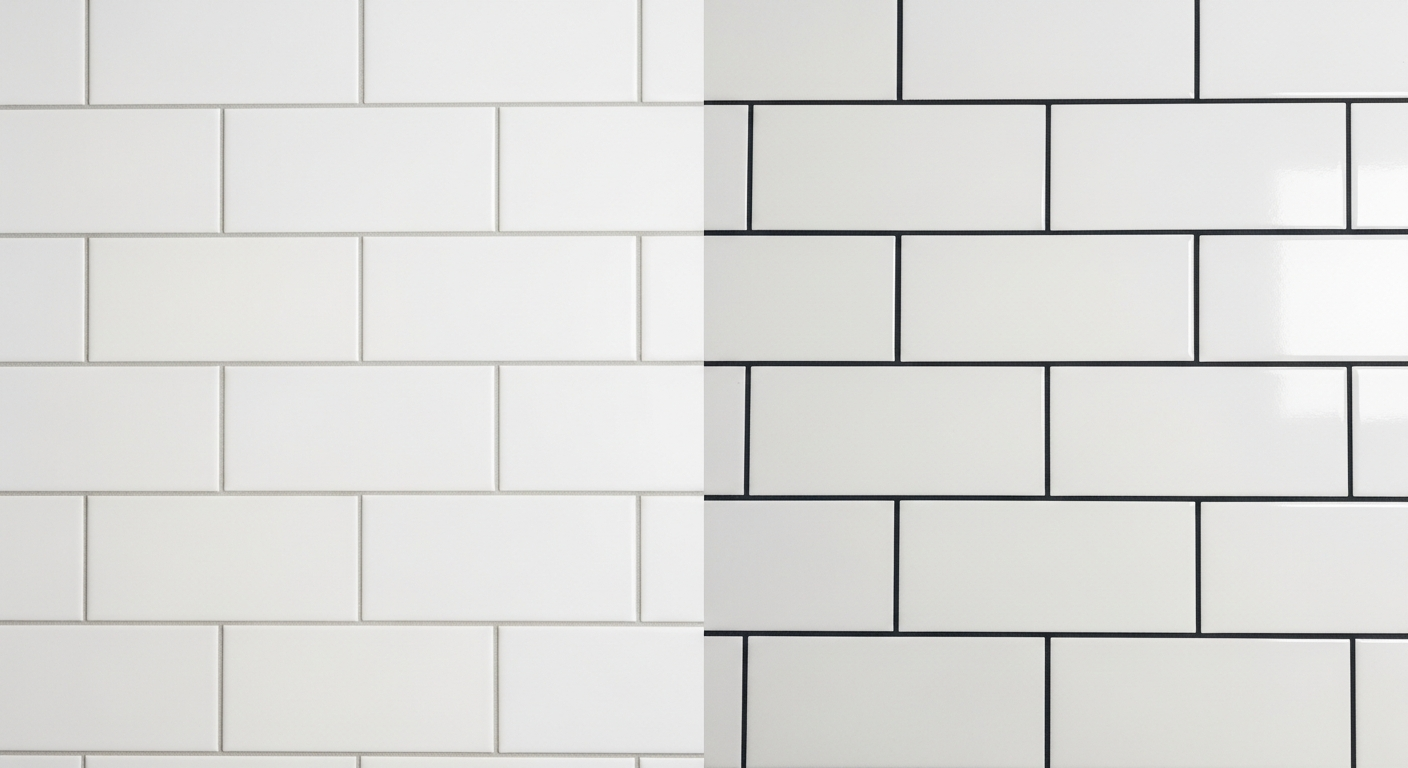
Grout color has as much visual impact as the tile itself. Matching grout (same color as the tile) minimizes the visibility of individual tiles, creating a more uniform, monolithic surface. Contrasting grout (darker or lighter than the tile) emphasizes the pattern geometry, making each tile distinct. A white subway tile with white grout reads as a clean, seamless surface; the same tile with charcoal grout reads as a bold geometric pattern. Neither approach is inherently better — the choice depends on whether the design intent prioritizes the pattern or the surface.
Grout width affects both aesthetics and maintenance. Narrow grout lines (1/16 inch) create a tighter, refined look. Standard grout lines (1/8 inch) suit most rectangular tiles. Wider grout lines (3/16 to 1/4 inch) are necessary for handmade tiles and deliberately emphasize the pattern. Epoxy grout resists staining and moisture better than cement-based grout ($4–$8 per pound versus $0.50–$2 for cement grout), making it the preferred shower choice.
Tile Size Guide for Showers
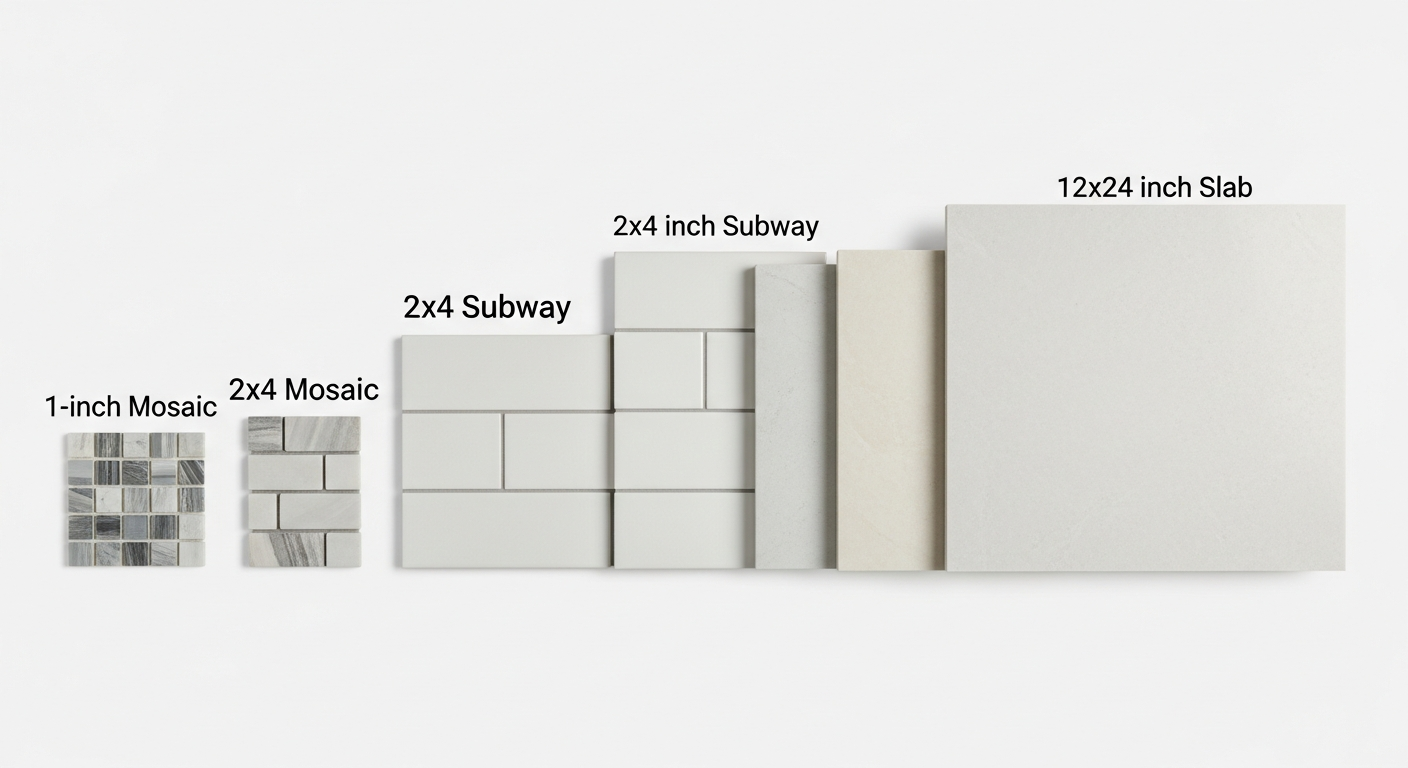
Tile size affects the perception of shower proportions, the number of grout lines (and therefore maintenance), and the installation complexity.
- Small format (1x1 to 2x2 inches): Best for shower floors (high traction from grout lines), niche interiors, and curved surfaces. Mesh-backed sheets speed installation. Material cost: $5–$30 per square foot.
- Medium format (3x6 to 4x12 inches): The versatile standard for shower walls. Enough grout lines for visual texture without overwhelming maintenance. Accommodates most patterns. Material cost: $2–$20 per square foot.
- Large format (12x24 to 24x48 inches): Fewer grout lines create a sleek, contemporary look. Requires a very flat substrate (within 1/8 inch over 10 feet). Marble-look porcelain in large format mimics natural stone slabs at a fraction of the cost. Material cost: $4–$25 per square foot.
- Slab format (48x96 inches and larger): Porcelain slabs cover entire shower walls with zero or minimal grout lines. Creates a monolithic, luxury appearance. Requires specialized installation with suction-cup handling equipment. Material cost: $15–$60 per square foot.
For shower floors specifically, tiles 4 inches or smaller are recommended because the grout lines provide traction and the smaller tiles conform to the floor slope more smoothly than large tiles. Large-format floor tiles may require lippage (uneven tile edges) at the slope transitions, creating both a tripping hazard and a visual flaw.
Frequently Asked Questions
What is the most popular shower tile pattern?
The classic subway tile in brick bond (3x6-inch tiles with half-offset rows) remains the most widely installed bathroom shower tile patterns choice due to its timeless appearance, low cost ($1–$4/sq ft), and straightforward installation. Stacked vertical subway tile is the fastest-growing alternative, favored in contemporary and minimalist designs.
Does herringbone tile cost more to install?
Herringbone installation costs $2–$4 more per square foot in labor compared to running bond due to the 45-degree angle cuts required at every edge. Material waste also increases to 10–15% versus 5–8% for straight layouts, adding to the total cost. For a standard 40-square-foot shower, expect $150–$250 additional total cost for herringbone.
What grout color is best for shower tile?
There is no universally best grout color — it depends on the desired visual effect. Matching grout creates a clean, uniform surface that hides dirt but can appear monotonous. Contrasting grout emphasizes the tile pattern dramatically but shows discoloration more readily. Medium-gray grout offers a practical compromise that complements most tile colors while concealing wear. Epoxy grout in any color resists staining and mildew significantly better than cement-based alternatives.
Can you mix tile patterns in a shower?
Mixing patterns works best when limited to three tile types that share a common element (color family, material, or finish). The standard approach uses a simple field pattern on most walls, a decorative accent on one feature wall, and a small-format mosaic on the floor. Avoid pairing two complex patterns (herringbone and arabesque, for example) on adjacent surfaces — the visual competition creates chaos rather than character.
What tile size is best for small showers?
Medium-format tiles (3x6 to 4x12 inches) work best in small showers, providing enough visual interest without overwhelming the space with grout lines. Large-format tiles (12x24) can make a small shower feel larger by reducing grout lines, but only if the substrate is perfectly flat. Avoid very small mosaics on all shower walls in tight spaces — the dense grout lines can make the enclosure feel busy and smaller. Use the project gallery to see how different tile sizes perform in various shower dimensions. Compare renovation pricing plans to find the right visualization option for your tile project.
Visualize Your Shower Tile with HanoDecor
Selecting bathroom shower tile patterns from samples and swatches rarely captures how the pattern will look at scale in your actual shower. Upload a photo of your bathroom and preview herringbone, subway, hexagon, and other patterns rendered on your shower walls with accurate proportions and lighting. Our bathroom remodel visualizer lets you experiment with grout colors, tile sizes, feature wall placements, and niche designs — eliminating guesswork and ensuring the final result matches your vision before a single tile is set.
Bathroom Shower Tile Patterns FAQs
Written by
Emily Rodriguez
Interior Design Editor covering living spaces, styling trends, and room makeovers. Former Architectural Digest contributor with a focus on accessible, budget-conscious design.