AI Color Palette Generators: How Machine Learning Picks Perfect Colors
Quick Summary
An in-depth exploration of how AI color palette generators use machine learning, neural networks, and deep learning models to create harmonious color schemes. Covers mood-based generation, trend prediction, top AI tools including Colormind, Khroma, and Huemint, and practical guidance on when to trust versus override AI color suggestions for interior design projects.


An AI color palette generator does something no traditional color wheel can — it learns from millions of real-world examples to predict which color combinations humans find most appealing. While conventional palette tools apply fixed mathematical formulas like complementary or triadic harmony rules, AI generators use neural networks trained on photographs, artwork, interior designs, and fashion collections to produce palettes that feel emotionally resonant rather than merely technically correct.
The rise of AI-powered color tools represents a fundamental shift in how designers and homeowners approach color selection. Instead of starting from color theory textbooks, you can now describe a mood — calm coastal retreat, energetic urban loft, warm rustic farmhouse — and receive a palette that captures that feeling. This guide explains how the technology works, compares the best AI palette generators available, and shows you when to trust the machine versus when to override its suggestions.
What Makes AI Color Palette Generators Different
Traditional color palette tools rely on the color wheel and mathematical relationships. Complementary colors sit 180 degrees apart, triadic colors form an equilateral triangle, and analogous colors occupy adjacent positions. These formulas guarantee harmony but produce predictable results. An analogous blue palette from Paletton looks nearly identical to an analogous blue palette from Adobe Color because both apply the same mathematical rule.
AI palette generators break free from these constraints. They learn color preferences from massive datasets — Colormind trains on movie stills, photography, and art; Khroma learns from your personal selections; Huemint generates palettes optimized for specific design contexts like websites and logos. The AI captures subtle relationships that mathematical formulas miss, such as the specific shade of warm white that pairs best with sage green in Scandinavian interiors or the exact terracotta that complements deep navy in Mediterranean design.
How Machine Learning Analyzes Color Relationships
Most AI palette generators use a type of neural network called a generative adversarial network (GAN) or a variational autoencoder (VAE). These models are trained on datasets containing thousands to millions of color combinations extracted from curated sources — professional photographs, award-winning interior designs, fashion collections, and graphic design portfolios.
During training, the model learns which color combinations co-occur in aesthetically successful designs and which combinations are avoided. It builds an internal representation of color space that encodes relationships far more nuanced than simple complementary or analogous rules. The model understands, for example, that dusty rose pairs well with both sage green and charcoal gray, but the optimal shade of each depends on the context — a nursery calls for lighter tints while a dining room benefits from deeper saturations.
Pattern recognition is the key advantage. Where a human designer might reference 50 to 100 design projects in their career, an AI model has analyzed millions. It identifies color trends, regional preferences, and style-specific palettes at a scale no individual can match. For a comparison of AI versus traditional tools, see our free palette generator comparison.
Top AI-Powered Color Palette Tools
Colormind is a deep learning color palette generator trained on photographs, movies, and art. It generates five-color palettes that feel organic and grounded because the training data captures real-world color relationships rather than abstract mathematical rules. You can lock one or more colors and let the AI fill in harmonious companions. The results consistently produce palettes with natural warmth and depth that pure color wheel tools struggle to replicate.
Khroma takes personalization further by learning your individual color preferences. After you select 50 colors you like from a curated set, Khroma's algorithm generates an infinite stream of two-color and four-color combinations tailored to your taste. The more you use it, the more refined its suggestions become. This makes Khroma especially valuable for designers developing a consistent personal aesthetic across multiple projects.
Huemint specializes in generating palettes optimized for specific design applications — websites, logos, brand identities, and print layouts. Unlike general-purpose generators, Huemint understands that a website hero section needs different color contrasts than a business card or a mobile app interface. It previews each palette on realistic mockups so you can evaluate practical usability before committing.
The HanoDecor Color Palette Generator applies AI to interior design specifically, generating palettes optimized for room contexts — wall colors, furniture finishes, textile accents, and lighting conditions. This domain-specific training means the palettes work immediately for home design projects without requiring translation from abstract swatches to real-world surfaces.
Mood-Based Color Generation: From Emotion to Palette
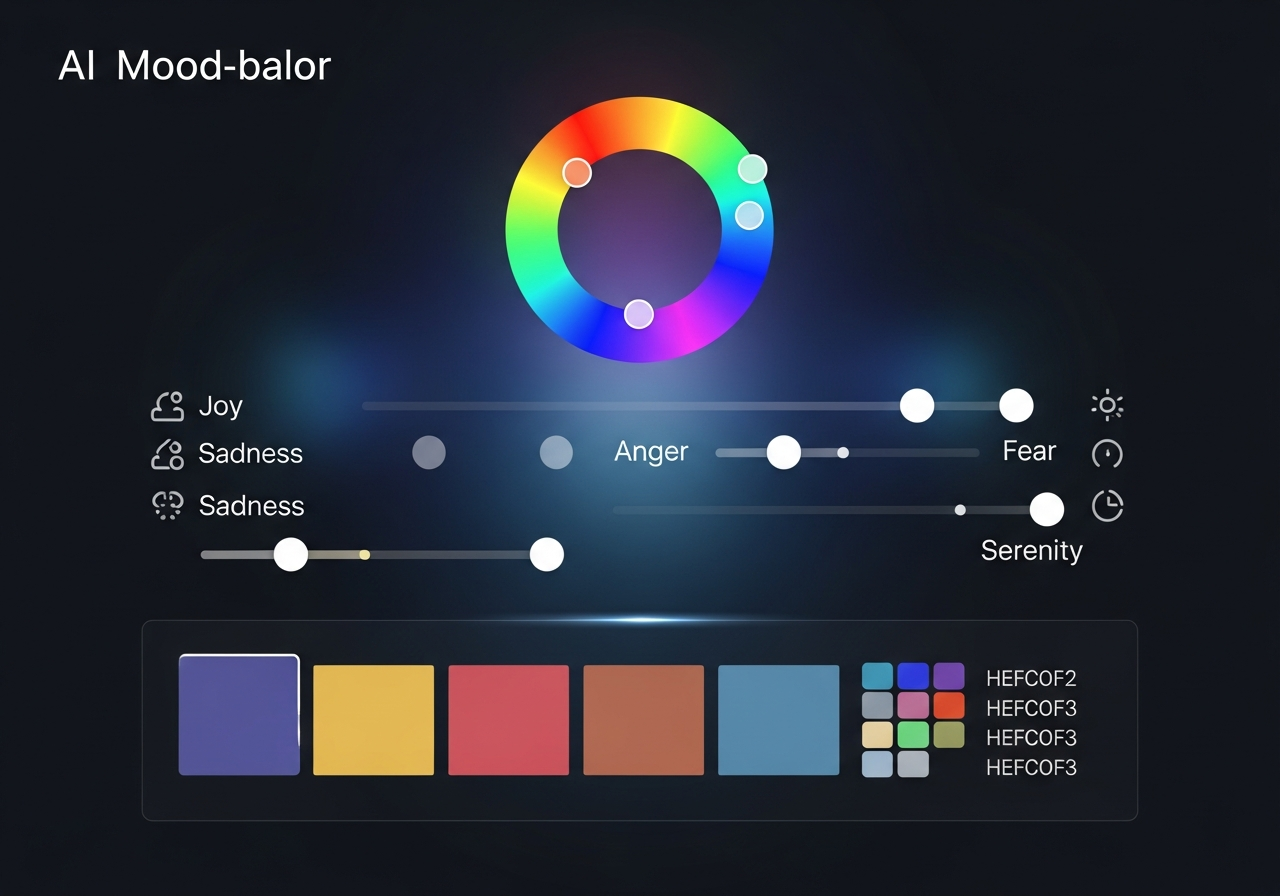
One of the most powerful features of AI palette generators is mood-based generation. Instead of starting with a specific color, you describe the feeling you want — serene, energetic, luxurious, cozy, dramatic, playful — and the AI translates that emotional intent into a corresponding color palette. This bridges the gap between how homeowners think about their spaces (in terms of feelings) and how designers work (in terms of specific colors).
The AI understands color psychology at a nuanced level. It knows that serenity maps to soft blues, sage greens, and warm whites — but also that the specific shade matters. A slightly gray-blue creates calm while a bright cerulean creates energy. A muted sage feels restful while a vivid emerald feels dramatic. These subtle distinctions are exactly what AI models excel at because they have seen thousands of examples of each emotional intention executed successfully.
For interior design, mood-based generation is transformative. Homeowners can articulate what they want their bedroom to feel like without knowing anything about color theory, and the AI translates that vision into actionable paint colors and fabric selections. This democratizes professional-quality design in ways that traditional tools cannot. Learn more about applying mood palettes to rooms in our home decor color palette guide.

AI Color Palettes for Interior Design Projects
AI palette generators are particularly powerful for interior design because they can account for variables that static color wheels ignore — natural lighting direction, room size, ceiling height, existing fixed elements like flooring and countertops, and the desired emotional atmosphere. A north-facing room that receives cool blue-tinted daylight needs warmer palette choices than a south-facing room bathed in golden light. AI models trained on interior photography learn these contextual rules automatically.
The HanoDecor Room Designer and AI House Painter integrate AI palette generation with photorealistic room visualization. You can generate a palette, apply it to your room photo, and see exactly how the colors interact with your existing furniture and lighting — all before purchasing a single paint sample. This combination of AI palette intelligence and visual preview eliminates the most common source of design regret: colors that looked perfect on a swatch but wrong on the wall.
For extracting palettes from photos of rooms you admire, our photo-based palette guide covers five methods that pair perfectly with AI generation tools.
Limitations and When to Override AI Suggestions
AI palette generators are not infallible. They learn from training data, which means they can reflect biases present in that data — overrepresenting popular Western interior design styles, favoring trendy colors over timeless ones, or suggesting combinations that work photographically but feel different in person. AI models also cannot account for your personal memories and emotional associations with specific colors.
Override AI suggestions when: you have a strong personal preference for a specific color that the AI keeps replacing; the AI generates a trendy palette when you want something timeless; the suggested colors conflict with fixed elements in your room that the AI cannot see; or the palette looks great on screen but feels wrong when you hold physical paint samples under your room's actual lighting. Always order physical samples before committing to AI-generated colors for large surfaces like walls.
The best workflow combines AI generation for initial exploration with human judgment for final selection. Use AI to discover combinations you might never have considered, then refine those suggestions based on your personal taste, your room's specific conditions, and the physical reality of paint and fabric under your lighting. This hybrid approach produces consistently better results than either pure AI or pure intuition alone.
Related Articles
Continue exploring AI-powered design tools: Best Free Color Palette Generators Compared reviews 10 tools including AI-powered options. How to Generate a Color Palette from a Photo covers five extraction methods. How to Use AI to Redesign a Room goes beyond color to full room visualization. Browse the design gallery for AI-generated interior design inspiration.
Frequently Asked Questions
Are AI color palette generators better than traditional color wheels?
AI generators and color wheels serve different purposes. AI generators excel at producing emotionally resonant, contextually appropriate palettes by learning from real-world examples. Color wheels guarantee mathematical harmony and give you precise control over color relationships. For most design projects, the best results come from using AI for initial palette exploration and color wheel tools for fine-tuning specific values.
How do AI palette generators learn my preferences?
Tools like Khroma use a preference-learning algorithm that analyzes the colors you select during an initial training phase (typically 50 color choices). The AI identifies patterns in your selections — whether you tend toward warm or cool tones, high or low saturation, dark or light values — and generates palettes that match your personal taste profile. The more you interact with the tool, the more refined its suggestions become.
Can AI generate palettes for specific room types?
Yes. Domain-specific AI generators like the HanoDecor Color Palette Generator are trained on interior photography and understand how colors interact in specific room contexts. They account for variables like natural lighting, room size, and the relationship between wall colors, flooring, and furniture finishes. General-purpose AI tools like Colormind produce beautiful palettes but require manual translation to room-specific applications.
Do AI palette generators work for non-interior design projects?
Absolutely. AI palette generators are used extensively in branding, web design, fashion, product design, and digital art. Huemint specializes in web and brand palettes, Khroma works across all design disciplines, and Colormind's training data spans photography, film, and art. The underlying technology — neural networks learning color relationships — applies universally across creative fields.
How accurate are AI-generated color palettes?
AI-generated palettes are highly accurate for creating harmonious color combinations that most people find appealing. However, accuracy depends on context. Screen colors never perfectly match physical paint, fabric, or materials. Always validate AI-generated palettes with physical samples in your actual space under your actual lighting conditions. The AI provides an excellent starting point, but final selection should always involve real-world testing.
Try AI-Powered Color Palette Generation with HanoDecor
Ready to experience what AI can do for your color selection process? The HanoDecor Color Palette Generator combines machine learning with interior design expertise to create palettes optimized for real rooms. Describe your desired mood, upload a room photo, or start from a single color — the AI generates harmonious palettes and shows you how they look in your space instantly.
Explore the full HanoDecor Studio for AI-powered room redesign, house painting visualization, and design idea exploration. Visit our design ideas hub for curated inspiration across every room type and design style.

AI Color Palette Generators FAQs
Written by
Priya Sharma
Priya is an award-winning UX designer who previously led design teams at Airbnb and Pinterest. Her focus on user-centered design ensures that HanoDecor's tools are intuitive and accessible to everyone, regardless of their technical background.