Famous Gothic Architecture: 20 Iconic Buildings That Defined an Era

Why These 20 Buildings Matter
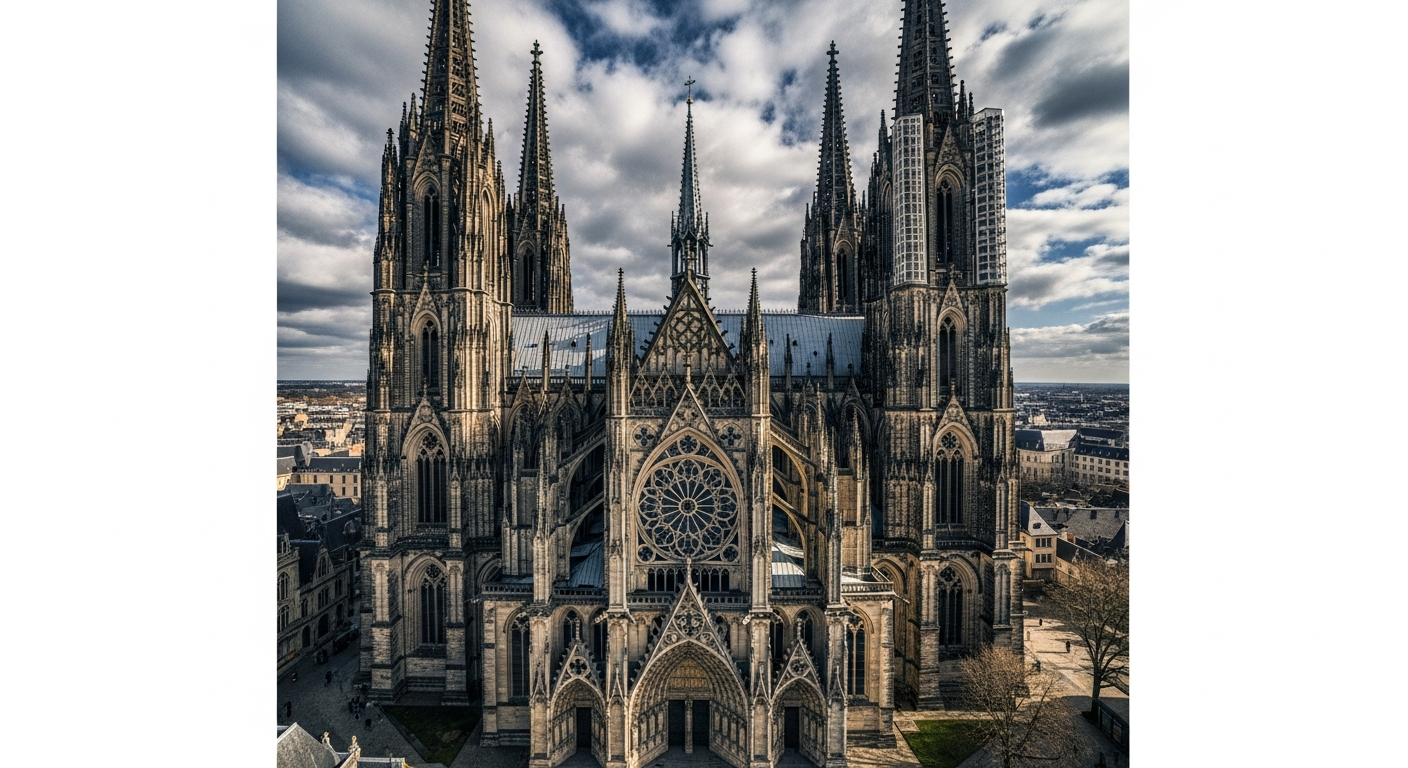
Gothic architecture spanned nearly four centuries, from its birth in the Île-de-France region around 1140 to the final flourishes of the Flamboyant style after 1500. In that time, master masons and their patrons created buildings of such extraordinary ambition that many remain the largest, tallest, and most technically daring structures in their cities nearly a millennium later. These are not relics frozen in time. They are living monuments, active places of worship, UNESCO World Heritage Sites, and enduring sources of architectural inspiration.
The twenty buildings in this guide were chosen for three reasons. First, each represents a significant achievement in gothic structural innovation, whether the first use of flying buttresses, the tallest stone spire, or the largest expanse of medieval stained glass. Second, each had a measurable influence on buildings that followed, establishing regional traditions or pushing other builders to attempt something even more ambitious. Third, each remains accessible to visitors today, making this guide both an architectural education and a practical travel reference.
We have organized the buildings by region, following the geographic spread of the gothic style from its French origins across England, Central Europe, Southern Europe, and beyond. For a deeper understanding of the complete history and theory of gothic architecture, start with our pillar guide. For the structural elements that define the style, see our characteristics and elements guide.
French Gothic Masterpieces
France is where gothic architecture was born, and French cathedrals remain the gold standard against which all other gothic buildings are measured. The five buildings below trace the style from its confident emergence at Notre-Dame through the structural perfection of Amiens to the luminous extremes of Sainte-Chapelle and the dramatic single spire of Strasbourg.

Notre-Dame de Paris (1163–1345)
Notre-Dame de Paris is arguably the most famous gothic building in the world. Construction began in 1163 under Bishop Maurice de Sully and continued for nearly two centuries, producing a cathedral that synthesized the experimental innovations of Early Gothic architecture into a coherent, monumental whole. The building stretches 128 meters long with a nave rising 33 meters, dimensions that were breathtaking for the twelfth century.
Notre-Dame's most celebrated features include its pioneering flying buttresses, added around the choir in the 1180s and later extended along the nave. These graceful, double-arched struts were among the first to be fully exposed and celebrated as architectural elements rather than hidden beneath aisle roofs. The three great rose windows, each approximately 13 meters in diameter, remain masterpieces of medieval glass art. The west facade, with its three portals, gallery of kings, and twin towers rising to 69 meters, established the template for French cathedral facades for generations.
The devastating fire of April 15, 2019, destroyed the nineteenth-century spire and most of the lead-and-timber roof. The ongoing restoration, which aims for completion by 2024, has revealed extraordinary details about medieval construction techniques while reaffirming the cathedral's structural resilience. The stone vaults, despite the inferno above them, largely held, a testament to the engineering precision of their twelfth-century builders.
Chartres Cathedral (1194–1220)
Chartres Cathedral represents the moment when gothic architecture reached maturity. After a fire destroyed most of the previous building in 1194, the new cathedral was constructed with remarkable speed, producing an unusually unified design that became the model for High Gothic construction. Standing 34 meters to the vault, Chartres introduced the three-story elevation, eliminating the gallery level of Notre-Dame to create a clerestory of unprecedented height and light.
Chartres is home to the best-preserved collection of medieval stained glass in the world. More than 150 windows containing over 4,000 individual figures survive from the early thirteenth century, their famous "Chartres blue" coloring produced by cobalt oxide that has never been precisely replicated. The Royal Portal on the west facade, dating from the 1140s, is the finest surviving example of Early Gothic sculptural art, its elongated column-figures representing a revolutionary integration of sculpture and architecture.
Amiens Cathedral (1220–1270)
Amiens Cathedral is the tallest complete gothic cathedral in France and a pure expression of High Gothic ambition. The nave vault soars to 42.3 meters, surpassing both Notre-Dame and Chartres by significant margins. The interior volume is so vast, at approximately 200,000 cubic meters, that the entire population of medieval Amiens could have fit inside with room to spare.
The west facade features a sculptural program of extraordinary richness, including the famous Beau Dieu figure on the central portal's trumeau. The choir enclosure contains a remarkable cycle of polychrome reliefs depicting the lives of Saints John the Baptist and Firmin. Originally, the entire cathedral exterior was painted in vivid colors, a fact confirmed by laser cleaning and ultraviolet light analysis that revealed traces of the original medieval paint scheme.
Sainte-Chapelle, Paris (1248)
Sainte-Chapelle is the supreme achievement of Rayonnant Gothic architecture, a style that pushed the dissolution of walls to its logical extreme. Built by King Louis IX to house his collection of Passion relics, the upper chapel is essentially a glass box: fifteen windows, each 15 meters tall, fill 670 square meters with 1,113 scenes from the Old and New Testaments. The stone mullions between the windows are so slender they seem barely adequate to support the vaulted ceiling above.
The chapel demonstrates that gothic architecture was not solely about size. At just 36 meters long and 17 meters wide, Sainte-Chapelle is intimate compared to the great cathedrals. Its power lies in the overwhelming concentration of colored light and gilded decoration, creating an interior that contemporaries compared to standing inside a jewel box. The restoration of the glass in the nineteenth century by Steinheil and Lusson preserved the medieval panels while replacing losses with historically informed reproductions.
Strasbourg Cathedral
Strasbourg Cathedral stands at the cultural crossroads of France and Germany, and its architecture reflects both traditions. The nave, begun in the mid-thirteenth century, follows French High Gothic models with a three-story elevation and six-part vaults. The west facade, however, is a masterpiece of German-influenced Late Gothic tracery, its surface covered with an intricate screen of openwork stone that seems to float in front of the wall behind it.
The cathedral's most distinctive feature is its single spire, rising 142 meters on the north tower. The south tower was never completed, giving the building its characteristic asymmetrical silhouette. From 1647 to 1874, it was the tallest building in the world. Inside, the elaborate astronomical clock, rebuilt in the 1840s using the original 1574 mechanism as a guide, computes solar and lunar eclipses, equinoxes, and a procession of automated figures that perform daily at solar noon.
English Gothic Landmarks
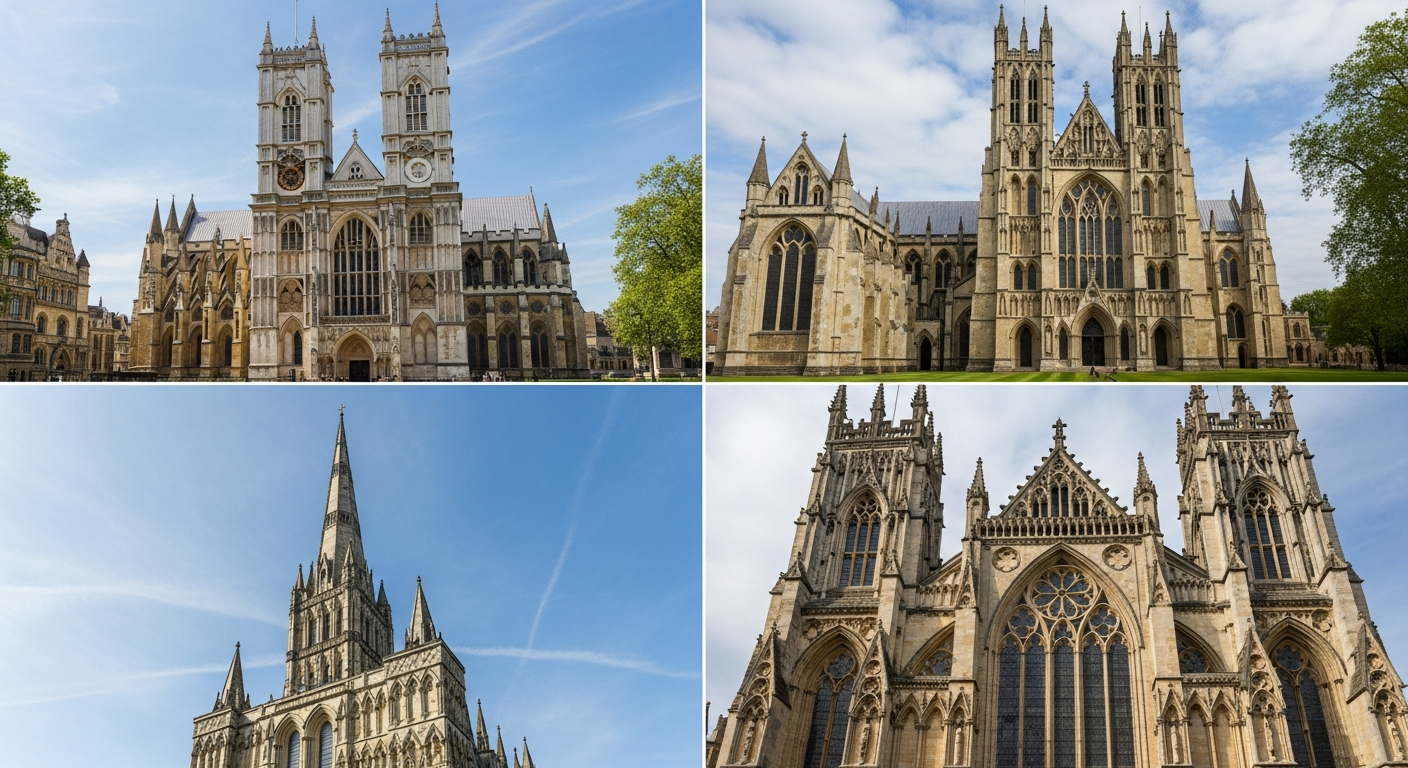
English Gothic architecture developed its own distinctive character, moving through three clearly defined phases: Early English (1180–1275), characterized by lancet windows and restrained elegance; Decorated (1275–1380), marked by elaborate tracery and flowing curves; and Perpendicular (1380–1520), distinguished by vertical panel tracery and spectacular fan vaults. The four buildings below represent the finest achievements of these phases.
Westminster Abbey, London
Westminster Abbey is England's coronation church and one of the finest examples of Perpendicular Gothic architecture. The present building was begun by Henry III in 1245 in a French-influenced High Gothic style, with a nave that rises to 31 meters, making it the tallest gothic nave in England. The building evolved over three centuries, with the west towers added in the eighteenth century by Nicholas Hawksmoor in a sympathetic gothic style.
The Henry VII Lady Chapel, completed in 1519, contains the most spectacular fan vaulting in existence. The pendant fan vaults appear to hang from the ceiling like stalactites, a structural tour de force that represents the absolute pinnacle of English Gothic stone carving. The chapel's stained glass, carved stalls, and bronze gates make it one of the most richly decorated spaces in Europe.
Canterbury Cathedral
Canterbury Cathedral holds a unique place in English architectural history as the site where gothic architecture first arrived in England. After a fire in 1174, the French mason William of Sens was hired to rebuild the choir in the new gothic style, bringing pointed arches and ribbed vaults across the English Channel for the first time. The cathedral thus embodies the full evolution of English Gothic, from the Early English choir through the Decorated nave to the Perpendicular Bell Harry Tower.
As the site of Thomas Becket's martyrdom in 1170 and England's premier pilgrimage destination, Canterbury's architecture served both liturgical and processional needs. The raised choir, the descending steps to the crypt, and the ascending steps to the Trinity Chapel where Becket's shrine stood create a dramatic architectural narrative that guided pilgrims through a carefully choreographed spatial experience.
Salisbury Cathedral (1220–1258)
Salisbury Cathedral is the purest expression of the Early English Gothic style. Unlike most medieval cathedrals, which were built and rebuilt over centuries, Salisbury was constructed in a single campaign of just 38 years, producing an exceptionally unified design. The building's proportions are elegant and restrained, with lancet windows, slender Purbeck marble shafts, and a horizontal emphasis that contrasts with the relentless verticality of French Gothic.
The cathedral's tower and spire, added between 1310 and 1330, rise to 123 meters, making it the tallest medieval structure in the United Kingdom. The spire was an audacious addition to a building not originally designed to support it, and the resulting structural stresses have required centuries of engineering intervention. The crossing piers visibly bow under the 6,500-ton load, a reminder that medieval builders sometimes pushed their materials to the absolute limit.
York Minster
York Minster is the largest medieval gothic cathedral in Northern Europe and the finest showcase of the Decorated Gothic style. The Great East Window, completed in 1408 by glazier John Thornton, measures approximately 23.7 by 9.4 meters, making it the largest expanse of medieval stained glass in the world. Its 311 panels depict the beginning and end of the world, from Genesis to Revelation.
The chapter house, an octagonal space with no central column, is covered by a timber vault spanning 18 meters without intermediate support, a remarkable feat of medieval carpentry. The west facade features a Decorated-style window with flowing, curvilinear tracery that epitomizes the style's love of organic, flame-like patterns. A devastating fire in 1984 destroyed the south transept roof but spared the medieval rose window, which was painstakingly restored over four years.
German and Central European Gothic
Gothic architecture arrived in the German-speaking lands somewhat later than in France and England, but German builders quickly developed distinctive regional variations. Brick Gothic dominated the Baltic coast where building stone was scarce, while the hall church, or Hallenkirche, with its aisles the same height as the nave, became a uniquely Central European contribution to the style. For a detailed comparison of regional gothic traditions, see our dedicated guide.

Cologne Cathedral (1248–1880)
Cologne Cathedral is one of the most extraordinary stories in architectural history. Construction began in 1248, following the French High Gothic model of Amiens, but halted around 1473 with only the choir, south tower base, and partial nave completed. For nearly four centuries, a massive crane sat atop the unfinished south tower, becoming an iconic symbol of the city. When construction resumed in 1842, builders used the original medieval plans, discovered in Darmstadt and Paris, to complete the building in a faithful continuation of the thirteenth-century design.
The completed cathedral is enormous. Its twin spires rise to 157 meters, making them the tallest twin church spires in the world. The nave stretches 144 meters long with vaults reaching 43 meters, rivaling Amiens in height. The Shrine of the Three Kings, a gilded reliquary dating from around 1200, remains one of the most important medieval goldsmith works in existence. The 632-year construction span makes Cologne a living document of gothic architecture's endurance and continuing relevance.
St. Vitus Cathedral, Prague
St. Vitus Cathedral dominates Prague Castle and the city skyline. Construction began in 1344 under French architect Matthias of Arras, who designed the choir in the classic French Rayonnant style. After his death in 1352, the Swabian architect Peter Parler took over and introduced bold innovations that defined Bohemian Gothic, including net vaults with interlocking ribs that anticipated Renaissance experimentation with geometry.
The cathedral's spectacular rose window on the west facade, measuring 10.4 meters in diameter, was created in 1927 by Art Nouveau artist Alfons Mucha, blending modern sensibility with medieval form. The Chapel of St. Wenceslas, with its walls encrusted with over 1,300 semi-precious stones and gothic frescoes, is among the most lavishly decorated spaces in Central European architecture.
St. Stephen's Cathedral, Vienna
St. Stephen's Cathedral is Vienna's most recognizable landmark, distinguished by its iconic patterned tile roof. The steeply pitched roof is covered with 230,000 glazed tiles arranged in chevron patterns displaying the coats of arms of the city and the Habsburg double-headed eagle. The south tower, known as Steffl, rises 136 meters and was completed in 1433, making it the tallest completed gothic tower of its era in Central Europe.
The cathedral's interior features a remarkable late gothic stone pulpit by Anton Pilgram, decorated with portraits of the four Church Fathers and a famous self-portrait of the sculptor peering from a window beneath the staircase. The catacombs below the cathedral contain the remains of over 10,000 Viennese citizens and the internal organs of Habsburg rulers, preserved in bronze urns.
Ulm Minster
Ulm Minster holds the world record that many gothic builders aspired to but none achieved on this scale: its main steeple rises to 161.5 meters, making it the tallest church tower in the world. Construction began in 1377 as a parish church, not a cathedral, making its ambition all the more remarkable. Like Cologne, the tower was not completed until the nineteenth century, with the final stone set in 1890 using medieval plans.
Visitors who climb the 768 steps to the top are rewarded with views extending to the Alps on clear days. The church's interior is a classic hall church, with aisles nearly the same height as the nave, creating an expansive, unified space quite different from the dramatic vertical contrasts of French cathedrals. The choir stalls, carved by Jorg Syrlin the Elder between 1469 and 1474, depict philosophers and sibyls alongside biblical figures in masterful detail.
Italian and Spanish Gothic
Gothic architecture in Southern Europe developed a character markedly different from its Northern counterparts. Italian builders never fully abandoned classical proportions, producing gothic buildings that are wider and lower than their French equivalents. Spanish Gothic, influenced by both French models and the Islamic architectural tradition of the Iberian Peninsula, created some of the largest enclosed spaces in the medieval world.
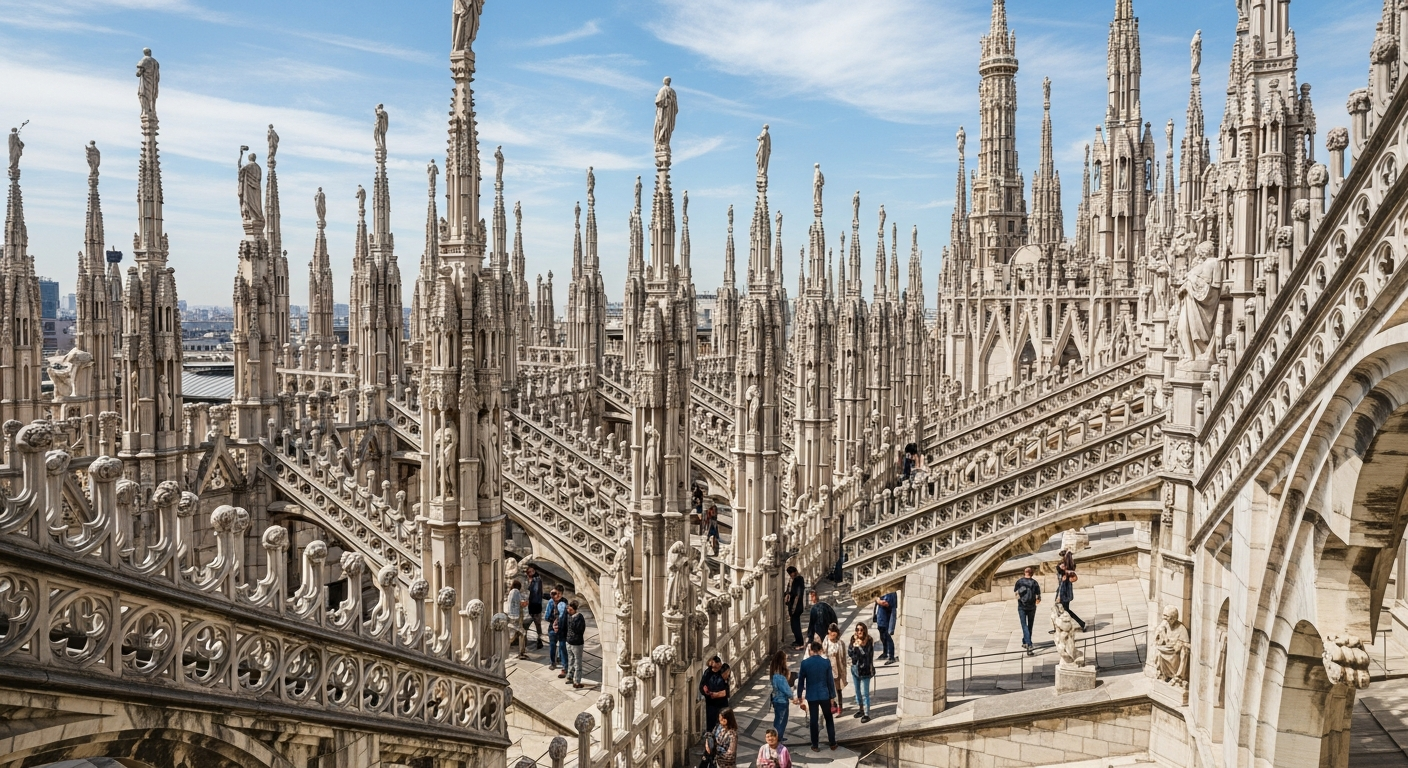
Milan Cathedral (1386–1965)
Milan Cathedral, the Duomo di Milano, is the largest gothic cathedral in the world by volume and the only major gothic cathedral built entirely of marble. Its construction spanned nearly six centuries, involving architects and engineers from across Europe in heated debates about structural principles documented in the famous records of the Fabbrica del Duomo. The result is a building of staggering visual complexity.
The exterior is adorned with 3,400 statues, 135 spires, and 700 figures. The rooftop, accessible to visitors, provides a surreal walk through a forest of marble pinnacles and flying buttresses. The interior shelters an area of 11,700 square meters under vaults rising 45 meters. The great Trivulzio candelabrum, a medieval bronze candelabra standing over 5 meters tall, and the statue of St. Bartholomew Flayed by Marco d'Agrate are among its most celebrated artworks.
Florence Cathedral (1296–1436)
Florence Cathedral, or Santa Maria del Fiore, demonstrates the uniquely Italian approach to gothic architecture. Designed by Arnolfo di Cambio in 1296, the building combines pointed arches and gothic proportions with a classical sense of breadth and horizontal emphasis. The exterior is clad in polychrome marble panels of green, pink, and white, a decorative strategy rooted in Tuscan Romanesque tradition rather than Northern Gothic precedent.
The cathedral is crowned by Brunelleschi's dome, completed in 1436, which is technically a Renaissance achievement but sits atop a gothic structure. The dome spans 42 meters without centring, using a herringbone brick pattern and double-shell construction that solved the engineering problem the gothic builders had left unresolved for over a century. Giotto's campanile, standing 85 meters beside the cathedral, is one of the most beautiful free-standing bell towers in Italian architecture.
Seville Cathedral (1401–1506)
Seville Cathedral is the largest gothic church by area in the world, covering approximately 11,520 square meters. It was built on the site of the Almohad mosque, and the builders explicitly set out to create something so large that future generations would think them mad. The former mosque's minaret, the Giralda, was retained and converted into the cathedral's bell tower, its Islamic geometric decoration standing in fascinating contrast to the gothic nave behind it.
The interior contains the largest altarpiece in Christendom, a carved and gilded retablo depicting 45 scenes from the life of Christ, created by multiple artists over 80 years. The cathedral also houses what is traditionally held to be the tomb of Christopher Columbus, carried by four allegorical figures representing the kingdoms of Castile, Leon, Aragon, and Navarre.
Sagrada Família, Barcelona (1882–present)
Antoni Gaudí's Sagrada Família is not, strictly speaking, a gothic building, but it is impossible to discuss famous gothic-inspired architecture without it. Gaudí inherited a conventional neo-gothic design in 1883 and transformed it into something entirely new: a structure that uses the structural logic of gothic architecture, particularly the management of thrust and counter-thrust, but replaces pointed arches with hyperbolic paraboloids and flying buttresses with branching columns that distribute loads like tree trunks.
Gaudí spent the last twelve years of his life working exclusively on the Sagrada Família, and construction continues today using his models and drawings. When completed, the central tower dedicated to Jesus Christ will rise to 172.5 meters, making it the tallest church structure in the world and surpassing Ulm Minster. The building represents both a homage to gothic structural principles and a radical reimagining of what those principles can achieve. For more on how gothic ideas evolved into the Gothic Revival and Neo-Gothic movements, see our dedicated guide.
Gothic Beyond Churches: Castles, Halls, and Civic Buildings
Gothic architecture was not limited to religious buildings. The same structural innovations and decorative language were applied to castles, palaces, town halls, and market halls across Europe. These secular gothic buildings are often overlooked in favor of cathedrals, but they demonstrate the style's versatility and its deep integration into every aspect of medieval life.
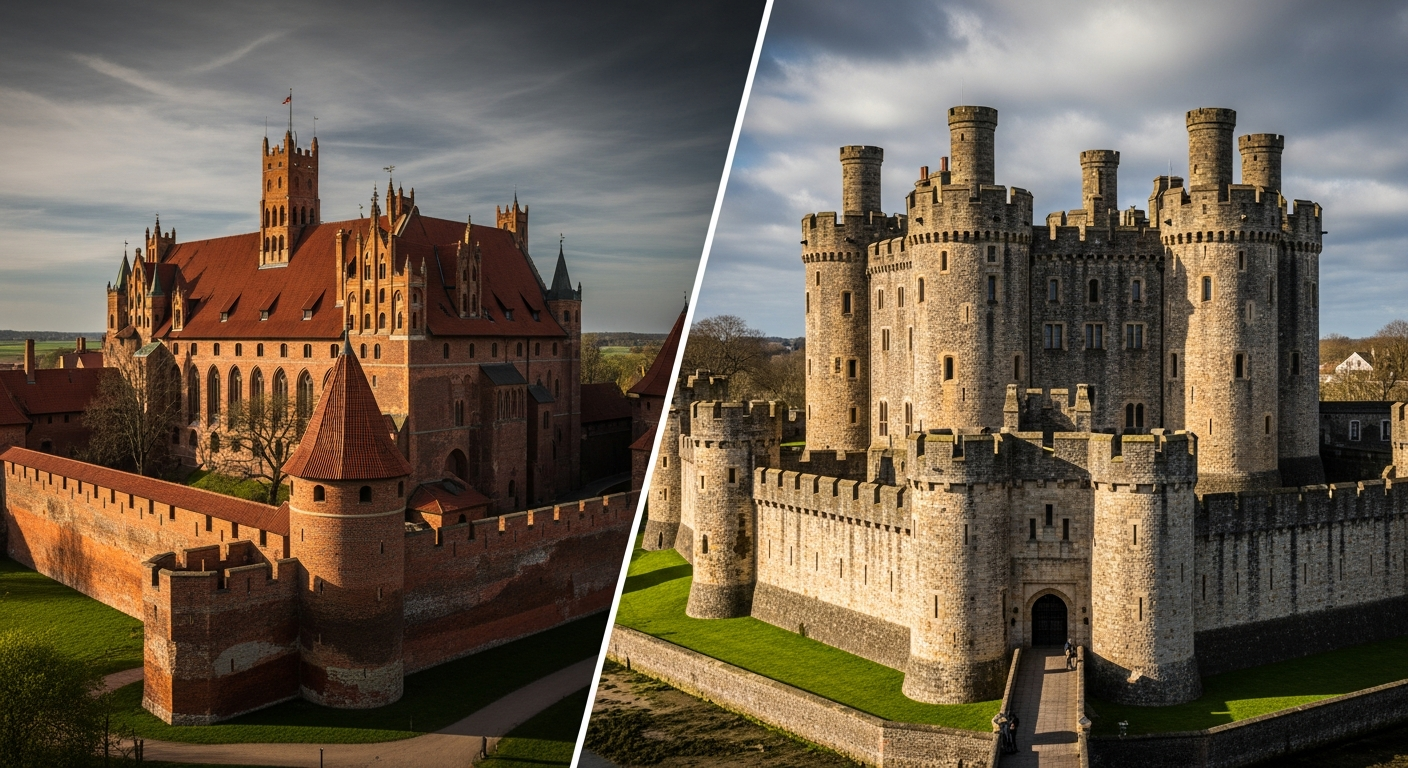
Malbork Castle, Poland (1274–1406)
Malbork Castle is the largest castle in the world by land area, covering approximately 21 hectares. Built by the Teutonic Knights as their headquarters, it is the supreme example of Brick Gothic architecture, constructed entirely of red brick in a region where building stone was unavailable. The castle complex consists of three concentric fortified sections: the High Castle with its church and chapter house, the Middle Castle with the Grand Master's Palace, and the Lower Castle with workshops and armories.
The Grand Master's Palace features a spectacular vaulted dining hall with palm-vault ribs springing from a single central column, a masterpiece of late medieval structural engineering. The castle suffered severe damage in World War II but has been meticulously restored and is now a UNESCO World Heritage Site and one of Poland's most visited monuments.
Doge's Palace, Venice (1340–1424)
The Doge's Palace is the finest example of Venetian Gothic architecture, a regional style that blends gothic structural forms with Byzantine and Islamic decorative influences drawn from Venice's extensive trade connections with the Eastern Mediterranean. The building's most famous feature is its structural inversion: a massive, apparently solid upper story of pink and white marble rests on an airy double arcade of pointed arches and delicate tracery, creating an effect that appears to defy gravity.
The palace served as the residence of the Doge, the seat of government, the law courts, and the state prison. Its interiors include the vast Sala del Maggior Consiglio, one of the largest rooms in Europe at 54 by 25 meters, decorated with paintings by Tintoretto and Veronese. The Bridge of Sighs, connecting the palace to the adjacent prison, is one of the most recognized structures in Venice.
Cloth Hall, Ypres, Belgium (1260–1304)
The Cloth Hall of Ypres is one of the largest and finest examples of civic Gothic architecture. The original building, completed around 1304, was a commercial hall where the lucrative Flemish cloth trade was conducted. Its facade stretches 133 meters, with a central belfry rising 70 meters, proclaiming the wealth and civic pride of medieval Ypres as loudly as any cathedral proclaimed the glory of God.
The Cloth Hall was almost completely destroyed during the First World War, when Ypres became one of the most devastated cities on the Western Front. The decision to rebuild it exactly as it had been, a process that took from 1933 to 1967, was itself a powerful statement about the enduring significance of gothic architecture as a symbol of civic identity. Today the building houses the In Flanders Fields Museum, connecting its medieval origins to its role in modern history. For more on how gothic design principles influenced later architectural movements, see our guide to brutalist architecture, which represents a very different approach to monumental building.
Frequently Asked Questions
What is the most famous gothic building in the world?
Notre-Dame de Paris is widely considered the most famous gothic building, recognized globally for its pioneering flying buttresses, iconic west facade, and the dramatic 2019 fire that galvanized worldwide support for its restoration. However, Cologne Cathedral, Milan Cathedral, and Westminster Abbey all rank among the most visited and photographed gothic structures.
What is the largest gothic cathedral?
Seville Cathedral is the largest gothic church by floor area at approximately 11,520 square meters, while Milan Cathedral is the largest by volume. Cologne Cathedral has the tallest twin spires at 157 meters, and Ulm Minster holds the record for the tallest single church tower at 161.5 meters.
How long did it take to build a gothic cathedral?
Construction times varied enormously. Salisbury Cathedral was built in just 38 years, while Cologne Cathedral took 632 years to complete. Most major gothic cathedrals required 100 to 300 years of continuous or intermittent construction, reflecting changes in funding, design ambitions, and political circumstances.
Are gothic buildings still being constructed today?
Yes. The Sagrada Família in Barcelona, begun in 1882, remains under active construction with a projected completion around 2026. The Washington National Cathedral, completed in 1990, and the Cathedral of St. John the Divine in New York, still unfinished, demonstrate that gothic architecture continues to inspire new construction. Many existing gothic buildings also undergo continuous restoration that requires traditional stonemasonry skills.
What makes French Gothic different from English Gothic?
French Gothic emphasizes height and verticality, with soaring naves, integrated flying buttresses, and unified interior spaces. English Gothic tends to be longer and lower, with more emphasis on horizontal lines, elaborate surface decoration, and unique features like fan vaults and hammer-beam roofs. For a detailed comparison, see our guide to French, English, and German Gothic regional variations.
Can I visit these gothic buildings?
All twenty buildings in this guide are open to visitors, though access hours and restrictions vary. Most cathedrals are free to enter for worship and general viewing, with fees for tower climbs, crypt access, or guided tours. Malbork Castle and the Doge's Palace charge admission. We recommend checking each site's official website for current visiting information, especially during restoration periods.
Experience Gothic Architecture Through Design
The soaring arches, dramatic light, and intricate ornamentation of gothic architecture continue to inspire interior designers and homeowners around the world. Whether you are drawn to the dark elegance of pointed arches and wrought iron, the luminous quality of stained glass accents, or the bold proportions of vaulted ceilings, gothic architectural principles can transform contemporary living spaces into environments of extraordinary character.
Ready to see how gothic-inspired design elements would look in your own home? Try HanoDecor Studio to visualize pointed arches, ribbed vault ceilings, rose window motifs, and other gothic details in your rooms using AI-powered design visualization. Upload a photo of your space and explore gothic-inspired transformations in seconds.
Browse our design gallery for inspiration, or explore our plans to unlock advanced visualization features and work with professional designers who specialize in historically inspired interiors.
Famous Gothic Architecture FAQs
Written by
James Park
Architectural Design Advisor specializing in exterior remodeling, siding systems, and structural home improvements. Licensed architect with 18 years of residential project experience.