How to Remodel Stairs: Treads, Railings, and Structural Upgrades
Quick Summary
A comprehensive guide to remodeling stairs, covering cosmetic refinishing of existing treads, full tread and riser replacement, railing and baluster upgrades, structural modifications, building code requirements, cost breakdowns, and material comparisons for modern stair renovation projects.
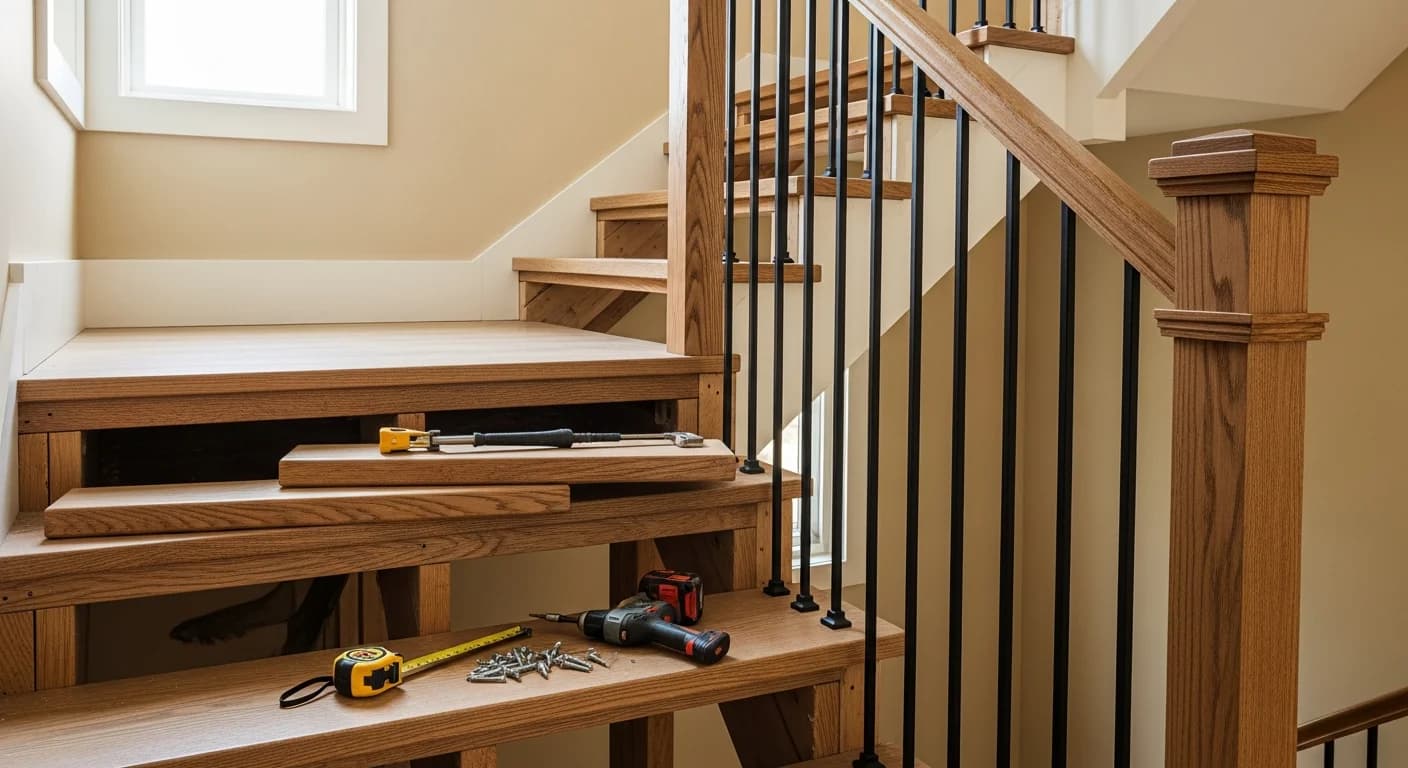
Learning how to remodel stairs can transform one of the most overlooked features in your home into a stunning architectural focal point. Whether your staircase has worn carpet, outdated oak balusters, or structurally compromised stringers, a stair renovation delivers dramatic visual impact in a relatively compact project scope. The average stair remodel costs $1,500 to $10,000 depending on whether you are refinishing existing surfaces or rebuilding the entire structure.
Staircase renovations have gained significant popularity as homeowners seek to modernize dated interiors without undertaking full-house renovations. Open risers, cable railings, floating treads, and mixed-material designs dominate current trends. This guide walks you through every phase of a stair remodel — from assessing your existing staircase and understanding building codes to selecting materials, hiring contractors, and managing the project timeline.
Assessing Your Current Staircase
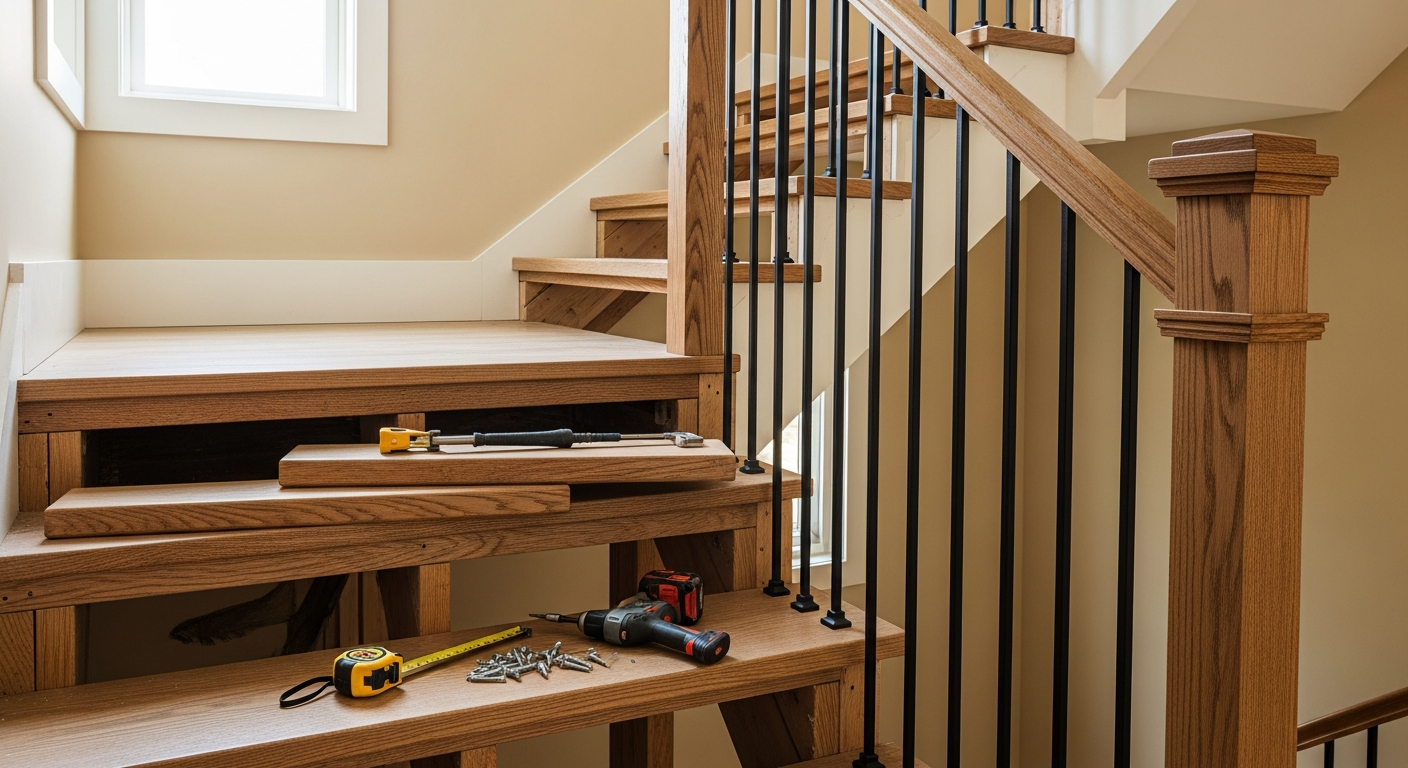
Before planning your stair remodel, conduct a thorough assessment of the existing structure. Check for squeaky or loose treads by walking up and down slowly and noting any movement or noise. Inspect the stringers — the diagonal support boards running along each side — for cracks, rot, or separation from the wall. Test the railing by applying moderate lateral pressure; any wobble indicates loose connections that need structural repair before cosmetic updates. For budget allocation, refer to our remodel budgeting guide.
Determine whether your staircase is a straight run, L-shaped with a landing, U-shaped, or spiral, as the configuration affects both material quantities and labor complexity. Measure tread depth (the horizontal surface you step on), riser height (the vertical face between treads), and total stair width. These measurements ensure replacement materials fit correctly and help you verify current code compliance. For whole-house renovation context, see our guide on where to start a house remodel.
Building Codes and Safety Requirements
Stair remodels must comply with local building codes based on the International Residential Code. Key requirements include minimum tread depth of 10 inches, maximum riser height of 7.75 inches, and consistent riser heights throughout the staircase (variation of no more than 3/8 inch). Handrails must be 34 to 38 inches above the stair nosing, graspable with a diameter of 1.25 to 2 inches, and continuous for the full length of the stairway.
Baluster spacing must be less than 4 inches apart to prevent children from passing through. Minimum stair width is 36 inches, and headroom clearance must be at least 6 feet 8 inches measured vertically from the stair nosing. Open risers, if used, cannot allow passage of a 4-inch sphere. Always check your local jurisdiction's amendments to the IRC, as many municipalities have additional requirements beyond the base code.
| Code Requirement | Minimum/Maximum | Notes |
|---|---|---|
| Tread Depth | 10" minimum | Measured from nosing to riser |
| Riser Height | 7.75" maximum | Must be consistent within 3/8" |
| Handrail Height | 34" – 38" | Measured from stair nosing |
| Baluster Spacing | Less than 4" | No 4" sphere passage |
| Stair Width | 36" minimum | Clear width between walls |
| Headroom | 6' 8" minimum | Vertical from nosing line |
Cosmetic Stair Refinishing: The Budget-Friendly Approach
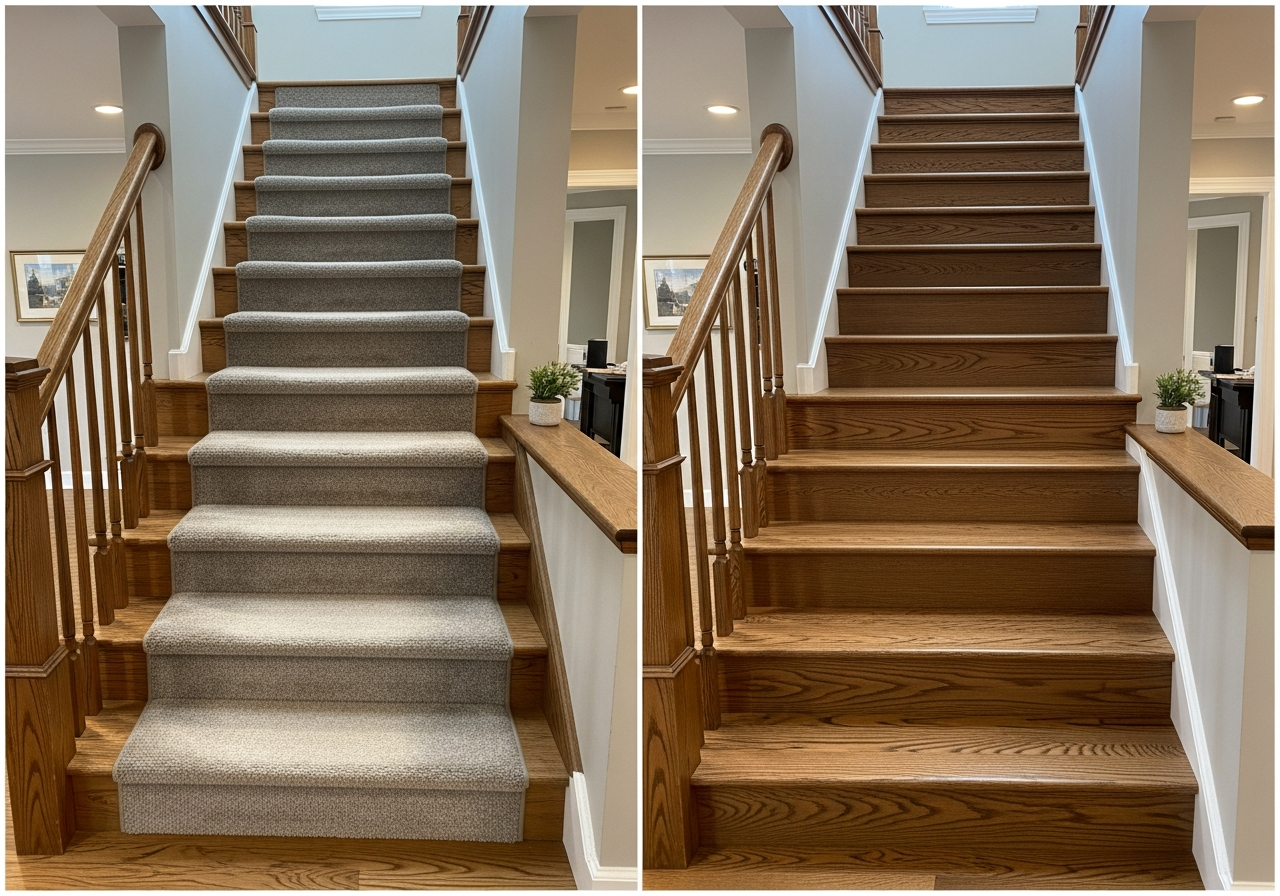
The most affordable stair remodel involves refinishing existing treads and updating the cosmetic appearance without structural changes. Removing carpet from stairs and refinishing the hardwood underneath costs $300 to $800 for materials and $500 to $1,500 for professional labor. Sand the treads with progressively finer grits (60, 80, 120), apply wood stain in your desired shade, and finish with three coats of oil-based polyurethane for maximum durability.
Painting risers white while staining treads dark creates a classic two-tone look that costs under $200 in materials for a DIY project. Adding stair runners over refinished treads provides traction and noise reduction while showcasing the wood on either side. Quality stair runners cost $15 to $50 per linear foot plus $200 to $500 for professional installation. This cosmetic approach transforms dated stairs in a weekend while preserving the existing structural components.
Tread and Riser Replacement Options
When existing treads are damaged, warped, or made from low-quality softwood, full tread replacement delivers the best results. Prefinished stair tread caps — 3/4-inch thick hardwood pieces that install over existing treads — cost $30 to $80 per tread for materials. Solid replacement treads in red oak, white oak, maple, or hickory run $40 to $150 each. For a standard 13-tread staircase, budget $500 to $2,000 for tread materials alone.
Installation requires precise measurement and cutting. Each tread must fit snugly between stringers or wall surfaces, with a consistent 1-inch nosing overhang at the front. Risers are typically replaced with primed MDF or matching hardwood, costing $10 to $40 per riser. Professional installation of treads and risers runs $50 to $100 per step, or $650 to $1,300 total. The combination of new treads, painted risers, and updated nosing profiles modernizes the entire staircase without touching the structural framework.
Railing and Baluster Upgrades
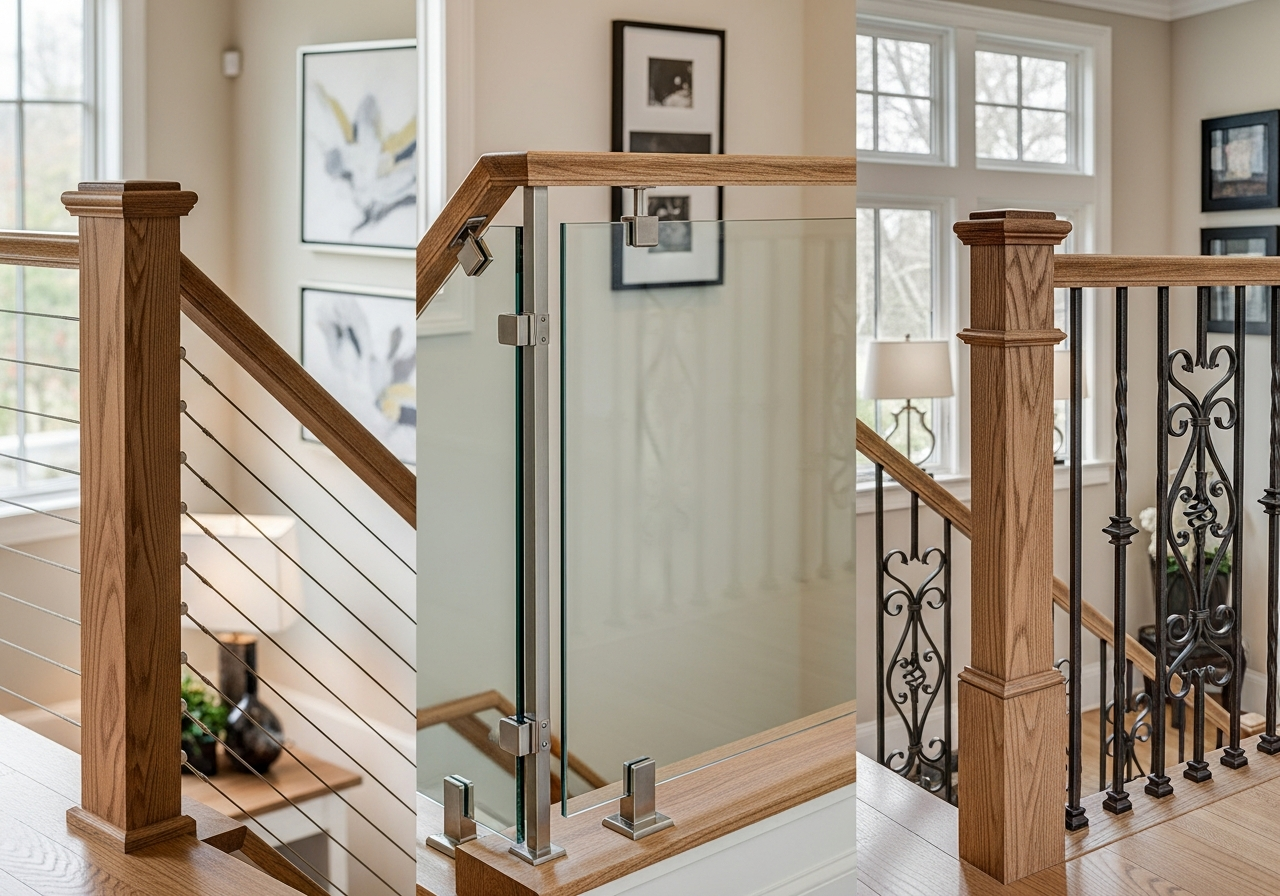
Updating railings and balusters is the highest-impact visual change in a stair remodel. Replacing traditional turned wood balusters with wrought iron costs $5 to $15 per baluster for materials and $800 to $2,500 total including installation. Cable railing systems — horizontal stainless steel cables tensioned between posts — create a clean, contemporary look for $100 to $200 per linear foot installed. For complementary style ideas, browse our modern and vintage mixing guide.
Glass panel railings deliver an ultra-modern aesthetic at $150 to $300 per linear foot, making them the premium option at $3,000 to $6,000 for a typical staircase. Horizontal metal bar railings fall between cable and glass at $80 to $150 per linear foot. The newel post — the large post at the top and bottom of the staircase — can be replaced or wrapped with new material for $200 to $800 per post. For complementary interior updates, explore our living room remodel guide.
Structural Stair Modifications and Full Rebuilds
Structural stair modifications require engineering analysis and typically involve replacing stringers, adjusting riser heights for code compliance, or changing the staircase footprint. Widening a staircase from 36 inches to 42 or 48 inches costs $3,000 to $8,000 and may require floor framing modifications above and below. Relocating a staircase entirely is a major renovation costing $10,000 to $25,000 depending on the complexity of structural framing changes.
Full staircase rebuilds involve removing the existing staircase down to the floor framing and constructing a new one from scratch. This approach costs $5,000 to $20,000 depending on design complexity, materials, and configuration. Floating staircase designs — where treads are cantilevered from a central steel stringer or wall-mounted brackets — represent the premium tier at $15,000 to $40,000. These dramatic designs require structural steel fabrication and engineering certification.
Stair Lighting and Finishing Details
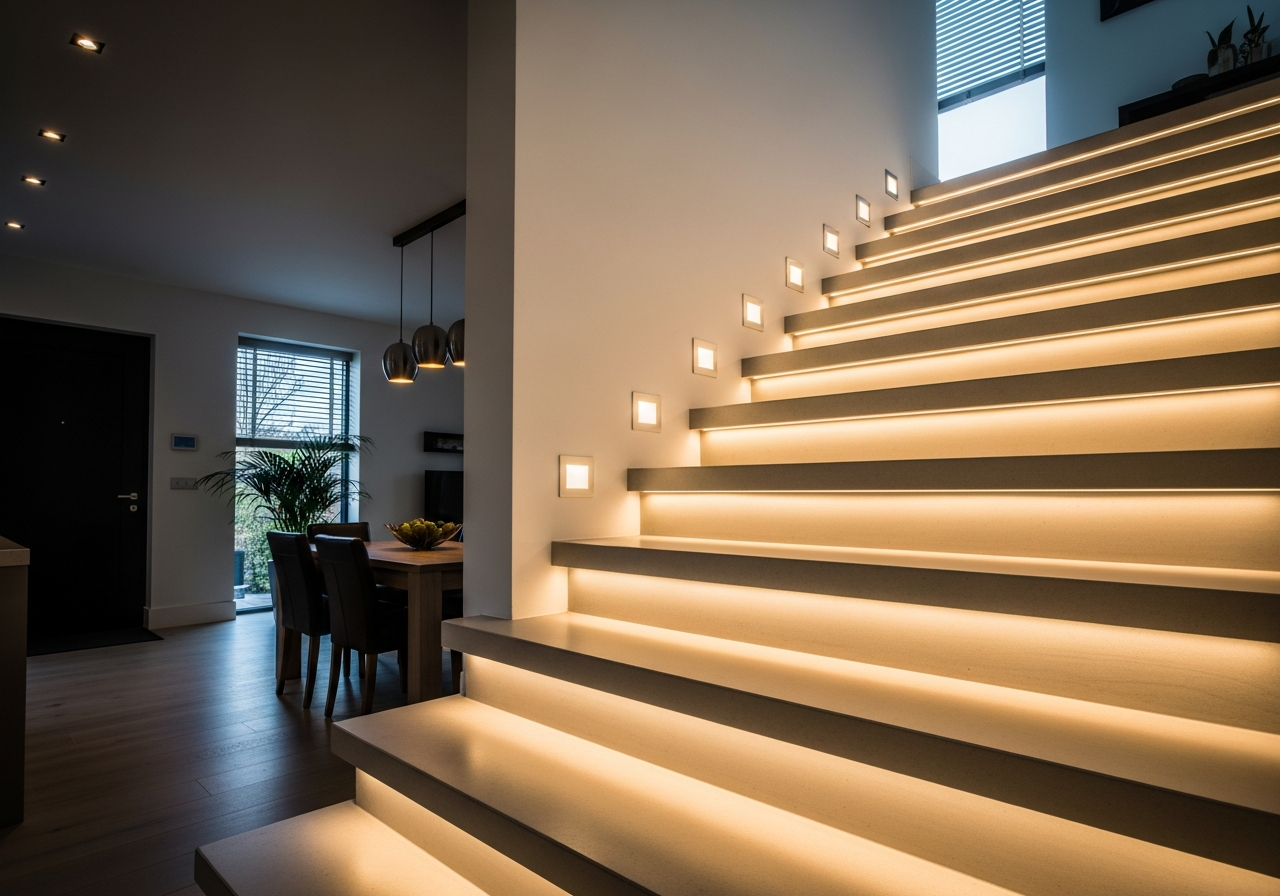
Stair lighting enhances both safety and aesthetics. LED strip lighting under each tread nosing costs $200 to $600 for materials and $300 to $800 for professional installation. Recessed wall step lights — small LED fixtures embedded in the wall alongside each step — run $50 to $150 per light installed, totaling $500 to $2,000 for a full staircase. Motion-sensor activation eliminates fumbling for switches and costs an additional $50 to $200 for the controller.
Anti-slip nosing strips add safety to hardwood or tile treads for $3 to $10 per tread. Carpet stair treads — individual adhesive-backed pieces for each step — offer traction without covering the entire tread surface, costing $100 to $300 for a set. Consider matching your stair materials with adjacent flooring for visual continuity. A stair remodel that flows seamlessly into the hallway or living room flooring creates a cohesive design statement throughout the home. Learn how to plan multi-room renovations with our home remodel preparation guide.
DIY vs. Professional Stair Remodeling
Experienced DIYers can handle cosmetic refinishing, carpet removal, painting risers, and installing stair tread caps. These projects require basic carpentry tools — a miter saw, orbital sander, nail gun, and measuring tape — and save $1,000 to $3,000 in labor costs. However, railing replacement, structural modifications, and floating stair installations require professional expertise due to building code requirements and safety implications.
Hiring a finish carpenter or stair specialist costs $50 to $100 per hour. General contractors typically charge 15% to 25% markup on subcontractor work. For projects involving structural changes, budget for a structural engineer ($300 to $800) and building permits ($150 to $500). The best approach for most homeowners is a hybrid model: handle demolition and painting yourself, then hire professionals for tread installation, railing work, and any structural components. Find the right professional with our contractor selection guide.
Frequently Asked Questions
How much does it cost to remodel stairs?
Stair remodel costs range from $500 to $2,000 for cosmetic refinishing (sanding, staining, painting), $2,000 to $5,000 for tread and riser replacement with new balusters, $5,000 to $10,000 for complete railing system upgrades with premium materials, and $10,000 to $25,000 or more for structural rebuilds or floating staircase designs. The average mid-range stair remodel costs approximately $4,000 to $7,000.
Can I remove carpet from stairs and refinish the wood underneath?
Yes, provided the wood underneath is solid hardwood in reasonable condition. Many older homes have hardwood treads hidden beneath carpet. Remove carpet carefully using a utility knife and pliers, then pull all staples and tack strips. Fill staple holes with wood filler, sand thoroughly, and apply stain and polyurethane. If the wood is softwood like pine or fir, consider installing hardwood tread caps over the existing surface instead of refinishing.
Do I need a permit to remodel my stairs?
Cosmetic changes like refinishing, painting, and replacing treads typically do not require permits. However, structural modifications, railing system changes, stair relocation, and any work that alters the rise, run, or width of the staircase generally requires a building permit and inspection. Cable and glass railing systems may need specific approval in some jurisdictions. Check with your local building department before starting structural stair work.
What is the most popular stair railing style in 2026?
Horizontal cable railings and thin metal balusters are the most popular stair railing styles in 2026, reflecting the ongoing trend toward clean, minimalist design. Glass panel railings remain popular in contemporary and luxury homes. Traditional wood balusters have evolved toward simpler square profiles rather than ornate turned designs. Mixed-material combinations — such as wood handrails with metal balusters — offer a transitional aesthetic that works across multiple interior styles.
How long does a stair remodel take?
Cosmetic refinishing takes 2 to 4 days including drying time for stain and polyurethane. Tread and riser replacement requires 3 to 5 days. Full railing system replacement takes 3 to 7 days depending on complexity. Structural rebuilds or floating staircase installations require 2 to 4 weeks. During renovation, you will need an alternate route between floors, so plan for temporary access via a ladder or secondary staircase if available.
Transform Your Staircase with HanoDecor's AI Designer
Visualize your stair remodel before picking up a single tool. Upload a photo of your current staircase and use our AI Room Designer to preview modern treads, cable railings, floating designs, and lighting configurations. Compare multiple railing styles, tread materials, and color combinations in photorealistic detail — then share the renderings with your contractor for precise execution.
Try the AI Room Designer free — see your staircase transformed in seconds. Whether you envision sleek cable railings or classic wrought iron balusters, preview every option before committing to materials and labor.
Related Articles
Continue your renovation planning with these guides: How to Remodel a Living Room covers adjacent spaces that connect to your staircase. Basement Remodel Guide addresses basement staircase considerations. House Remodel Cost Guide puts stair renovation in whole-home budget context. Home Renovation Tips provides essential planning strategies for any project.
How to Remodel Stairs FAQs
Written by
Lisa Wang
Sustainable Design Writer focused on eco-friendly materials, energy efficiency, and budget-conscious home improvement. LEED Green Associate with expertise in low-impact renovation strategies.