How to Use Home Equity to Finance a Remodel: HELOC vs Loan Comparison
Quick Summary
A detailed comparison of HELOC and home equity loan options for remodel financing covering interest rate structures, repayment terms, tax deductibility, qualification requirements, borrowing limits, and project-type recommendations. Includes real-cost scenarios and decision framework for choosing between the two products.


Learning how to use home equity to finance a remodel opens the door to your home's most powerful financial asset. American homeowners collectively hold over $32 trillion in home equity, and tapping into that equity through a HELOC or home equity loan provides the lowest borrowing rates available for renovation projects. Both products use your home as collateral, but they work very differently — and choosing the wrong one can cost thousands in unnecessary interest.
This guide breaks down HELOC versus home equity loan side by side, covering rate structures, repayment mechanics, tax implications, and the project scenarios where each excels. Whether you are financing a $20,000 bathroom remodel or a $150,000 whole-house renovation, one of these products fits your situation better. Pair this financing knowledge with our remodel budgeting guide to make confident financial decisions before construction begins.
How Home Equity Borrowing Works
Home equity equals your home's current market value minus your outstanding mortgage balance. If your home appraises at $450,000 and you owe $280,000, you have $170,000 in equity. Most lenders allow you to borrow up to 80 to 85 percent of your home's value minus the existing mortgage — in this example, that means a maximum of $80,000 to $102,500 available for borrowing ($450,000 times 0.85 equals $382,500, minus $280,000 mortgage).
Both HELOCs and home equity loans are secured by your home, which is why rates are significantly lower than unsecured personal loans or credit cards. However, this also means your home is at risk if you default on payments. Before borrowing against equity, ensure the remodel project adds measurable value and that the monthly payments fit comfortably within your budget — typically no more than 5 to 8 percent of gross monthly income for renovation debt.
HELOC — How It Works
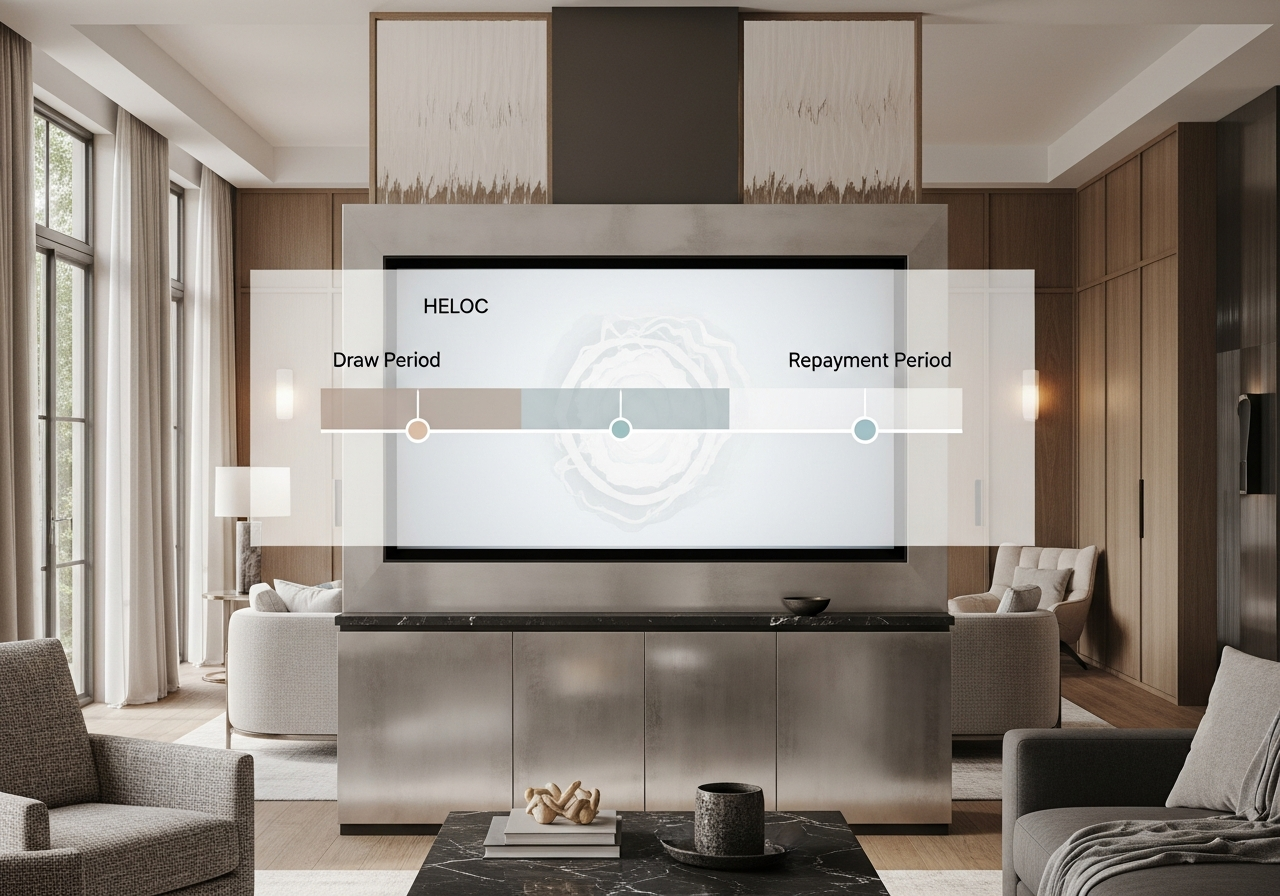
A Home Equity Line of Credit (HELOC) functions like a credit card secured by your home. You receive a credit limit based on your equity, and you draw funds as needed during a draw period that typically lasts 5 to 10 years. During the draw period, most HELOCs require interest-only payments on the outstanding balance. After the draw period ends, you enter a 10 to 20 year repayment period where you pay both principal and interest.
Current HELOC rates range from 7.5 to 9.5 percent and are typically variable, tied to the prime rate plus a margin. This means your rate — and monthly payment — can fluctuate with Federal Reserve interest rate decisions. Some lenders offer fixed-rate lock options that let you convert a portion of your balance to a fixed rate, providing rate certainty on larger draws while maintaining variable-rate flexibility on smaller ones.
Home Equity Loan — How It Works
A home equity loan (sometimes called a second mortgage) provides a lump sum at a fixed interest rate with equal monthly payments over a set term, typically 5 to 30 years. Current home equity loan rates range from 7 to 10 percent fixed. You receive the full loan amount at closing and begin making principal-and-interest payments immediately. The fixed rate means your payment never changes, making budgeting straightforward.
Closing costs for home equity loans run $2,000 to $5,000, covering appraisal ($300 to $600), origination fees (0.5 to 1 percent of the loan), title search, and recording fees. Some lenders waive closing costs for loans above a minimum threshold or for borrowers who maintain a checking account with the same institution. Shop at least 3 to 5 lenders to compare rates, fees, and closing cost waivers.
Side-by-Side Comparison
| Feature | HELOC | Home Equity Loan |
|---|---|---|
| Rate Type | Variable (some fixed-lock options) | Fixed |
| Current Rates | 7.5–9.5% | 7–10% |
| Disbursement | Draw as needed | Lump sum at closing |
| Repayment | Interest-only during draw period | P&I from day one |
| Term | 5–10 yr draw + 10–20 yr repay | 5–30 yr fixed |
| Closing Costs | $0–$5,000 (often waived) | $2,000–$5,000 |
| Flexibility | High (draw and repay as needed) | Low (fixed amount and schedule) |
| Rate Risk | High (variable) | None (fixed) |
| Best For | Phased remodels, uncertain scope | Defined scope, predictable payments |
Tax Benefits of Home Equity Borrowing
Interest paid on home equity products is tax-deductible when the funds are used for substantial home improvements — defined by the IRS as projects that add value, prolong the life, or adapt the home to new uses. Remodeling a kitchen, adding a bathroom, replacing a roof, or finishing a basement all qualify. The deduction applies to combined mortgage and home equity debt up to $750,000 (for loans taken after December 2017).
The tax benefit can be significant. On a $75,000 home equity loan at 8 percent, you pay approximately $6,000 in interest the first year. If you are in the 24 percent tax bracket, the deduction saves $1,440 annually, effectively reducing your interest rate to about 6.1 percent. Keep detailed records of how borrowed funds are spent — only the portion used for home improvement qualifies for the deduction. Consult a tax professional for guidance specific to your situation.
Which Option Fits Your Remodel?

Choose a HELOC if your remodel will be phased over several months with costs spread out over time, if the total project cost is uncertain (discovery-dependent work like old home renovations), or if you want the flexibility to draw additional funds if the scope expands. The interest-only draw period keeps early payments low while you are also paying for materials and labor out of pocket. A HELOC also works well if you plan to make additional home improvements in the next few years.
Choose a home equity loan if you have a well-defined project scope with firm contractor bids, if you want the certainty of a fixed payment that will not change with interest rate movements, or if current variable rates are near historical highs and you want to lock in before potential increases. Home equity loans are also better for borrowers who prefer the discipline of a fixed amortization schedule rather than the temptation of a revolving credit line.
Real-Cost Scenario: $60,000 Remodel
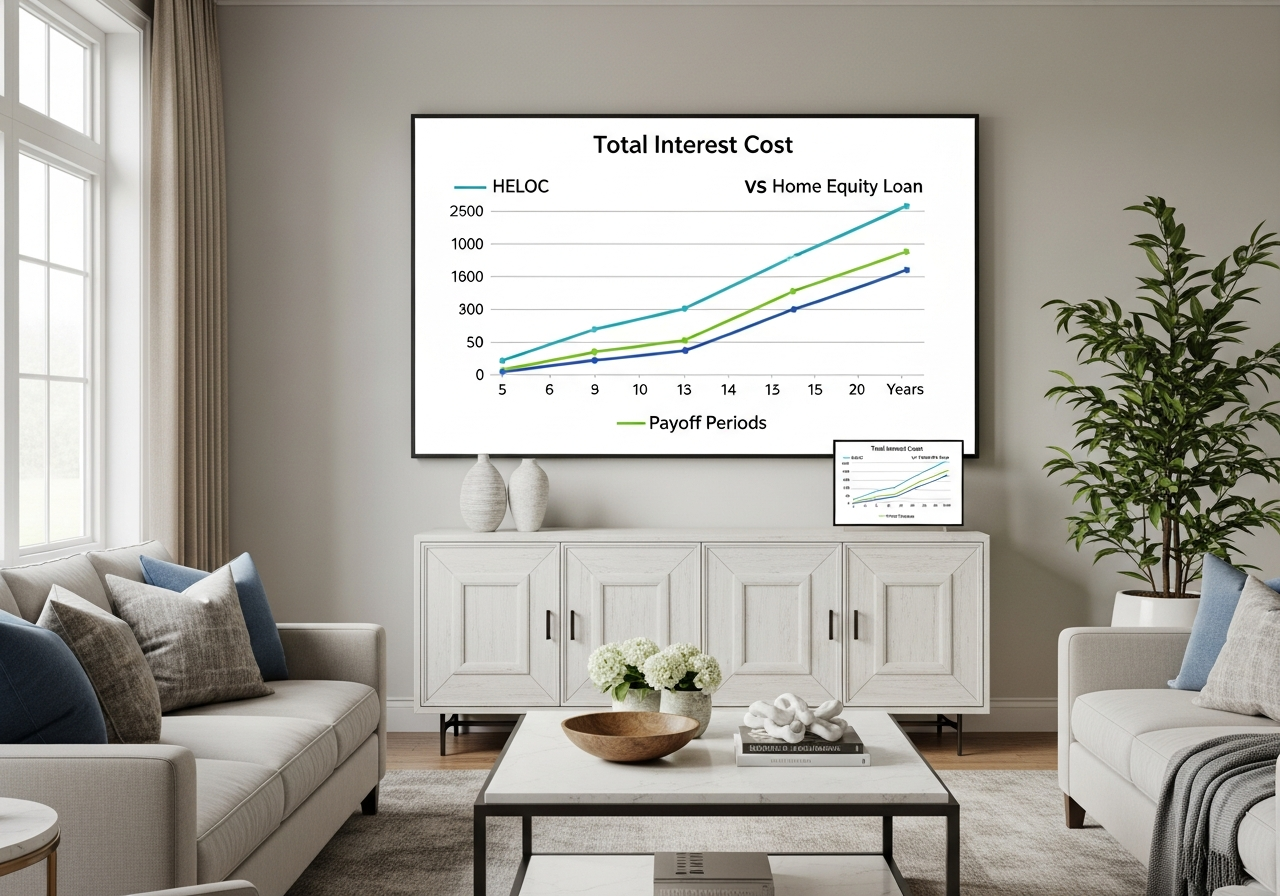
Consider a $60,000 kitchen remodel financed two ways. With a HELOC at 8.5 percent variable, drawing funds over 4 months and making interest-only payments during a 10-year draw period, the total interest cost depends heavily on repayment speed. Paying it down over 5 years costs approximately $14,000 in interest. Paying minimum interest-only for 10 years then principal over 15 years costs approximately $52,000 in total interest.
With a home equity loan at 8 percent fixed for 10 years, the monthly payment is $728 and total interest is approximately $27,300. The home equity loan costs less in total if you take the full term, but the HELOC costs less if you aggressively pay down the balance within 3 to 4 years. Your repayment discipline and interest rate environment should drive the decision. See our broader remodel financing comparison for additional options.
Qualification Requirements
Both products require a minimum credit score (typically 680 or higher for the best rates), a debt-to-income ratio below 43 percent, at least 15 to 20 percent equity in your home, and a current home appraisal. Lenders may also require proof of stable income for at least 2 years and verification that property taxes and homeowner's insurance are current. If your credit score is below 680, consider a home remodel loan guide for alternative options.
Related Articles
Explore more financing and planning resources: How to Finance a Home Remodel: 8 Options Compared, How to Get a Construction Loan for a Remodel, How to Pay for a Remodel: Financing Ranked, House Remodel Costs, and How to Budget for a Remodel.
Frequently Asked Questions
Is a HELOC or home equity loan better for a remodel?
A HELOC is better for phased remodels with uncertain timelines, while a home equity loan is better for defined-scope projects with known costs. HELOCs offer flexibility but carry variable rate risk. Home equity loans offer payment predictability but require borrowing the full amount upfront.
How much equity do I need to borrow for a remodel?
Most lenders require at least 15 to 20 percent equity in your home to qualify for either a HELOC or home equity loan. You can typically borrow up to 80 to 85 percent of your home's appraised value minus your outstanding mortgage balance. Some lenders allow up to 90 percent combined loan-to-value for well-qualified borrowers.
Can I deduct home equity loan interest on my taxes?
Yes, interest on home equity loans and HELOCs is tax-deductible when the funds are used for substantial home improvements. The deduction applies to combined mortgage and home equity debt up to $750,000 under current tax law. Keep receipts and documentation proving the funds were used for qualified improvements.
What credit score do I need for a home equity product?
Most lenders require a minimum credit score of 620 to 680 for home equity products, with the best rates reserved for scores above 740. A score below 680 may still qualify but at higher rates — typically 1 to 3 percentage points above prime borrower rates. Improving your score before applying can save significant interest over the loan term.
Visualize Your Remodel Investment
Before committing to financing, see exactly what your remodel will look like. HanoDecor's AI Studio creates realistic renderings of your renovation plans, helping you set an accurate scope and budget before applying for a HELOC or home equity loan. Browse the design gallery for inspiration and use the Room Designer to finalize your vision and align it with your financing capacity.
How to Use Home Equity to Finance a Remodel FAQs
Written by
Lisa Wang
Sustainable Design Writer focused on eco-friendly materials, energy efficiency, and budget-conscious home improvement. LEED Green Associate with expertise in low-impact renovation strategies.