How to Pay for a Remodel: 7 Financing Options Ranked by Total Cost
Quick Summary
A ranked comparison of 7 remodel payment methods ordered by total cost including cash, HELOC, home equity loan, FHA 203k, personal loan, contractor financing, and credit cards. Features real interest calculations on a $40,000 project and a decision framework based on project size and borrower profile.
Deciding how to pay for a remodel is the second most important decision after choosing what to renovate. The financing method you select can add $0 to $50,000 or more in interest and fees to a $40,000 project — a difference that dramatically affects your true renovation cost. Yet most homeowners choose their financing based on convenience or the first option their contractor suggests, without comparing total cost across all available methods.
This guide ranks 7 payment methods from lowest to highest total cost, using a $40,000 project as the benchmark. Every option has a legitimate use case — the cheapest method is not always the best fit — but understanding the true cost of each empowers you to make an informed decision that aligns with your financial situation and project timeline.
Rank 1 — Cash (Total Cost: $40,000)
Paying cash eliminates interest entirely, making it the lowest total-cost option. You pay exactly the project price with zero financing overhead. Cash also gives you maximum negotiating leverage — many contractors offer 3 to 5 percent discounts for cash payment, potentially saving $1,200 to $2,000 on a $40,000 project. There are no credit checks, no applications, and no monthly payments to manage.
The downside is opportunity cost — $40,000 in savings could earn 4 to 5 percent annually in a high-yield savings account or 8 to 10 percent in market investments. If your investment returns exceed your borrowing cost, financing and keeping cash invested may produce better long-term wealth. However, the psychological benefit of debt-free renovation and the elimination of monthly payments has value that pure math does not capture.
Rank 2 — HELOC (Total Cost: $44,000–$58,000)
A HELOC provides the second-lowest total cost for homeowners with sufficient equity. Current variable rates of 7.5 to 9.5 percent on a $40,000 draw produce $4,000 to $18,000 in total interest depending on repayment speed. Paying off the balance in 3 years costs approximately $4,800 in interest (total: $44,800). Taking the full 15-year repayment period costs approximately $18,000 (total: $58,000). The key advantage is flexibility — draw funds as construction progresses and pay interest only on the outstanding balance.
HELOCs work best for phased remodels where costs are spread over months. The variable rate carries risk if interest rates rise significantly. Some lenders offer fixed-rate lock features that mitigate this risk on large draws. Closing costs are often minimal or waived entirely, making HELOCs particularly cost-effective for homeowners who plan to repay aggressively. Review our HELOC vs home equity loan comparison for details.
Rank 3 — Home Equity Loan (Total Cost: $46,000–$68,000)
A home equity loan at 7 to 10 percent fixed provides payment predictability that HELOCs lack. On $40,000 at 8 percent for 10 years, the monthly payment is $485 and total interest is approximately $18,200 (total: $58,200). Shorter terms reduce total cost — a 5-year term at the same rate has a $811 monthly payment but only $8,700 in total interest (total: $48,700).
The fixed rate eliminates interest rate risk, making home equity loans better for budget-conscious homeowners who want certainty. Closing costs of $2,000 to $5,000 add to the total cost compared to HELOCs. Interest may be tax-deductible when used for home improvements, effectively reducing the rate by your marginal tax bracket. Home equity loans rank third because the fixed rate is typically slightly higher than the initial HELOC rate.
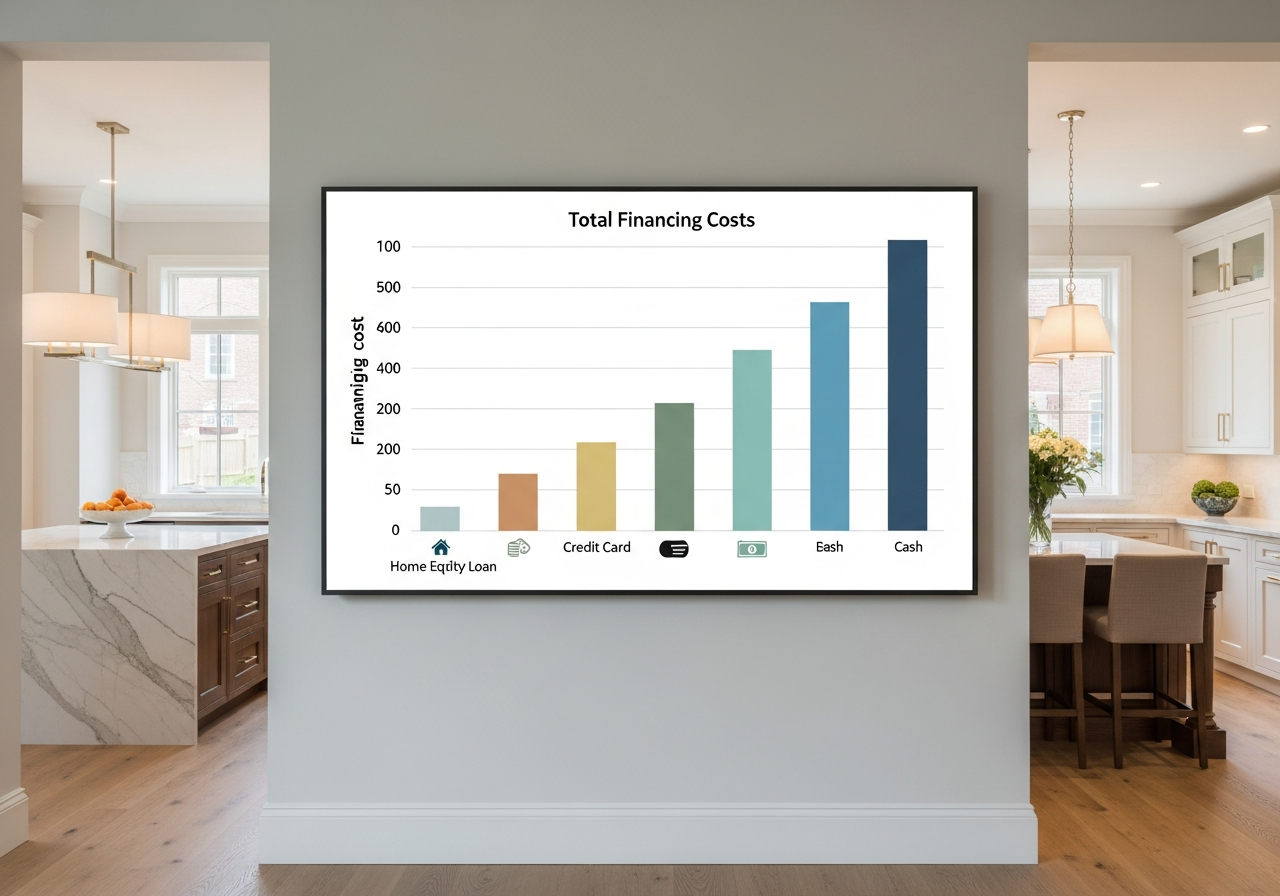
Rank 4 — FHA 203(k) Renovation Loan (Total Cost: $48,000–$72,000)
The FHA 203(k) bundles renovation costs with your mortgage at 6.5 to 8 percent over 15 to 30 years. With mortgage insurance (0.55 to 0.85 percent annually) and a 30-year term, total interest on the renovation portion alone ranges from $22,000 to $38,000. However, if you are refinancing at a lower rate than your current mortgage, the overall savings may offset the renovation interest. The 203(k) is the most accessible option for homeowners with less than 20 percent equity.
The HUD consultant fee ($400 to $1,000 for Standard loans), mortgage insurance, and extended amortization period make the 203(k) more expensive than home equity products for well-qualified borrowers. But for those with limited equity or lower credit scores (minimum 580), it may be the only viable option for a major renovation. The draw schedule provides built-in project oversight. See our complete financing comparison for more details.
Rank 5 — Personal Loan (Total Cost: $46,000–$64,000)
Personal loans at 6 to 18 percent (credit-dependent) for 3 to 7 year terms provide fast funding without using your home as collateral. A well-qualified borrower (720+ credit score) can expect 8 to 12 percent on $40,000 for 5 years, producing $9,000 to $14,000 in total interest (total: $49,000 to $54,000). Less-qualified borrowers (640 to 680 credit score) face 14 to 18 percent, pushing total cost to $58,000 to $64,000.
Personal loans rank fifth because rates are higher than secured home equity products and terms are shorter (increasing monthly payments). However, the speed of funding (1 to 3 business days), absence of collateral risk, no appraisal requirement, and no closing costs make personal loans attractive for smaller projects or homeowners who prefer not to leverage their home. They are also the best option for renters doing permitted renovations on leased property.
Rank 6 — Contractor Financing (Total Cost: $40,000–$60,000)
Contractor financing ranges from excellent (0 percent promotional for 12 to 18 months) to expensive (12 to 18 percent after promotional periods). If you can pay $40,000 in full within a 15-month promotional window, total cost is $40,000 — equivalent to cash. If you carry a balance past the promotional period, deferred interest charges retroactively apply to the full original balance, and rates jump to 18 to 25 percent, making this the most expensive option.
The wide cost range reflects the gamble of promotional financing. Contractor financing ranks sixth because most homeowners underestimate the risk of carrying a balance past the promotional period. Additionally, contractors often inflate the financed price by 5 to 15 percent compared to their cash price, which erases the promotional benefit. Always compare the cash price to the financed price before choosing this option. Read our contractor selection guide for negotiation tips.
Rank 7 — Credit Cards (Total Cost: $40,000–$90,000+)
Credit cards are the most expensive remodel financing option if a balance is carried beyond promotional periods. A $40,000 balance at 22 percent APR with minimum payments takes 25+ years to pay off and costs $50,000+ in interest (total: $90,000+). However, like contractor financing, credit cards can cost zero if you use a 0-percent introductory card and pay in full within the promotional period.
Credit cards should only be used for remodel expenses under $10,000 where you have a firm plan to pay the balance within the promotional window. Some cards offer 2 to 5 percent cash back on home improvement purchases — on a $5,000 project paid within a 0-percent window, that is $100 to $250 back with zero interest. For larger projects, the risk and cost are simply too high.
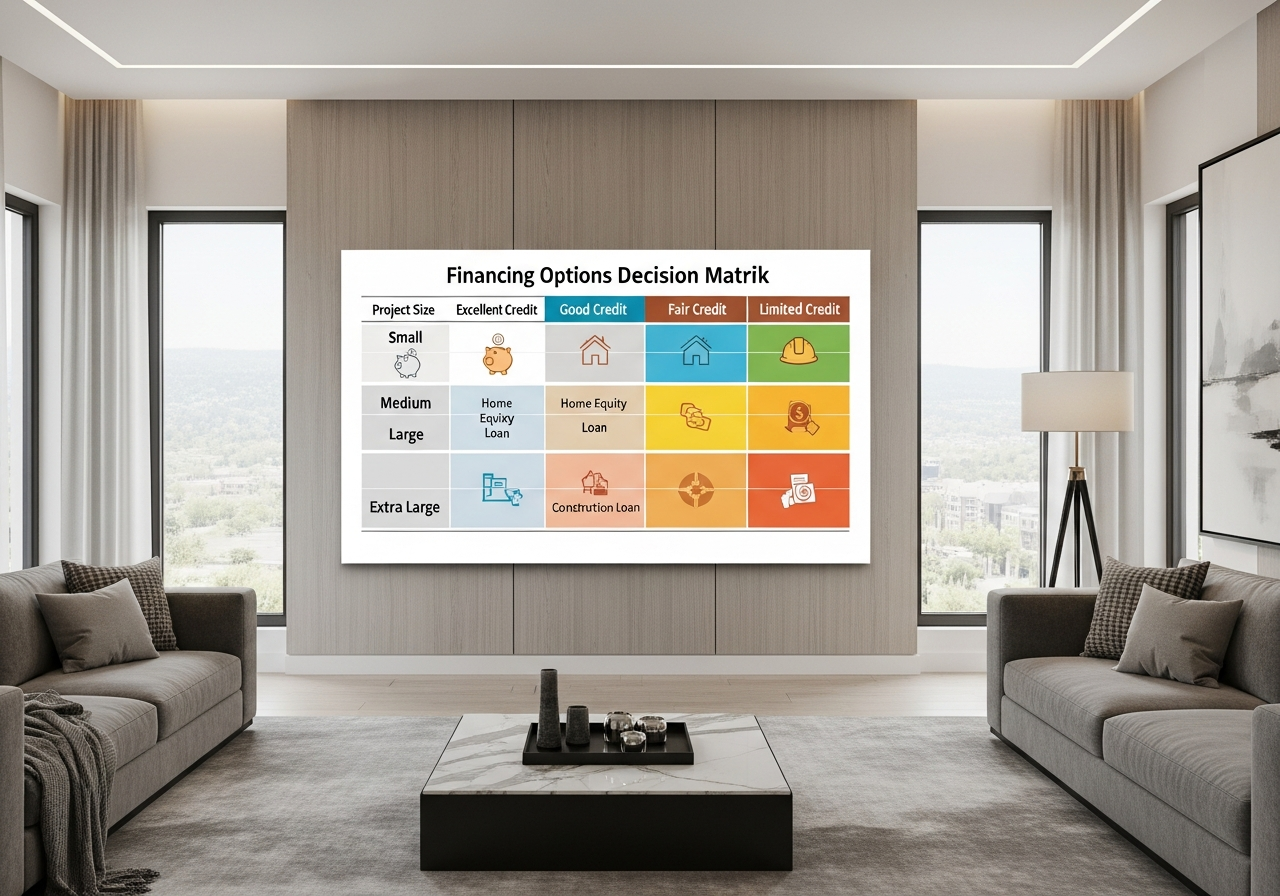
| Rank | Method | Total Cost on $40K | Monthly Payment | Best For |
|---|---|---|---|---|
| 1 | Cash | $40,000 | $0 | Any project if funds available |
| 2 | HELOC | $44,000–$58,000 | Varies | Phased remodels, flexible draws |
| 3 | Home Equity Loan | $46,000–$68,000 | $485–$811 | Fixed budget, payment certainty |
| 4 | FHA 203(k) | $48,000–$72,000 | $280–$400 | Low equity, bundled with mortgage |
| 5 | Personal Loan | $46,000–$64,000 | $700–$1,000 | No collateral, fast funding |
| 6 | Contractor Financing | $40,000–$60,000 | Varies | Short promo periods only |
| 7 | Credit Cards | $40,000–$90,000+ | Varies | Under $10K, promo period only |
Related Articles
Continue your financing research: How to Finance a Home Remodel: 8 Options Compared, HELOC vs Home Equity Loan, How to Get a Construction Loan, Home Remodel Loan Guide, and How to Budget for a Remodel.
Frequently Asked Questions
What is the cheapest way to pay for a remodel?
Cash is the cheapest option, eliminating all interest costs. Among borrowing options, a HELOC with aggressive repayment (3 to 5 years) is typically the lowest-cost method, followed closely by a short-term home equity loan. The key is minimizing both the interest rate and the repayment period.
Should I use savings or borrow for a remodel?
Use savings if it does not deplete your emergency fund (keep 3 to 6 months of expenses in reserve). Borrow if the project is urgent, if borrowing rates are lower than your investment returns, or if the renovation significantly increases home value. A hybrid approach — paying 50 percent cash and financing 50 percent — balances cost savings with liquidity preservation.
Is contractor financing a good deal?
Contractor financing can be a good deal only if you pay the balance in full within the promotional period and the financed price is not inflated compared to the cash price. Always request both a cash price and a financed price. If the contractor increases the price by more than 3 percent for financing, you are likely better off securing independent financing.
How do I choose between a HELOC and personal loan?
Choose a HELOC if you have 15+ percent home equity and want the lowest rate. Choose a personal loan if you have limited equity, want to avoid using your home as collateral, or need funds quickly (1 to 3 days vs 2 to 4 weeks for a HELOC). For projects under $25,000, the rate difference may be small enough that the personal loan's speed and simplicity outweigh the cost premium.
Visualize Before You Finance
Define your project scope before choosing a financing method. HanoDecor's AI Studio lets you see realistic renderings of your planned remodel, helping you set an accurate budget that drives the right financing decision. Explore the design gallery for inspiration and use the Room Designer to finalize your vision before committing to a payment plan.
How to Pay for a Remodel FAQs
Written by
Lisa Wang
Sustainable Design Writer focused on eco-friendly materials, energy efficiency, and budget-conscious home improvement. LEED Green Associate with expertise in low-impact renovation strategies.