Should You Remodel or Move? Decision Framework for Homeowners
Quick Summary
A comprehensive decision framework helping homeowners determine whether to remodel their current home or move to a new one. Covers financial analysis including remodel costs versus moving costs, real estate market conditions, ROI calculations, lifestyle assessment, emotional factors, neighborhood considerations, and a step-by-step scoring system for making the final decision.

The question of should you remodel or move confronts nearly every homeowner who has outgrown their space, inherited a dated layout, or simply craves a change. It is one of the biggest financial decisions a family can make, with the average home remodel costing $46,500 and the average home purchase transaction totaling $55,000 to $75,000 in moving-related expenses when you factor in agent commissions, closing costs, moving fees, and temporary housing. Yet most homeowners make this decision based on emotion rather than data.
This guide provides a structured decision framework that weighs financial, lifestyle, and emotional factors systematically. By scoring each category, you can replace gut-feel paralysis with a clear, personalized recommendation. Whether your kitchen needs a complete overhaul, your family has added a member, or your neighborhood no longer fits your lifestyle, this framework helps you determine the smartest path forward for your situation.
The True Cost of Moving vs. Remodeling in 2026
Most homeowners underestimate the total cost of moving by 30 to 50%. Beyond the purchase price of a new home, transaction costs include real estate agent commissions (5 to 6% of sale price), closing costs on both selling and buying (2 to 5% each), moving company fees ($2,000 to $8,000 for local moves, $5,000 to $15,000 for long-distance), temporary housing if timing does not align, and immediate repairs or updates needed in the new home. For a $400,000 home, these transaction costs total $35,000 to $60,000.
Remodeling costs vary dramatically based on scope. A kitchen and bathroom renovation runs $40,000 to $80,000, a whole-house remodel costs $100,000 to $200,000+, and targeted updates like painting, flooring, and fixtures can be completed for $10,000 to $25,000. The critical difference is that remodeling dollars go directly into your home's equity and functionality, while moving transaction costs are largely non-recoverable. For detailed cost analysis, see our guide on how much it costs to remodel a house.

| Cost Category | Remodeling | Moving |
|---|---|---|
| Primary Investment | $15,000–$200,000+ | $250,000–$600,000+ (new home) |
| Agent Commissions | $0 | $15,000–$36,000 |
| Closing Costs | $0 | $8,000–$30,000 |
| Moving Expenses | $0 | $2,000–$15,000 |
| Temporary Housing | $0–$3,000 | $2,000–$8,000 |
| Immediate New-Home Fixes | N/A | $5,000–$20,000 |
| Mortgage Rate Impact | Current rate preserved | New rate (potentially higher) |
| Equity Retained | 60–80% of investment | Transaction costs reduce equity |
Factor 1 — Financial Position and Mortgage Rates
Your current mortgage rate plays a significant role in this decision. Homeowners who locked in rates below 4% during 2020-2021 face a substantial financial penalty when moving to a new home with current rates of 6.5 to 7.5%. On a $350,000 mortgage, the difference between 3.5% and 7% translates to approximately $850 more per month — over $300,000 in additional interest over 30 years. This mortgage rate lock-in effect makes remodeling financially advantageous for millions of homeowners.
Evaluate your available financing for either path. Remodeling can be funded through home equity loans, HELOCs, cash-out refinancing, or savings. Moving requires a down payment on the new home (typically 10 to 20% of purchase price), which may be partially offset by equity from selling your current home. Run both scenarios through a total-cost calculator covering a 7 to 10 year horizon to see the true financial impact. Our guide on home remodel financing options breaks down the best funding strategies.
Factor 2 — Local Real Estate Market Conditions
Market conditions influence both sides of the equation. In a seller's market with low inventory and rising prices, your current home will sell quickly and at a premium — but the replacement home will also cost more. In a buyer's market with high inventory, you can purchase a new home at favorable terms, but selling your current home may take longer and yield less. The ideal scenario for moving is when you are selling in a hot market and buying in a cool adjacent market, but this alignment is uncommon.
Research your local housing supply, median days on market, sale-to-list price ratios, and year-over-year appreciation trends. If your neighborhood is appreciating at 5 to 8% annually, remodeling becomes more attractive because you are building equity on a rising asset. If your area has stagnated or is declining, the financial case for moving to a higher-growth area strengthens. Consult a local real estate agent for a comparative market analysis of your current home's value before making projections.

Factor 3 — Structural Feasibility of Your Remodel Goals
Some remodeling goals are straightforward — updating a kitchen, finishing a basement, or adding a bathroom. Others are structurally complex or even impossible without enormous expense. Adding a second story, relocating a load-bearing wall, expanding the footprint significantly, or converting a single-family home into a multi-generational layout may cost more than the home is worth after completion. A structural engineer or architect can assess feasibility and provide ballpark costs within one to two consultations.
Consider the concept of renovation ceiling — the maximum value your home can achieve in your neighborhood regardless of improvements. If comparable homes in your area sell for $350,000 and your planned remodel would push total investment past that threshold, the project may not pencil out financially. Conversely, if your home is currently undervalued relative to the neighborhood because of deferred maintenance or dated finishes, targeted remodeling can close that gap profitably. Read our guide on where to start a house remodel for prioritization strategies.
Factor 4 — Lifestyle and Family Needs Assessment
Financial analysis only captures part of the picture. Lifestyle factors often tip the scale decisively. Consider school district quality — if your children need access to better schools, moving may be the only practical option. Evaluate your commute: a remodeled kitchen does not reduce a 90-minute daily commute. Think about aging in place: if you plan to stay through retirement, a single-story layout may be essential, and converting a two-story home is rarely cost-effective compared to moving to a ranch.
Inventory your current home's non-negotiable limitations. A 1,200-square-foot home cannot be remodeled into a 2,500-square-foot home without adding square footage, which requires available lot space, zoning approval, and significant structural investment. If your family genuinely needs four bedrooms and your home has two without feasible expansion options, moving is the logical path. But if your needs are about style, layout, and finish quality rather than raw square footage, remodeling delivers those improvements more cost-effectively.
Factor 5 — Emotional Attachment and Community Roots
Do not underestimate the emotional dimension of this decision. Research from the National Association of Realtors shows that 42% of homeowners who moved within two years of purchasing cited regret about leaving their previous neighborhood. Established relationships with neighbors, proximity to friends and family, familiarity with local businesses, and connection to community institutions like churches or clubs have measurable impacts on wellbeing that no new kitchen can replicate.
Conversely, some homeowners stay in homes they have outgrown because of emotional inertia rather than rational analysis. Sentimentality about where your children took their first steps does not outweigh a failing foundation, an unsafe electrical system, or a neighborhood with declining services. Be honest about whether your attachment is to the physical house or to the community surrounding it — because you can remodel a house but you cannot remodel a neighborhood.

The Remodel-or-Move Scoring Framework
Use this five-factor scoring system to make your decision. Rate each factor from 1 to 5, where 1 strongly favors moving and 5 strongly favors remodeling. Financial position (mortgage rate advantage, equity, financing access), market conditions (selling/buying dynamics), structural feasibility (can you achieve your goals within the existing home), lifestyle fit (commute, schools, space needs), and community attachment (neighborhood relationships, proximity to support network). Total your score: 20 to 25 strongly favors remodeling, 10 to 19 is a toss-up requiring deeper analysis, and 5 to 9 strongly favors moving.
For homeowners in the 10 to 19 range, the tiebreaker is often project timeline. Remodeling a kitchen takes 8 to 16 weeks; a whole-house renovation takes 4 to 12 months. Finding, purchasing, and moving into a new home takes 3 to 6 months on average. If you need changes urgently — a growing family, a health-related accessibility requirement — the faster path may tip the decision. Our guide on house remodel timelines provides detailed scheduling data.
When Remodeling Is Almost Always the Better Choice
Remodeling makes clear financial sense when you have a mortgage rate below 5%, your neighborhood is appreciating steadily, your home has good bones (solid foundation, sound roof, updated mechanicals), and your desired changes involve finishes and layout rather than fundamental size constraints. Homeowners who need an updated kitchen, a renovated bathroom, a finished basement, or a refreshed living space almost always get better value from remodeling. The average kitchen remodel recoups 60 to 75% of its cost at resale, while moving transaction costs are 100% lost.
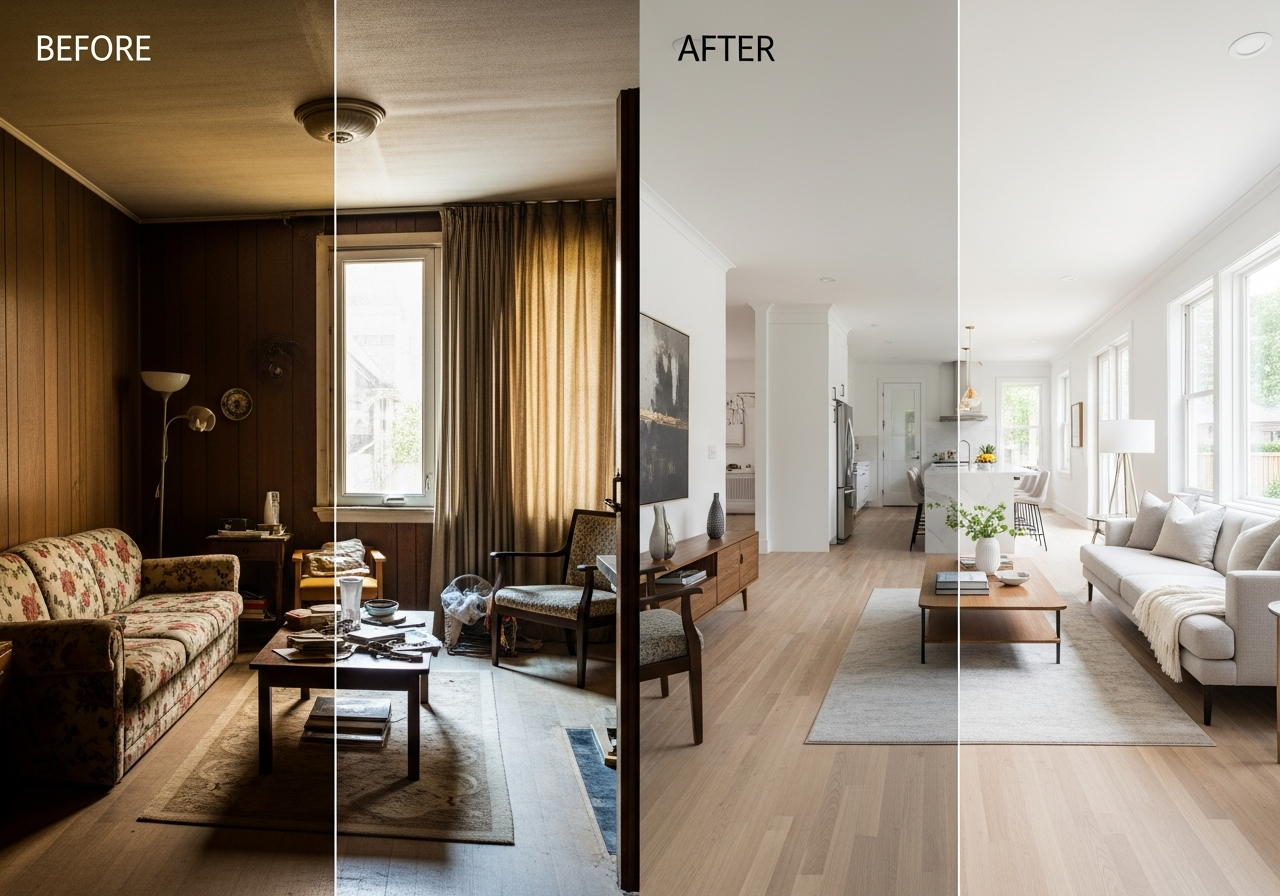
Remodeling also wins when you love your lot, your view, or your yard and those features would be difficult or impossible to replicate in a new purchase at a similar price point. Mature landscaping, established gardens, and large lots in desirable locations carry significant value that is easy to take for granted. Use our AI Room Designer to visualize how your existing rooms could look after a remodel — seeing the potential often makes the remodeling case more compelling.
When Moving Is the Smarter Decision
Moving becomes the better choice when your home's fundamental limitations cannot be cost-effectively resolved. If you need significantly more square footage and your lot cannot accommodate an addition, if the neighborhood school district does not meet your family's needs, if your commute is unsustainable, or if the home has major structural issues like foundation problems, widespread mold, or an outdated septic system, the cost of remediation may exceed the cost of relocation.
Moving also makes sense when you have minimal equity in your current home, your mortgage rate is already at market levels, and the renovation ceiling in your neighborhood limits how much value you can add through improvements. In declining markets where home values are stagnating or falling, investing $80,000 in a remodel that adds only $40,000 in resale value represents poor capital allocation. For help planning a whole-home renovation if you decide to stay, see our home remodel preparation guide.
Frequently Asked Questions
Is it cheaper to remodel or buy a new house?
In most cases, remodeling is cheaper than buying a new house when total transaction costs are included. The average whole-house remodel costs $46,500 while moving transaction costs alone average $35,000 to $60,000 — before the price difference between your current and new home. However, if your remodel scope exceeds 50% of your home's current value, buying new may offer better value. The mortgage rate differential is often the decisive factor in 2026.
How do I know if my house is worth remodeling?
Your house is worth remodeling if the post-renovation value will not exceed the neighborhood ceiling (highest comparable sale) by more than 10%, the structural systems are sound, the desired changes are physically feasible within the existing footprint or with allowable additions, and the total investment keeps you below 80% of the projected post-renovation value. A pre-renovation home inspection and appraisal provide the data needed for this analysis.
What remodeling projects add the most resale value?
According to Remodeling Magazine's Cost vs. Value report, the highest-ROI projects are garage door replacement (103% return), manufactured stone veneer (96%), minor kitchen remodel (81%), fiber cement siding (80%), and window replacement (68%). Full kitchen and bathroom remodels return 55 to 75% depending on scope and local market conditions. The key insight is that mid-range projects consistently outperform luxury-tier renovations in ROI percentage.
Should I remodel before selling my house?
Strategic pre-sale remodeling focuses on cosmetic updates with the highest ROI: fresh paint, updated fixtures, refinished hardwood floors, and minor kitchen and bathroom refreshes. Avoid major renovations before selling — you will not recoup the full cost and your design choices may not match buyer preferences. Instead, invest $5,000 to $15,000 in targeted cosmetic improvements that make the home feel move-in ready, then price the home competitively to attract offers quickly.
How does the current housing market affect the remodel-or-move decision?
In 2026's market with elevated mortgage rates and limited housing inventory, the financial case for remodeling is stronger than it has been in over a decade. Homeowners with sub-5% mortgage rates face a significant rate penalty when purchasing a new home. Low inventory means replacement homes are scarce and competitively priced. These conditions make remodeling the financially superior choice for the majority of homeowners who are satisfied with their location and lot.
Related Articles
Explore more resources for your decision: Full Gut Remodel Costs helps you budget for a major renovation. Home Renovation Tips provides a comprehensive overview of the renovation process. How to Use AI to Plan a Home Remodel shows how technology can help you visualize possibilities. How to Budget for a Remodel covers financial planning strategies.
Visualize Your Home's Remodel Potential with HanoDecor
Undecided because you cannot picture what your current home could become? Upload photos of your rooms and let our AI show you the transformation potential. Seeing a photorealistic rendering of your kitchen, bathroom, or living room after a remodel often makes the decision crystal clear.
Try the HanoDecor Studio free — upload any room photo and explore dozens of design styles in seconds. See your home's hidden potential before committing to either remodeling or moving. The results might surprise you and tip your decision with confidence.
Should You Remodel or Move? Decision Framework for Homeowners FAQs
Written by
Priya Sharma
Priya is an award-winning UX designer who previously led design teams at Airbnb and Pinterest. Her focus on user-centered design ensures that HanoDecor's tools are intuitive and accessible to everyone, regardless of their technical background.