How to Finance a Kitchen Remodel: 6 Smart Ways to Pay Without Draining Savings
Quick Summary
A comprehensive guide to financing a kitchen remodel covering six major options — HELOCs, home equity loans, personal loans, FHA Title I loans, contractor financing, and credit cards — with interest rate comparisons, qualification requirements, pros and cons, ROI calculations, and strategic recommendations for different budget levels.
Knowing how to finance a kitchen remodel is just as important as choosing the right countertops or cabinet style. The average kitchen renovation costs $25,000 to $75,000, and most homeowners do not have that amount sitting in a savings account. The right financing strategy preserves your emergency fund, minimizes interest costs, and may even offer tax advantages — while the wrong choice can saddle you with years of high-interest debt that erodes the value your remodel adds to the home.
This guide compares six proven ways to pay for a kitchen remodel, breaking down interest rates, qualification requirements, repayment terms, and the total cost of borrowing for each option. Whether your project is a $10,000 cosmetic refresh or a $80,000 gut renovation, there is a financing path that fits your credit profile, equity position, and risk tolerance. We also analyze the ROI of kitchen remodeling to help you determine how much of your investment you can expect to recoup at resale.
Option 1 — Home Equity Line of Credit (HELOC)
A HELOC is the most popular financing choice for kitchen remodels because it offers low interest rates, flexible draws, and potential tax deductibility. A HELOC works like a credit card secured by your home equity — you receive an approved credit limit and draw funds as needed during a 5- to 10-year draw period, paying interest only on what you borrow. Current HELOC rates average 7.5 to 9.5% (variable), significantly lower than unsecured personal loans or credit cards.
HELOCs are ideal for phased kitchen remodels because you can draw funds in stages as expenses arise rather than taking a lump sum upfront. Most lenders allow borrowing up to 80 to 85% of your home's appraised value minus your remaining mortgage balance. The interest may be tax-deductible if funds are used for home improvement (consult your tax advisor). The downside is variable interest rates that can rise over time, and your home serves as collateral — defaulting risks foreclosure. For broader financing comparisons, see our home remodel financing guide.
Option 2 — Home Equity Loan (Fixed-Rate Second Mortgage)
A home equity loan provides a lump-sum payment at a fixed interest rate with predictable monthly payments over 5 to 30 years. Current rates average 7.0 to 9.0% fixed, slightly higher than HELOC initial rates but without the variable-rate risk. This option suits homeowners who prefer budget certainty — you know exactly what your monthly payment will be for the life of the loan. Typical borrowing limits match HELOCs at 80 to 85% combined loan-to-value.
Home equity loans work best for kitchen remodels with a defined scope and firm budget since you receive all funds at closing. Closing costs run 2 to 5% of the loan amount ($500 to $3,750 on a $75,000 loan), which some lenders waive for loans above certain thresholds. Like HELOCs, interest may be tax-deductible for home improvement use. The fixed-rate structure protects against rising interest rates, making this option attractive in uncertain economic environments. Learn more about using home equity in our home equity financing guide.
Option 3 — Personal Loan (Unsecured)
Personal loans offer fast funding without using your home as collateral. Approval takes 1 to 5 business days with no appraisal required, making personal loans the fastest financing option for kitchen remodels. Interest rates range from 6.5 to 18% depending on credit score, with borrowers scoring above 740 qualifying for the lowest rates. Loan amounts typically cap at $50,000 to $100,000 with repayment terms of 2 to 7 years.
The major advantage of personal loans is speed and simplicity — no home equity requirement, no appraisal, and no risk of foreclosure. The trade-off is higher interest rates compared to equity-backed options and shorter repayment periods that increase monthly payments. A $30,000 personal loan at 10% over 5 years costs approximately $637 per month and $8,220 in total interest. For smaller kitchen remodels under $25,000, personal loans often make the most financial sense due to low closing costs and fast disbursement.
Option 4 — FHA Title I Home Improvement Loan
FHA Title I loans are government-insured home improvement loans available to homeowners with limited equity or lower credit scores. These loans cap at $25,000 for single-family homes with terms up to 20 years. Unlike HELOCs, FHA Title I loans do not require a minimum equity position — making them accessible to homeowners who recently purchased or whose property values have not appreciated significantly. Interest rates are fixed and currently average 7.5 to 11%, set by individual lenders.
The application process is more involved than a personal loan, requiring documentation that the funds will be used for permanent home improvements. Not all lenders offer FHA Title I loans, so you may need to search specifically for participating lenders. For kitchen remodels under $25,000 — which covers most cosmetic renovations and many mid-range projects — this program provides an attractive fixed-rate alternative for borrowers who do not qualify for traditional equity products.
Option 5 — Contractor Financing and Store Credit Programs
Many kitchen remodeling contractors partner with lending institutions to offer in-house financing, often featuring promotional rates like 0% interest for 12 to 18 months. Home improvement retailers like Home Depot and Lowe's offer project-specific credit lines with similar promotional periods. These options can be smart for smaller projects if you can pay off the balance before the promotional period ends — after which rates typically jump to 18 to 26% APR.
The risk with promotional financing is deferred interest. Many programs charge retroactive interest on the original balance if not paid in full by the promotional deadline. On a $15,000 kitchen remodel with 24-month 0% financing, missing the payoff deadline by even one day could trigger $4,000 to $5,000 in backdated interest charges. Use contractor financing strategically for projects you can confidently pay off within the promotional window, and always read the fine print regarding deferred versus waived interest terms.
Option 6 — Credit Cards and Cash-Out Refinance
Credit cards should be a last resort for financing a kitchen remodel due to average APRs of 20 to 28%. However, a 0% introductory APR card can work for small purchases under $5,000 if paid off within the promotional period (typically 15 to 21 months). Use cards strategically for fixtures, hardware, and materials while financing the labor component through a lower-rate loan. Cash-back rewards cards can also offset 1 to 2% of material costs.
Cash-out refinancing replaces your existing mortgage with a larger one, giving you the difference in cash. This option makes sense only when current mortgage rates are lower than your existing rate — otherwise you are increasing the cost of both your home loan and your renovation. Closing costs of 2 to 5% of the total loan amount make cash-out refinancing expensive for smaller kitchen remodels. For a comprehensive ranking of all payment methods, see our remodel financing ranking.
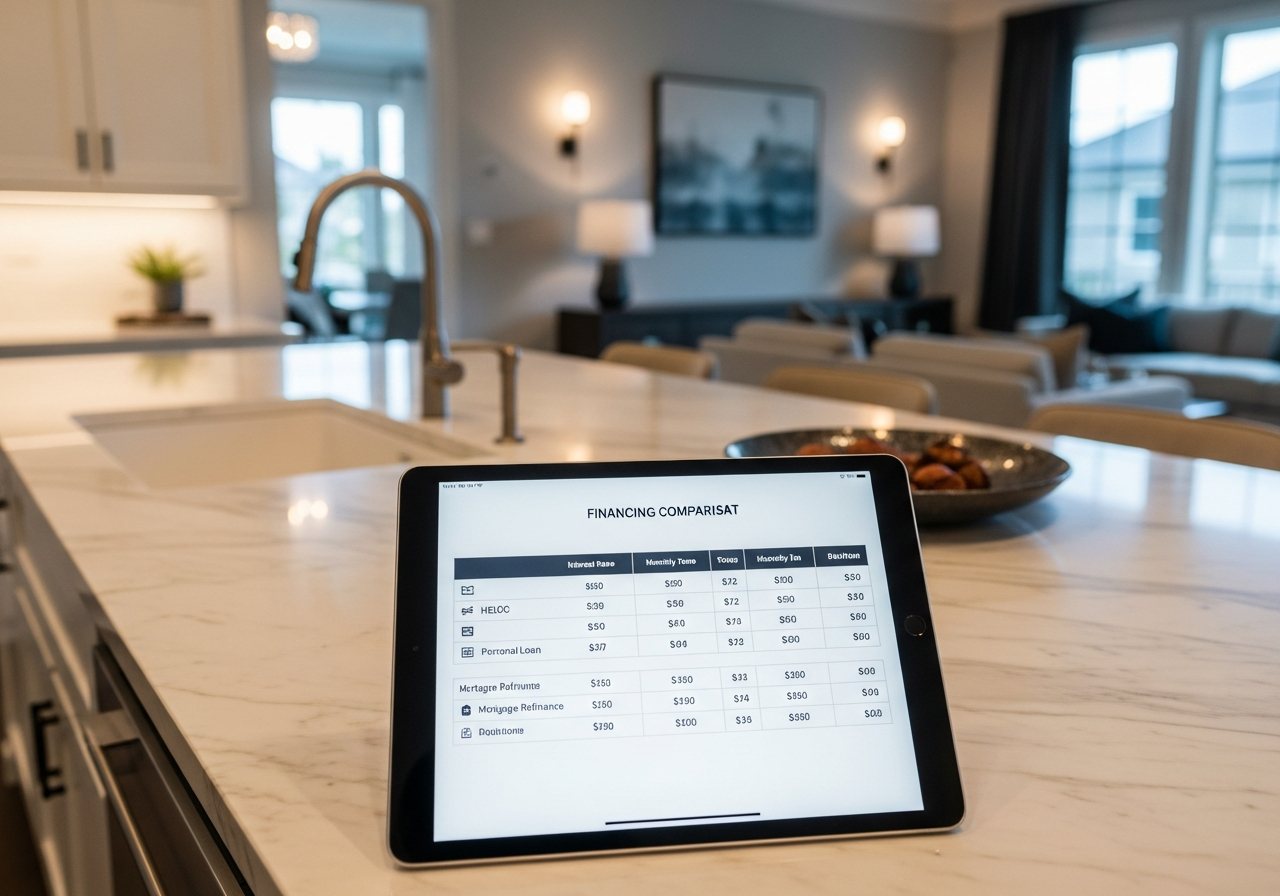
| Financing Option | Interest Rate (2026) | Max Amount | Funding Speed | Collateral Required |
|---|---|---|---|---|
| HELOC | 7.5–9.5% variable | 80–85% equity | 2–4 weeks | Yes (home) |
| Home Equity Loan | 7.0–9.0% fixed | 80–85% equity | 2–4 weeks | Yes (home) |
| Personal Loan | 6.5–18% fixed | $50K–$100K | 1–5 days | No |
| FHA Title I | 7.5–11% fixed | $25,000 | 2–6 weeks | No (under $7,500) |
| Contractor Financing | 0% promo / 18–26% after | Varies | Same day | No |
| Credit Card | 0% promo / 20–28% after | Credit limit | Instant | No |
Kitchen Remodel ROI: Is Financing Worth It?
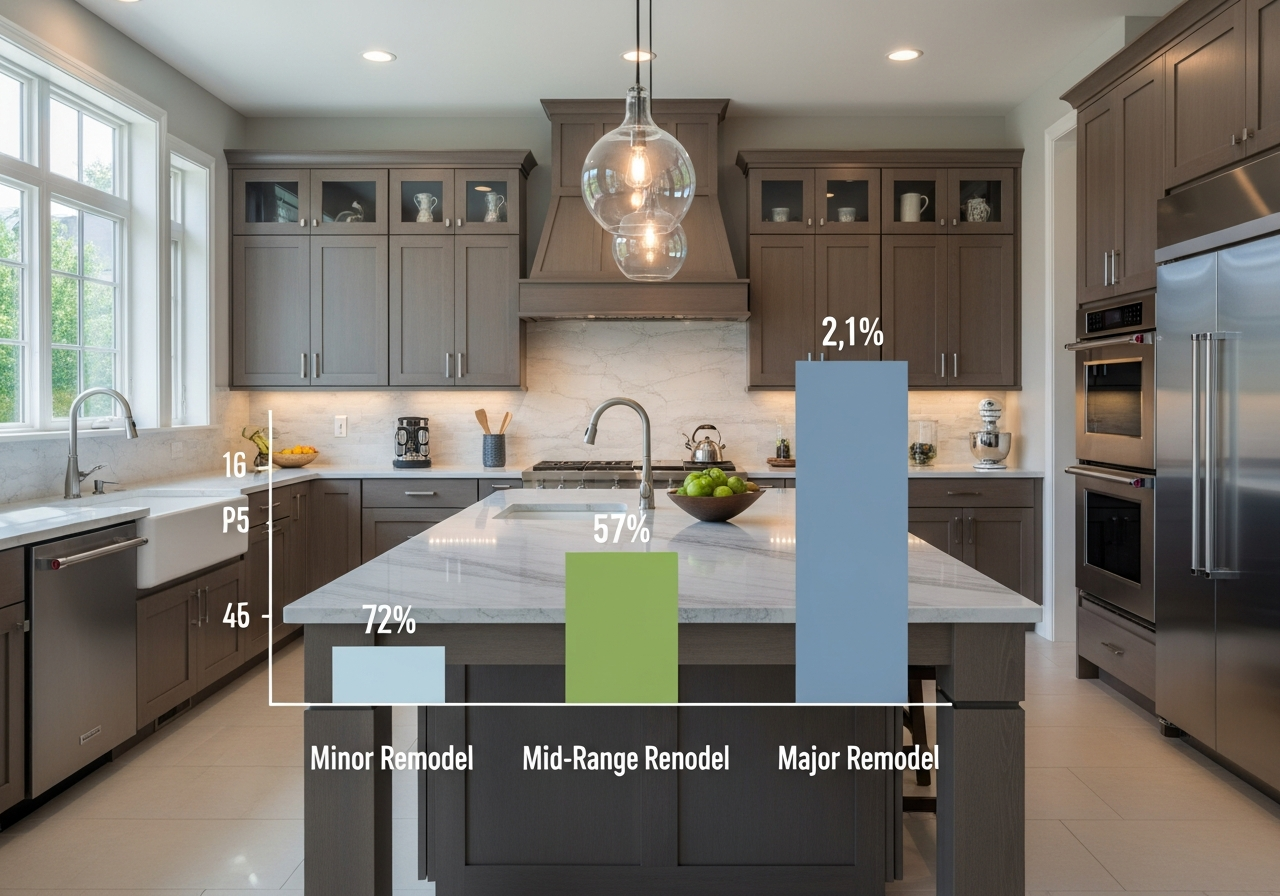
The average mid-range kitchen remodel recoups 72 to 78% of costs at resale, while minor kitchen remodels return up to 85% according to the Remodeling Magazine Cost vs. Value Report. This means a $40,000 kitchen renovation adds approximately $29,000 to $31,000 in home value. When financed at 8% interest over 10 years, the total borrowing cost adds approximately $8,400 in interest — still leaving you with a significant net positive if you sell within the loan term.
The ROI calculation shifts favorably when you consider that a remodeled kitchen reduces time-on-market by an average of 15 days and helps your listing attract 20 to 30% more showing requests. Even if you do not plan to sell, a functional and beautiful kitchen delivers daily quality-of-life returns that are difficult to quantify but universally appreciated. The key is matching your financing cost to your budget tier — do not take a $75,000 loan for a kitchen that only needs a $25,000 refresh. For cost estimation, see our 2026 kitchen remodel cost guide.
How to Choose the Right Financing for Your Budget
For kitchen remodels under $15,000, a personal loan or 0% promotional credit card usually offers the best combination of speed, simplicity, and total cost. For mid-range projects of $15,000 to $40,000, a HELOC provides the lowest interest rates and flexible draws that match the phased nature of construction. For major renovations exceeding $40,000, a home equity loan delivers fixed-rate predictability and long repayment terms that keep monthly payments manageable.
Never finance more than 80% of the project cost — keeping at least 20% as a cash contribution reduces your loan size, qualifies you for better rates, and provides a contingency buffer for unexpected expenses. Before applying for any loan, check your credit score and dispute any errors that could raise your interest rate. Even a 1% rate reduction on a $40,000 loan saves approximately $2,200 over a 5-year term. For budgeting help, read our remodel budgeting guide.
Frequently Asked Questions
Can I finance a kitchen remodel with bad credit?
Yes, homeowners with credit scores below 640 can finance through FHA Title I loans, which have more flexible credit requirements than conventional products. Some contractor financing programs also approve borrowers with lower credit scores, though at higher interest rates. Improving your credit score by even 50 points before applying can reduce your interest rate by 1 to 3%, saving thousands over the loan term.
Is HELOC interest tax deductible for a kitchen remodel?
HELOC interest is tax deductible when funds are used to buy, build, or substantially improve the home that secures the loan, up to $750,000 in total mortgage debt. A kitchen remodel qualifies as a substantial improvement. However, you must itemize deductions to claim this benefit, and the standard deduction may exceed your itemized total. Consult a tax professional for your specific situation.
How much should I put down in cash versus financing?
Financial advisors recommend paying 20 to 30% of the kitchen remodel cost in cash and financing the remainder. This approach preserves your emergency fund (3 to 6 months of expenses), reduces the loan amount and interest charges, and demonstrates skin in the game to lenders — potentially qualifying you for better rates. Never drain your savings below your emergency fund minimum to avoid financing.
Should I pay off the loan before selling my home?
You do not need to pay off a home improvement loan before selling — the balance is settled from sale proceeds at closing. However, if the outstanding loan balance plus your mortgage exceeds the home's sale price, you would need to bring cash to closing. This scenario is rare for kitchen remodels since they typically add 72 to 85% of their cost in home value. Check your total debt-to-value ratio before listing.
Related Articles
Plan your kitchen remodel finances alongside these resources: complete kitchen remodel guide for full project planning, home remodel loan guide for application tips, kitchen remodel cost estimation for accurate budgeting, and kitchen redesign guide for design inspiration that informs your budget.
Plan Your Kitchen Remodel with Confidence
With the right financing strategy in place, you can focus on designing the kitchen of your dreams without financial stress. Visualize your remodel ideas, experiment with materials and layouts, and build a realistic scope of work that aligns with your financing capacity.
Explore the HanoDecor Studio — upload a photo of your kitchen and preview transformations across styles and budget levels. Use the Kitchen Remodel Tool to visualize specific design options, and browse our kitchen ideas gallery for inspiration that matches your budget.
How to Finance a Kitchen Remodel FAQs
Written by
Emily Rodriguez
Interior Design Editor covering living spaces, styling trends, and room makeovers. Former Architectural Digest contributor with a focus on accessible, budget-conscious design.